


I don't have much to say
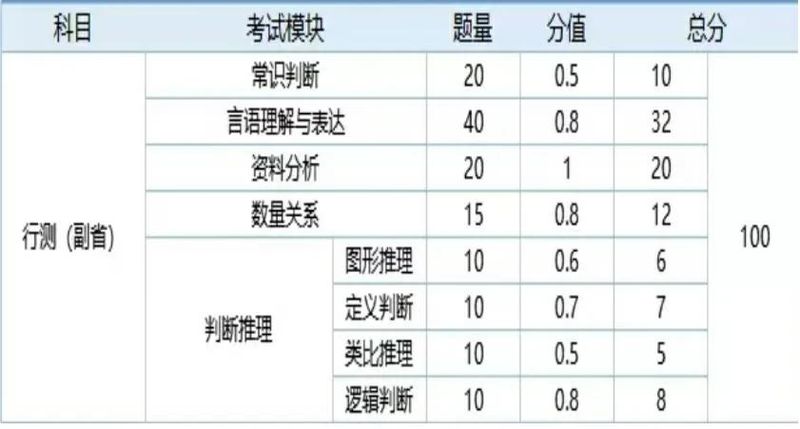
As can be seen from the above table:
100 branch measurements, 32 points for words, 26 points for reasoning, 20 points for analysis of information, 12 points for quantity and 10 points for common sense。
It is easy to see that words, judgments, information, one out of three, amounting to 78 points, or almost 80 per cent, must be the focus of a review
People are easy-to-blind, forgetful animals, sometimes just rushing forward, and may not even know what direction they are going or have run in the wrong direction。
In particular, in the course of conducting surveys, many people have a rather low level of knowledge about the subject. They know only what to do, and how to do it; they know only what to do, but not how to do it。
This has led many people to repeat their questions, make rolls, and still fail to reach 70+, let alone land。
Then i'll share my landing experience with the irons, all of them good conscience
The difficulty of the topic
Quantitative relation
That doesn't explain. You'll know once you've done it。
Ii. Timing and sequence of topics
My personal habits are:
One, 8:55, common sense, common sense at examination, five minutes。
2. Write an analysis of the information, 30 minutes of four major issues, in four-three-one-two order。
Three or five minutes for a card to check if it was painted wrong and no more questions。
Commence the reasoning of judgement, in the order of analogy-definition-logic-graphic, 35 minutes。
Five. Word understanding. Just do it normally, 20 minutes. Some people ask me, "why do you have to finally make a speech understanding? Well, there are too many ambiguous answers, but if you can read the chinese word, you can have an answer. Besides, it took you a long time to do the right thing. Huh。
6. Write mathematical questions, browse first, see familiar subjects first, and be done in 20 minutes, whether or not。
Seven. Paint cards, check。
The order of issues varies according to the preferences of the individual and does not force himself to do what he does not do。
But i personally suggest that the analysis of the information or the reasoning of the judgement be written first, rather than a verbal understanding. Because of the linguistic content of linguistic understanding, you have largely lost your ability to understand logic。
3. How to proceed with the survey
1. Information
A chalk survey of 5,000 questions:
It's all about the years! That's all i need! And after every exam, the chalk library is refreshed
Also, it's easy to organize, and the answer is in the back of the chapter, it's a reasonable layout, it's not a search, it's saved me a lot
The answer is also very simple, very detailed and very few mistakes。

2. Video classes
You're the best
Yyds
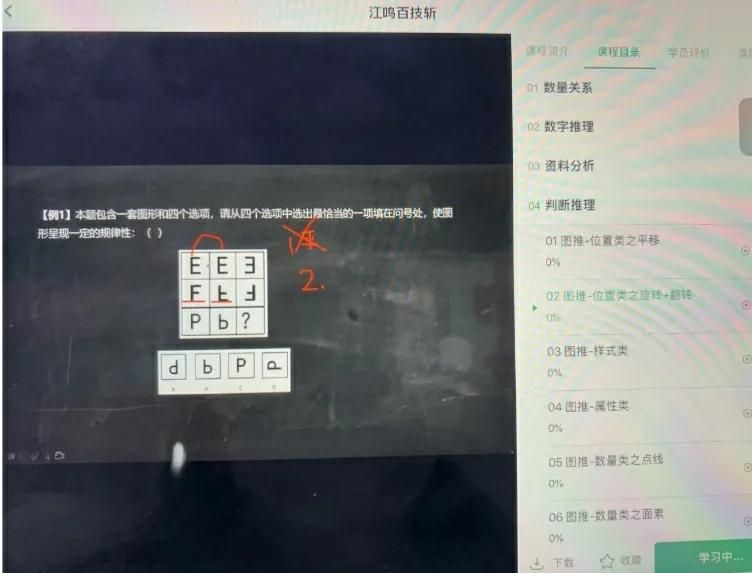
It's completely different from those who teach the puzzles, and he's teaching me how to start from the right point of view and find easier ways of doing it。
When i learned the skills of mr. Jiang moe, i felt that i had learned a lot about the original ambiguity and that there had been a lot of "some other way of doing it."。
However, it was important to focus on his lessons and take notes, otherwise some dry goods and key points might be missed。
After kung moo's skill, every module has its skills, it's one minute, and it's easy to get through 75 points
Iv. Qualification techniques
1. No blind brushing, one by one。
In fact, i took a few turns in preparation for the public examination, and i was used to doing a lot of things first, remembering that there were 500 questions, i didn't have a way of summing up, i didn't have the skills, i was not only slow, i wasn't very good at doing things, and i didn't have the confidence to do so much wrong, and i couldn't integrate myself, and i was often done and left behind。
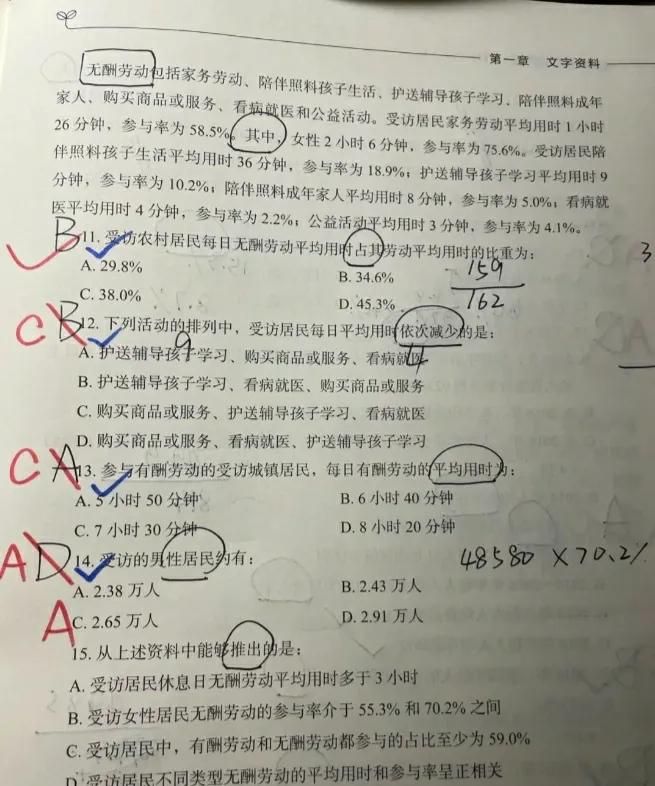
The lessons of jiang moon were then repeated, and then the module was drawn up, the words were understood, and then the logical reasoning was that of one, the lessons were completed and the question was brushed, and the efficiency of the subject was improved considerably。
2. Ensure the correctness of the subject before speeding up。
It was normal to start with slow questions, especially for newcomers, who had to deal seriously with each of them, and some of them could be duly abandoned。
For example, some of the subjects that matter in quantitative terms are very difficult, and it's only possible to do more of them in a limited amount of time, first by listening to lessons, by keeping the basics in order, by reading text books thick
In particular, some of the topics of data analysis take time, so even a 10-20-sum attack is necessary. It's going to be speed later. It's built on a lot of brushes, and it's going to be speeding up with a certain foundation. What would not be done was to give up decisively, and what would be done must be given a score, and at a later stage of preparation for the examination, it would be possible for itself to sequence the issues in a manner consistent with the principle of expediency。
3 the national examination and the provincial examination must be done 3-5 times。
The real question is the wind. And the value of a set of truths is more than 10 simulations, which i wrote three-to-five times in preparation for my examination, especially since this year’s 2023 state examination has had to be done by my young partner in 2022 and by other provinces。
4. Maintaining the habit of recording errors, taking the treasure data for the first one to two weeks。
When it is done normally, care must be taken to record errors, which are largely not new in the weeks preceding the examination, whereas the errors accumulated in the previous period are the best pre-test review material。
5. Take care of the accumulation of material and be more efficient with the app brush。
This is mainly the accumulation of evidence of common sense, keeping an eye on what is happening and what is happening, because the issue is really too broad。
And it's just that it's not too hard to remember a common sense。
V. Highlights of the module review
Word understanding
Is the highest number of questions and the highest value of the measurement module. It is therefore important for the candidates to take this seriously。
This module needs to be practiced and language developed。
The second is to learn, become familiar with, and apply the usual formulas of this module, such as dot symmetry, summation, synonyms, focus, paragraph analysis, etc., so that you know how long materials need not be read word for word, you can quickly identify the focus, you can finish in a minute。
Finally, we would like to summarize the common error options, such as overabsolute expression, partiality, transposition of concepts, imposition of causes and consequences, obfuscation and confusion, so that the same pattern is followed when there is insufficient time or when there is little to know what to choose。
The reasoning of judgment
It's a big score, so it's a module to take down! There's a lot of this module, and there's a lot of skill。
Graphical reasoning: positions, styles, superscripts, conversions, symmetry, curves, closures, etc., the basic patterns must be well remembered。
Comparable reasoning: such topics are simple, they are exclusively the subject of points, they are the subject of speed, but they focus on objective analysis instead of feeling. Thinking about the counterpoint, locking down the answers, making clean questions, saving time, is useless, and may come back. Logical judgement: focus on reasoning formulas, mastery, flexibility。
Logical judgements are divided into condensed, weakened, reinforced and so on, which, while seemingly difficult, are extremely regular and cannot be detached from the subject, which is detached from it。
Definition judgement: when responding to multiple definitional judgements, it is important to see the subject clearly, and it is easier to identify key points, capture definitions, define the correspondence between definitions, define a series of subparagraphs, or learn well in english, manage the relationship between principals and guests, and simplify it。
Quantity relations
There are not many basic issues to understand, such as clustering, value-added issues, disparaging principles, cattle grazing issues, profit issues, itinerary issues, etc。
Learn how to solve problems and try to speed them up. If a generic method of solving a subject is not available, then techniques such as surrogacy, exclusion, hypothesis, inversion, etc. Could be considered。
Analysis of information
The analysis of the data is a paper tiger, which is relatively simple and which can be upgraded quickly after a review, with a basic formula followed by a quick word (quick reading material, fast columning, quick estimation) to do much more。
Common sense
The knowledge involved is extensive and varied, and this part of the study can be done without the stress, with the impression of using a mobile phone app to brush it during free time。



