In the field of competition strategy, michael e. Porter, the father of competition strategy, is a distant mountain of everest。
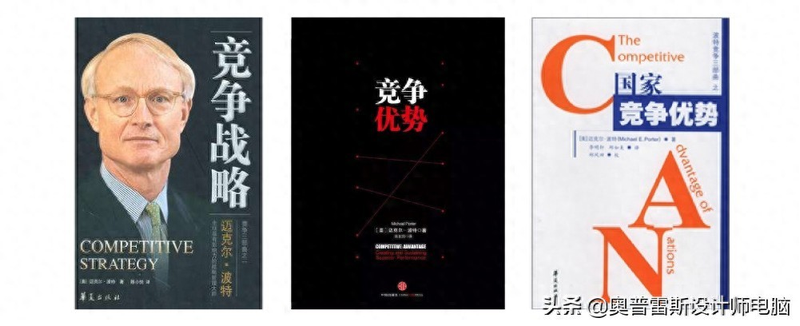
As the world's first strategic authority, porter is a classic “heavy” -
Graduated from princeton university, with a ph. D. In economics from harvard university and an honorary ph. D. From many universities, at 32 years of age, with a tenured professor at harvard business school, whose classics, competition strategy, competitiveness strength, national competitive strength, are known as the triples of competition。
There are many classic theories about porter's competition strategy, and five keywords can help us get a first reading。
I. What is a strategy
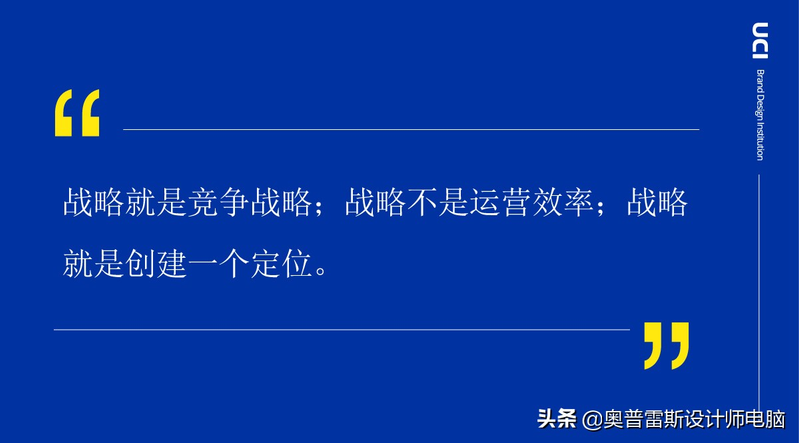
In 1996, porter published " what is a strategy " in the harvard business review, elaborating on the core philosophy of a competition strategy: strategy is a competition strategy; strategy is not operational efficiency; strategy is creating a niche。
According to porter, the strategy has three elements — positioning, trade-offs, and symmetry。
Positioning is the creation of a unique and favourable positioning; operational efficiency and strategic positioning are two key factors in the excellence of an enterprise, and operational efficiency in lieu of strategy necessarily leads to zero-sum competition, price wars and rising cost pressures; and strategic positioning is about differentiation。
To trade is to trade in competition and not to do anything. The different forms of competition are incompatible and choose the path to be followed, which is “opt-in”. The “opportunity” will make mimics difficult because they erode their advantages。
The so-called accolades are the operational activities undertaken to achieve the objectives. Compatible with the following: it is difficult for competitors to imitate each other because of the strengthening of their operations。
This is consistent with master drucker's career theory。
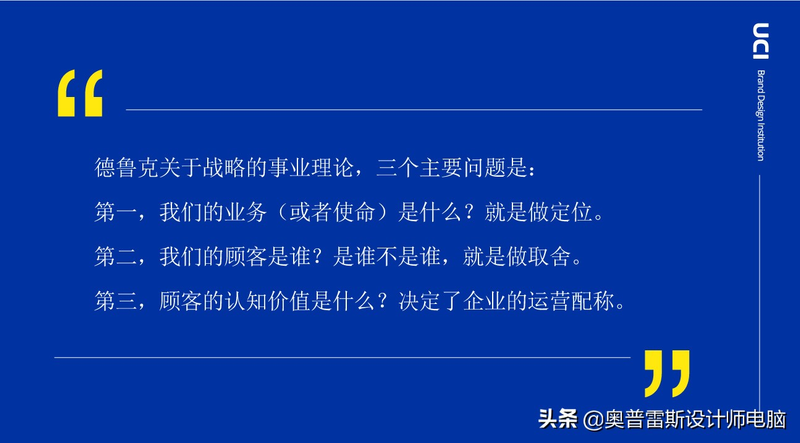
The three main issues of drouk's career theory on strategy are:
First, what is our business? It's about positioning。
Secondly, who's our customer? Who's not who, is who。
Third, what is the cognitive value of the customer? The business hyphenation was determined。
In addition, reese and trout speak of positioning, but the positioning theory and porter's positioning are different, although both emphasize competition。
Porter's positioning is to occupy a differentiated and profitable position in an industrial competitive environment
The positioning theory, on the other hand, focuses on the mind and the good, arguing that “cognisance takes precedence over reality and is better than doing it”, and takes a place in the mind of consumers。
Ii. Five force models
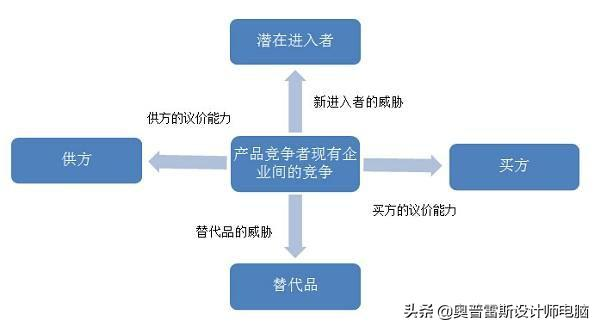
In 1980, michael porter's first widely publicized book, competition strategies: industry and competing analytical techniques, produced a business model for competition strategy analysis to help enterprises understand and challenge the competitive markets in which they are located. This is the famous five-power analysis model。
So-called five-power:
1. Vendor bargaining power。
Vendor bargaining with the enterprise will result in higher prices for the company's purchases and affect the company's profitability. Intel and chase, for example, are suppliers of many electronics products whose bargaining power is very strong and can even determine the survival of certain brands。

2. Buyer's bargaining power。
If clients have multiple options and bargains, this will lead to industry price wars and declining profitability, affecting the profitability of companies. The richer the consumer choice ladder, the more vulnerable the brand will be。
3. Capacity of potential competitors to enter。
The entry of new competitors will result in enterprises having to respond accordingly. This will inevitably lead to increased costs and reduced profits。
4. Alternative capacities for alternative products。
The emergence of alternative products and their increased capacity to do so inevitably lead to an inability to increase the prices of corporate products. The impact on treasure-hunting and the town of kyoto was clear when a plethora of foreign troops surged。

The competitiveness of competitors in the industry。
Strong competitive dynamics will lead to increased r & d costs and marketing inputs, as well as lower product prices, ultimately reducing business profitability。
The five-power model is a theoretical thinking tool, but it is not a strategic tool that can be replicated in real-life practice because it is based on three assumptions:
1. Strategy developers have comprehensive information on the whole industry. Clearly, this is unlikely in reality。
2. There is only competition and no cooperation with the industry. In reality, however, an increasing number of firms are advocating a virtuous “competition plus cooperation” relationship。
3. The size of the industry is fixed, competition is zero-sum game, and greater resources and markets can be captured only by taking the share of the counterparty. In practice, however, it is now often through innovation that enterprises work together to make cakes for larger industries, thereby gaining access to greater resources and markets。
Iii. Three general strategies
Based on the five-power model, porter proposed three “general strategies for competition”:
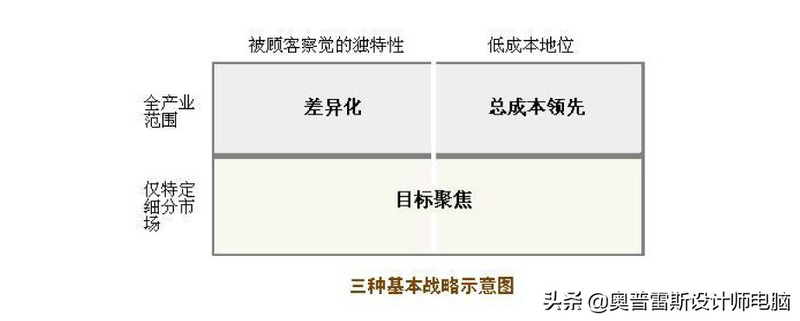
A. Diversity strategy。
Differentiation is a strategy that distinguishes the products of an enterprise from those of a competitor, creating distinctive characteristics. At its core is the acquisition of a unique feature of value to customers, i. E. The willingness of clients to pay higher prices by providing them with valuable products or services。
In order to highlight the differences between themselves and their competitors, there are four basic avenues for product differentiation, service differentiation, personnel differentiation and image alienation。

The apple company of jobs builds its own differentiation in terms of products, services, image, etc., by implementing the concept of “think different”。
B. Low-cost strategies。
Also known as cost-led strategies, a strategy for firms to gain competitive advantage by effectively reducing costs by making the total cost of an enterprise lower than that of competitors or even the same industry, and by providing products or services at the lowest cost。
The adoption of low-cost strategies does not mean that the quality of products or services becomes irrelevant, but rather reflects the uniqueness of the enterprise by cutting costs。
The cost-led strategies include the main types of simplified product type, improved design type, material saving type, reduced labour cost, production innovation and automation type. The successor giant fuscon, the microwave giant grant, is a leader through low-cost strategies。

C. Dedicated strategies。
Also referred to as a concentration or focus strategy, it is a strategy to concentrate the business activities of an enterprise on a particular group of buyers, part of a product line or a geographical market, with the core being to target a particular user group, a subdivided product line or a subdivided market。
The specialization of corporate operations can serve a narrow strategic target group with greater efficiency and effectiveness, thus defeating competitors who compete on a broader scale. By meeting the needs of a special target group, the company differentiates, or achieves low cost or both when serving that target。
Ferrari's focus on the needs of the wealthy population has become a legend of luxury cars。

Iv. Value chain
The task of enterprises is to create value. The value creation activities of enterprises can be divided into two categories: basic activities include internal logistics, production operations, external logistics, markets and sales, services, etc., and ancillary activities include procurement, technology development, human resources management and enterprise infrastructure. These different but interrelated productive activities constitute a dynamic process of value creation, namely, value chains。
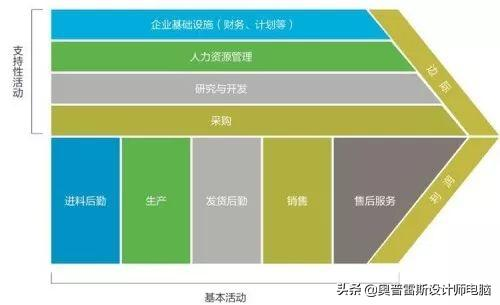
In economic activities, there is an industry value chain between upstream and downstream linked enterprises, links between business units within enterprises constitute an enterprise value chain, and a value chain exists between business units within enterprises. Every value activity in the value chain has an impact on the value ultimately achieved by the enterprise. Business-to-business competition is that of the entire value chain, whose integrated competitiveness determines the competitiveness of the enterprise。
Value chains can be broken down and integrated. While traditional large-scale, small-scale enterprises have difficulty developing in competition, others have a different path, designing a new value chain, choosing the best links through the market, linking them together and creating new values, namely, the fragmentation of the value chain + finding core competitiveness + fostering core competitiveness + the integration of the value chain = a successful virtual operation。
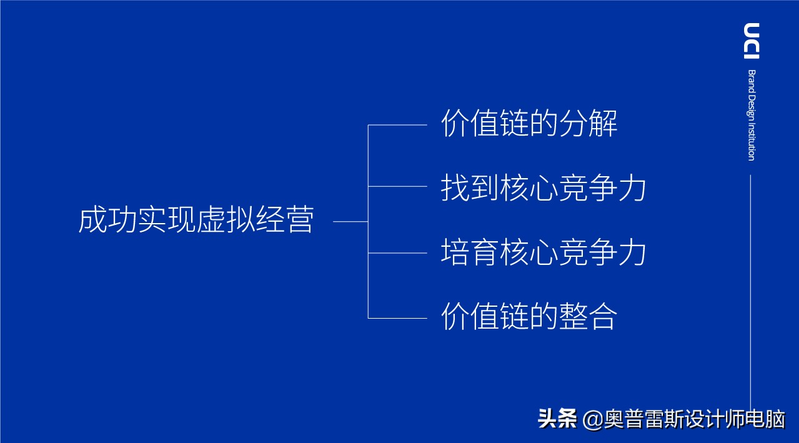
The fragmentation and integration of value chains as a business strategy can guarantee the best return on investment。
There are no factories and no manufacturing products. However, it has some competitiveness in branding and marketing. The integration of the dominant producers has led to the creation of a leading and hard-selected electrician value chain。
V. Mike potter diamond model
The diamond model, also known as the theory of national competitive advantage, analyses why a particular industry in a given country is more competitive internationally。
According to porter, there are four factors determining the competitiveness of a given industry in a country:
The factors of production - including human resources, natural resources, knowledge resources, capital resources, infrastructure。
The availability and sophistication of high-level and professional factors of production determine the quality of competitive advantage if a country is to build strong and sustainable industrial advantages through factors of production。
Israel's science and technology agriculture is an example of the full utilization of knowledge resources, capital resources and infrastructure, in the absence of natural resources。
Demand conditions - mainly in the domestic market。
Global competition did not diminish the importance of domestic markets, which were the engine of industrial development. This can also be an advantage for local firms if local customer demand is ahead of other countries, as advanced products need to be supported by the demand of the front。
The performance of relevant and supporting industries - whether or not they are internationally competitive。
Related and supporting industries and advantage industries have a stake in shaping national competitive advantages. The phenomenon of industrial clusters suggests that a dominant industry does not exist on its own, but must have emerged together with the relevant powerful industries in the country。

China electronics first street — shenzhen wah, jingbei — witnessed the development of china's electronics industry。
4. Business strategy, structure, performance of competitors。
It is important to drive firms towards international competition. This impetus may come from the pull of international demand, or from pressure from local competitors or market pushes. The most relevant factor for creating and maintaining a competitive advantage in industry is a strong rival in the domestic market。
These four elements have a two-way effect and form the diamond system (see figure below)。
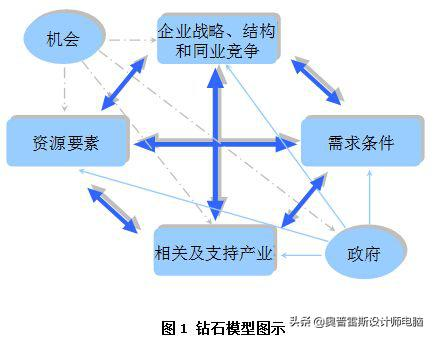
5. In addition to the four main elements, there are two main variables:
Opportunities. Opportunities are unattainable and can affect changes in four main elements. Opportunities are also two-way, often losing the pre-existing competitor advantage while new competitors gain advantage, and “opportunities” can only be developed by producers who can meet new needs。
B. Government. Industrial competition is dominated by enterprises, not governments, and the creation of competitive advantages is ultimately reflected in enterprises. But governments can provide the resources needed by enterprises to create an environment for industrial development。

China's manufacturing of 2025 is the government's major strategy for leading industrial development and establishing a national competitive advantage。
Prof. Porter's strategic approach to competition was useful in analysing external elements of the competitive environment and in selecting areas for a favourable market。
Of course, achieving the goals of the cause will also require a combination of capacity and internal resources。