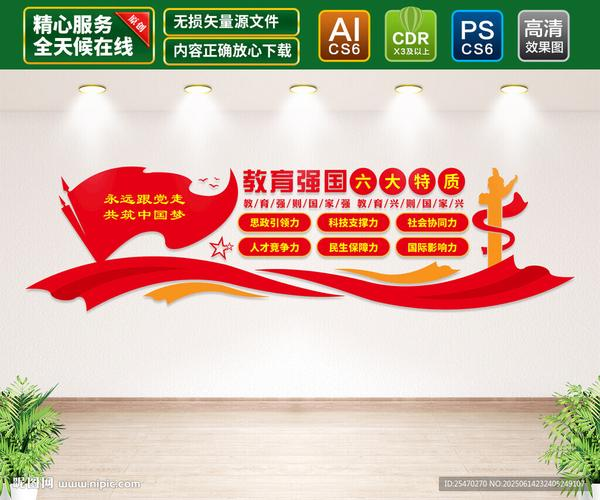
The secretary-general of xi jinping emphasized at the national education congress that the country we want to build is one of china's most special socialist education powers. It should have strong political leadership, talent competitiveness, scientific and technological support, livelihood security, social synergy and international influence to provide strong support for china's modernization and comprehensive promotion of strong nation-building and national renewal。
This “six-power” is interdependent and mutually reinforcing, contributing together to the overall development of the educational power-building, the essence of which coincides with the political, strategic and people-to-people identity of education。
The “six strength” is both an important underpinning and a key criterion for educating the powerful. A profound understanding and grasp of the scientific connotations of “six-power” necessarily requires a deep understanding and grasp of the political, people's and strategic attributes of education. Among them, the political orientation of education is a direct expression of the political attributes of education, ensuring that education serves the political landscape of the country and remains committed to the training of socialist qualified builders and reliable successors. International influence, while promoting china’s excellent traditional culture through education, and the chinese-style modernization story to enhance the country’s soft power, conveys the country’s political vision, thereby enhancing international understanding and acceptance of china. At the same time, the strategic attributes of education for strong nations, as a major national strategy, are fully visible in terms of human competitiveness and science and technology support. The country's long-term development and strategic goals are underpinned by the integrated implementation of strategic deployments, such as the promotion of education, science, technology and innovation, and talent development. Human security and social synergy, in turn, fully reflect people's identity in education and people-centred development。
In the new phase of the new era, we need to continue to deepen the comprehensive reform of education, to strengthen the “six-power” building so that education can strengthen the nation and lay a solid foundation for the renewal of the nation。
It's a powerful thought and leadership that makes the spirit shine on the politics of education. Bottom
To strengthen the party's overall leadership of the education process, the first priority is to ensure that the fundamental tasks of the lycans are carried out effectively and that education remains firmly in the direction of socialism。
The political attributes of education determine the determination to “introduce the politics of thought throughout the teaching of education” and respond to and concern about the fundamental question of “what to develop, how to prepare, and for whom”. Political leadership is a central expression of the political attributes of education, rooted in the party's theoretical innovation and intellectual political educational practice. From mao zedong's ideas to xi jinping's new era of china's specialist socialist ideas, from the ideas of the revolutionary era to the core values of socialism of the new era, a system of political education with a unique identity has evolved。
A strong policy-oriented approach, guided by the marxist theory, is required, on the one hand, by an in-depth interpretation of the content and breadth of thought-political education, which reveals its intrinsic logic, and, on the other, by a professional approach to living politics, which requires educators to have solid expertise and teaching skills, to be able to combine their professional characteristics with the actual political education of the students, and to ensure that the political education of thought is informed. In the final analysis, educators must constantly upgrade their political and professional skills in order to guide students to the firm marxist faith, the chinese socialist belief in identity, the great revival of the chinese nation's faith, develop its love for the country, its sense of social responsibility and its sense of morality, and build a solid political foundation for the development of socialist builders and successors of the full development of the moral and intellectual capacities。
Stimulating strong talent competitiveness to enhance quality education drivers
Education for strong nations plays a strategic role in promoting the deep integration of the human factor with the new quality of productivity, and new production factors, while human competitiveness further promotes self-renovation in education. As an element of the strategic attributes of education, talent competitiveness is a key force in building a strong and sustainable education system。
From the introduction of “respect for knowledge and respect for talent”, to the further implementation of the science-based strategy for the creation of a strong nation, as well as to the fallout of the “two-tier” construction, strong-based programmes, and high-level creative talent programmes, our party has consistently placed talent development at the forefront of national development, successfully attracting a large number of high-level talent from abroad and increasingly focusing on home-grown talent development and motivation, providing strong talent support for economic and social development. In order to better adapt to the building, nurturing and unleashing of new quality productivity in countries with strong education, talent needs to be acquired, the organic interface between basic and higher education strengthened, an integrated and innovative talent-building system built, and educational coherence and systems enhanced. At the same time, there is a need to work together to deepen the integration of labour and education, to unite schools, to encourage cross-disciplinary and cross-cutting exchanges and to work towards the development of strategic, applied talent capable of creating and mastering new quality production resources, and to stimulate the innovation and creativity of talent。
Build a strong technological support to harness the advantages of modern educational resources
Science and technology support is a vivid practice of the mutual empowerment of science and technology and education and, above all, a key to the modernization of the education system and the challenges of digital technology change. Since the opening up of the reforms, our country has experienced a historic leap in education and science and technology from rehabilitation to deepening reform to innovation-driven development. This series of changes is reflected not only in the continued increase in scientific investment in higher education, but also in the overall optimization of science, technology and educational institutional mechanisms. In particular, since the 18th congress of the party, science, technology and innovation have been elevated to the heart of the national development strategy, and science and technology self-reliance is a top priority in building a new stage of development, implementing a new concept of development and shaping a new development landscape. At the national level, scientific and technological inputs have been continuously increased and resources allocated to education have been optimized in order to support the development of education in terms of content and quality and to expand the advantages of modern educational resources. “science and technology are the first productivity” has been given a new dimension, not only to emphasize the direct contribution of the support of science and technology to economic growth, but also to improving the quality of education; “innovation is the first driving force for development”; it is further stated that the building of a strong nation must be guided by innovation and constantly strengthen the foundation and strategic support of education, science and technology, and talent in the process of modernizing china。
Building strong technological support must be immediate and long-term. The first is to strengthen scientific and technological innovation, focusing on frontier areas such as big data, artificial intelligence and cloud computing, to accelerate the development and application of educational technologies, and to promote the intellectual and personal upgrading of educational tools and tools. The second is the deepening of educational and pedagogical reforms, the integration of science and technology into the curriculum, teaching methods and evaluation systems, and the stimulation of student autonomy and innovation. Third, to optimize the allocation of educational resources, increase investment in and support for educational science and technology projects, and promote the efficient transformation of scientific and technological achievements into educational practices。
Enhancing strong livelihood security to deliver education to the satisfaction of the people
Human security implies a balance between equity in education and quality of education, that is, ensuring equal access to education for every child. A series of initiatives have been effective in raising the level of education in the country as a whole, from universal to compulsory education, with basic equilibrium, quality balance and universal access to higher education, from poverty alleviation with regard to education precision to the revitalization of rural education. In particular, in recent years, the country's education sector has achieved remarkable results in guaranteeing basic, quality and equity by increasing its investment in education, optimizing its structure and deepening its educational reform。
To ensure a strong human security, bearing in mind the people's attributes of education, and recognizing that “education is an important means of improving the quality of people's integration and promoting the full development of the human person”, the fundamental question of who education serves, who depends on development and who shares results is answered correctly. First, to deepen equity in education and promote balanced development. (c) increase its support for education in rural, remote and ethnic areas, paying attention to the educational needs of specific groups and reducing the educational gap between urban and rural areas, regions and schools. Secondly, it is necessary to upgrade the level of schooling and optimize the provision of education. Focusing on the improvement of the quality of education continues to meet the needs of the population for diversified and individualized education. Third, to strengthen policy support and expand the safeguards system. The establishment of mechanisms for the steady growth of investment in sound education, the prioritization of funding for education, the improvement of the system of laws and regulations governing education, the safeguarding of the legitimate rights and interests of teachers and students, and efforts to create a safe, harmonious and orderly educational environment。
A strong social synergy to build a common governance and shared education bureau