


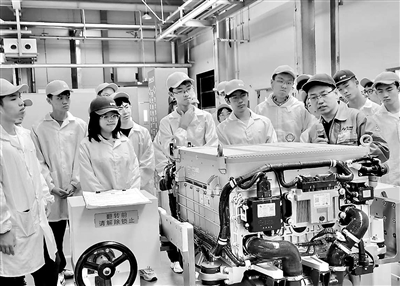
Students of the hydrogen energy department of the north china university of electricity visited the beijing billion technology limited fuel cell engine system production workshop. School supplies
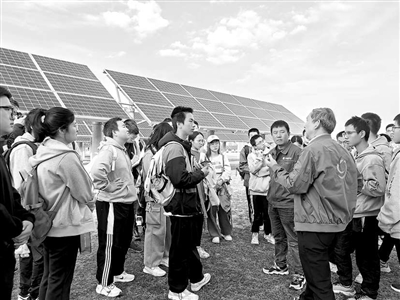
The university of qinghua taught liu jianjia to guide students on photovoltaic technology under the “two carbon” goal during the course “survey for sustainable development”. School supplies
“to be highly specialized, knowledge alone is not enough. The best way is to bring theoretical learning and innovative practices together.”
“the development of students' adaptive and lifelong development for future careers is a top priority in building new professions”
This year, deep professional restructuring was announced at the university of jordan and shandong. In fact, two schools are not an example. The optimization of professional adjustment throughout higher education is accelerating。
The general secretary of xi has emphasized at the national conference on education that: “the development of science and technology, the need for national strategies, will be guided by the need to improve innovation, optimize the structure of higher education, improve the mechanisms for restructuring the institutions of higher education and the development of human resources, and strengthen basic, emerging, cross-cutting and advanced skills”
“the implementation of excellence initiatives in first-class disciplines, which promote the integration of disciplines, and the extraordinary layout of disciplines that are urgently needed to strengthen basic, emerging and cross-cutting disciplines and support endangered and cold-minded disciplines.” this is called for in the framework plan for the construction of the power of education (2024-2035)。
Since the 18th congress of the party, as of september 2024, more than 21,000 undergraduate places had been added to the national higher education institutions, and 12,000 specialized places that were inappropriate for economic and social development had been withdrawn or suspended. In 2024 alone, 1,673 more specialized sites were added for the national strategy, and 1,670 specialized sites not adapted to economic and social development were abolished。
The discipline is the core pillar of the higher education system and the basic platform for talent development. New professional development involves development objectives, curriculum systems, teaching methods and teacher capacity. How can professional growth be supported by proactive updating of course content? How can cross-cutting disciplines be promoted through the sharing of curriculum resources? What are the difficulties and challenges in building new professions? Interviews and research have recently been conducted by the journalist。
How can interdisciplinary specializations, which involve a wide range of disciplines, effectively integrate and shape identity development programmes
Focus on core literacy, build a new curriculum
Research on sustainable development, introduction to resource science when i first got into school in the fall of 2024, it was surprising to see my curriculum at the university of qinghua's su chung school, 31 ben zing jia, 31, “i went to new specialty `cross-engineering', which i had never heard before.”
In follow-up learning, knowledge of economics, management and sociology is present in the classroom, making it difficult to read and see. He smiled and said, "the culture and content of the college is new, and i have a feeling of "manipulating wings for technologists."
The sense of inspiration is closely linked to the salient features of the new profession。
“many new professions have been created in recent years, such as `cross' `correspondence'. “professional setting follows two logics. The logic of scientific and technological development and the logic of social needs. The current wave of scientific and technological revolutions and social development issues are more unpredictable, and we can no longer cope with a single-scientific knowledge
The identification of several new professions that have emerged in recent years, such as the core knowledge of hydrogen energy science and engineering, which involves multidisciplinary disciplines such as materials, chemistry, electrochemistry, soft matter science and engineering, which are multidisciplinary in physical, chemical, biological and engineering fields, and intelligent visual engineering, which is reflected in a combination of optical sensing, artificial intelligence, machine vision and space information。
However, this feature also poses a great challenge to the development of new professions: how can knowledge systems between different disciplines be effectively integrated to shape distinctive teaching models and curricula
The new specialty of “crosswork” at the university of qinghua's su chung school has responded by refining common knowledge and developing a new curriculum。
As an example of “environmental quality project”, camp hu hong, dean of the su chung school of the university of tsinghua, described the new course as a consolidation of four previous courses on water and environmental governance, atmospheric environmental governance, soil management and solid waste use into one, producing common knowledge。
“like the `segregation technology doctrine', which was spread over four courses and is now completed once.” camp hu hong presentations, which lead students to understand the overall “environmental problem”, not just the issue of a single environmental medium。
“in terms of knowledge logic, common knowledge is the underlying logic of thinking. From the point of view of student development, the more common and fundamental the knowledge acquired, the wider its adaptation.” according to camp hu hong, the curriculum development programme and curriculum design of the new specializations of the college focus on developing students' logical, systemic and iterative thinking to “leave from the mistakes in the development of people with strong professional skills, but with limited vision and weak creative capacity”。
As an entry point, the su chung college redesigned three core classes of specialization centred on resource-use system engineering, energy system engineering and water system engineering. Of these, 29 new courses with 72 credits accounted for nearly half of the 146 total credits in the university. Four four-plus-x orientations have been constructed, such as the “green economy and global governance” orientation, where the curriculum group is oriented towards management, requiring a separate six-center economics approach; an increase in the share of basic bio-chemical courses in the case of a “resource energy and climate change” orientation in engineering; and an “one-one-size-fits-all” approach to curriculum development by students。
As an industry college, the north china electricity university, in building new “storage” and “hydrogen energy” specializations, explored a closely integrated “teaching-research-industry” path to serve the core curriculum of new specializations。
“many of the core knowledge of the new profession exists in a process of upgrading from industry to research and then gradually to disciplines.” according to liu jianju, professor at the north china electricity university and director of the centre for hydrogen energy innovation, 12 core courses in storage battery technology, super-container energy technology and nine core courses in hydrogen technology and applications, hydrogen energy and fuel cells have been created by the storage energy profession around the latest developments and needs in the chain of industries related to hydrogen energy. At the same time, the principle of “strength of hands + broad base” is upheld, which compresses the length of the theoretical course and increases the corresponding experimental course hours。
“for industry-oriented institutions, new professional development needs to take advantage of technological advances at the frontier and build on the maturity of the old system in order to develop non-replaceable talent.” according to mauritian。
The scope of application of new professions and the resulting lack of capacity to integrate and innovate among students should be addressed
Innovative culture models highlighting key competencies
At the end of 2024, 99 freshmen from the university of south-west transport school of integrated circuits received a special test: “dey for sholding equipment”. This is the end of the "code to matter" class。
The work of the first freshman course in high power semiconductor science and engineering is the prototype of the ion injection machine concept. At 7 a. M., he began to produce electrical circuits and re-engineer the demonstration, and the work involved semiconductor materials, ion injections, electroscopes, etc., which he and his team learned about “autonomy supermodels”。
The examination lasts one day. In one day, students produced 22 works, including light sources, glue-painters, laser carving machines, visual detection devices, etc. The work is young, but innovative, as in the case of the shobo group, which is a “precision, remote control, automatic workstation”. Initially, they conceived of having a brushing mechanism, but failed. “it was only after our team that we switched to a walk-in-the-wire control program that we managed to finish the class.” shaw boven said。
“this is just the first challenge facing students in high power semiconductor science and engineering.” holly, managing vice-president, school of integrated circuits, university of south-west transport, described the major semiconductor science and engineering as the new specialties opened in 2024. Over the next four years, students will need to complete a number of interdisciplinary projects. The college also embeds industry practice in a number of courses, with no less than 10 weeks of work experience。
Why is it so designed? “the strength of the project-type curriculum lies in the interdisciplinary integration capacity and industry insight of the students in the real context through project integration.” holly explained that new specializations, especially in the interdisciplinary field, were common in the construction of new specializations because of the variety of knowledge systems and fields of application in which traditional knowledge was transferred, which often led to in-depth learning, lack of capacity to integrate applications and innovation。
Faced with this challenge, bringing students into the real world and solving real problems has become a choice for a number of new specializations in higher education。
The qinghua dae-hwa su chung college offers a new class, “behind the classes”, outside the first and second classes。
“we want students to learn beyond time, beyond space and beyond borders. This new class runs through the university for four years." “beyond the classes”, the head of “beyond the classes”, introduced the first 13 topics of the first year of school, “beyond the classes”, namely, new energy, future cities, textiles, etc., with a group of 5-6 students, who went into in-depth research in more than 10 enterprises, such as the south china water norther group, new energy investment ltd., and the china institute of urban planning and design. Each topic involves a professor from qinghua and an industry mentor as a bridge between knowledge and application。
Northeast forestry university, for its part, explores a model for the development of engineering personnel in the new field of agro-forestry engineering. “the model is based on competitions in disciplines, such as the national university students’ competition for mechanical innovation design, and the hierarchy and relevance of competitions at the professional level。
“knowledge alone is not enough to become a high-level specialist. The best way to do so is to bring theoretical learning and innovative practices together.” in the view of mau luk-teng, learning to solve a small, complex problem; learning to do another step to solve a problem that is more difficult; and learning to do so is harder. This has resulted in both the structuralization of knowledge and the resolution of practical problems, which can better address the adaptation of new professional development to society based on expertise。
How can teachers keep up with changes in the way “z generation” students learn, the impact of new technologies
Build a strong teaching staff centred on teaching competence
When the north china electricity university introduced a new “storage power” specialty, the construction of a “storage power plant system” in a specialized core course became a challenge。
“this course is completely new and has no experience to learn.” the director of the office of energy science and engineering, giant star, introduced the selection of two young teachers from the college to form a curriculum development team for long-term research on thermal orientation and battery energy systems, while at the same time studying the curriculum system in a systematic manner while at the same time looking at industry enterprises。
“we work with the southdu power supply to jointly build the `technology system for simulation of energy power stations'; to develop an innovative platform for the integration of energy storage technologies in the national production and education systems; to develop a virtual integrated design of the energy power plant system; and to develop the materials for multi-site chemical storage plants on our own.” in the course of construction, the teacher's understanding of the curriculum has been improved, the teaching philosophy has been updated and practical competencies have been developed, laying the foundation for the new course。
The establishment of a strong cadre of highly qualified teachers, geared towards new curricula and new professional development needs, is an important condition for the delivery of new professions。
There are no full-time teachers at the qinghua su chung college, but instead teachers are recruited on the basis of the curriculum. “the principle of hiring is the most suitable teacher, teaching the most familiar content.” according to camp hu hong, more than 60 teachers from four colleges were involved in the development of the curriculum and gave lectures in 29 new courses alone。
The university of southwest transport college of integrated circuits has introduced high-end industrial personnel from enterprises as teachers. In particular, the college of integrated circuits has introduced about 20 industry mentors to the necessary courses, such as internships, practicals and graduation designs。
“however, industry mentors have a heavy workload and are of non-teacher origin, they have difficulties in teaching and need adequate coordination and support.” holly said that in the case of graduation design or project guidance, schools were generally equipped with 1:1 school teachers and industry mentors to enhance communication support。
In the face of changes in the way in which “z generation” students learn, the problems of teachers' innovating and adapting their teaching methods have become more pronounced, calling for a new teaching management system。
“school cooperation and industry-oriented teaching has become a central and strong focus of the new professional workforce.” the director of the space optical engineering research centre of the harbin university of industry school of space and technology, zhi xianyang, believes that the industry-oriented model of teaching, which allows teachers to improve their practical skills through project cooperation, can also bring up-to-date technology and research findings to the classroom to ensure that the content of teaching is kept up to date with the latest technological developments。
In interviews, journalists learned that emerging professions also face many external problems in building, such as low social awareness and the employment of graduates。
“it is important to conduct research before a new profession is established, due to its short duration, its rare name, its low historical maturity and low social awareness.” wang ling, vice-president of the front line soft substances school of china polytechnic university, made an in-depth study prior to the establishment of the new “soft substances science and engineering” specialty, and found that the only high-end new electronic information, semiconductor lighting electric cars and nuclear power equipment developed in the bay of australia were 11 strategic and emerging industries that required high-level talent in soft matter。
In holly's view, professional cycles follow industry and industry. Many of the professions now phased out have also been popular in the past. Thus, “the development of students' adaptive and lifelong development for future careers is a top priority for building new professions”。
Chinese journal of education, 20/03/03, 03rd edition



