


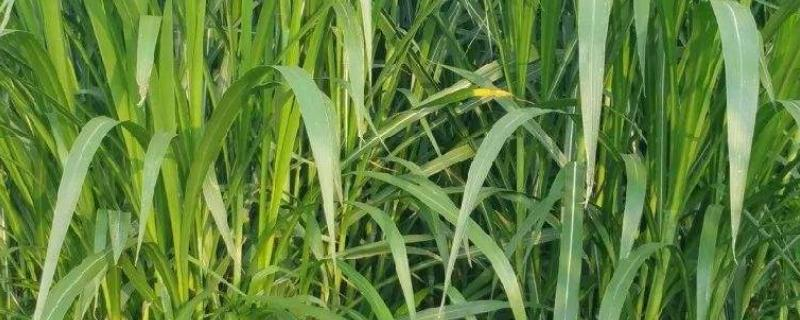
Cows can be grown on sudanese grass, rye grass, dog tails, vermin, euphoria, and plumgrass. Sudangrass: about 1 - 2. 5 metres high, about 3 - 6 mm braid diameter, about 15 - 30 cm long leaves and around 1 - 3 cm wide, can be harvested 3 - 4 times a year after planting and can produce 5 - 10 tons of acre. 2. Black wheat grass: a plant of about 30-90 cm high, leaves of about 5-20 cm long, width of about 3-6 mm wide, root soft on the base section, and acre production of up to 8,000-10,000 kg。
I. What kind of pasture does cattle grow
1. Sudanese grass
(1) the species is one-year grasshopper, single-born or bushed, approximately 1 - 2. 5 metres high, with a length of about 3 - 6 mm in diameter, 15 - 30 centimetres in length and 1 - 3 centimetres in width, in linear or linear shape。
(2) the species consists of springy growing grass, which is warm and abundant in warm and rainy places. Reproduction takes place in the form of seed planting for the months of february-april and can be followed by three to four harvests per year, yielding approximately 5 to 10 tons/acre。
(3) the seed sprout is at 20-30°c and can be sowed for four to five days at appropriate conditions, reaching about five pieces after five to six weeks, at which point the plant will begin to split and grow rapidly and bloom after 80 to 90 days。
(4) the soil requirements of this species are not stringent and can be planted in a weak acid soil, light salted soil, not on land that is poorly drained, wetter, acidic or alkaline, or otherwise prone to poor growth。
(5) it is more appropriate to plant this species on black calcium soil, and on dark calcium soil, where the former crops are suitable for multi-year mixed grazing and multi-year legume grazing。
2. Black wheat grass
(1) the species is a multi-year plant of approximately 30-90 cm tall, with roots soft on the base section, leaves with about 2 mm long tongues, blades with linear shapes of about 5-20 cm long and 3-6 mm wide, with micro-circle。
(2) the biologically wet and cooler climate (cooly and less heat resistant) of the species is suitable for growing in areas where summer and winter are not too cold, with short daylight, strong light and low temperatures conducive to the planting of strains and the cessation of partitioning at high temperatures。
(3) the species is more humid and can be cultivated at an annual precipitation level of 500-1,500 mm (appropriate annual precipitation of about 1,000 mm) and in areas with poor drainage and high groundwater levels。
(4) the species can be sowed in spring and autumn, march-april and september-october. Early in autumn, one harvest can be harvested before winter and two to three before summer, yielding about 8,000 to 10,000 kg/acre。
Three, dog tail
(1) the plant is large, has a mustache, has a supporting root, has a straight stem or base knee, at an altitude of about 10 to 100 cm and a base diameter of about 3 to 7 mm。
(2) the species, which is mostly grown in the wilderness and by road up to 4,000 metres above sea level, is the more common plant in the drylands, characterized by damp resistance, vulnerability, drought resistance, cold resistance, trampling, etc。
(3) the species is derived from temperate, warmer temperate areas of the eurasian continent and is currently distributed throughout the world in temperate and subtropical areas。
(4) the species is suitable for growth in warm and humid climatic areas, and is well grown in fertilized, fertilized sandy and clayy sandy soils, which can be sowed in the months of april and june, harvested or directly grazing, with a harvest of 3-4 times/year, yielding about 4-7 tons/acre。
Four, the bouquet
(1) the species is a multi-year herbivorous, legume, cylindrical, and approximately 30-100 cm tall。
(2) the species is rich in proteins and multiple vitamins and is known as “the king of pastures”。
(3) cultivation is possible in most parts of the country, from march to may in the spring and from august to september in the autumn, with 3 to 4 harvests per year, with a typical yield of about 4,000 - 8,000 kg/acre and a general production of 1,200 - 2,400 kg/acre in the dry grass。
5. Mexican corngrass
(1) the species is a one-year herbivorous plant with a height of about 3-4 metres, with a greater ability to split and regenerate, with a capacity of 30-60 branches per bush, and in part 90 or more。
(2) the species is heat resistant and prefers to grow in warm and wet environments at temperatures of 10-15°c。
(3) the species can be planted in fertile and irrigated areas, suitable for the month of february-april (around 200-235 days) and 7-9 harvests in the year following seeding, yielding about 5-10 tons/acre
6. Elephant grass
(1) a plant of approximately 2-4 metres high, with a straight stem, smooth or hairyness, and a curvature of hair。
(2) the species is a herbivorous, multi-year, large herbivorous plant characterized by high utilization, good taste, soft and juicy, and high nutritional value。
(3) the species can grow in sand, clay, adaptive and soil-resistant acidity, with 6-8 harvests and approximately 75-150 tons/ha per year。
Seven
(1) the species is a multi-year herbivorous plant with a height of more than 5 metres, with a growth height of 20-30 knots, with a direct surface of 9-15 cm in length, a relatively short upper section and a long lower middle section。
(2) the species is suitable for cultivation in most parts of the south, with planting time in march-june, with a planting density of around 2000-3,000 acres per acre。
Ii. How to store pasture feed
1. Prepare cyanide bags
(1) a non-toxic plastic film with a thickness of 0. 2 mm is made into a blue bag。
(2) small bags are cylindrical, 1 m high and 1. 1 m in diameter, which is easily moved; medium bags are long, 4 m long, 2 m wide and 1. 5 m high。
2. Raw material
(1) the pasture is dryed for a period of time to keep the water content at 60-80 per cent and then in small fractions of a length of 2-6 cm。
(2) black wheat grass can be dilated to 4-6 cm and corn straw to 2-3 cm。
3. Packed storage
(1) the short-lived herbs shall be packed in a bag, which shall be compacted and sealed and sealed to ensure that there is no leakage。
(2) it needs to be noted that the herb load is not excessive in order to prevent the bag from being punctured。



