


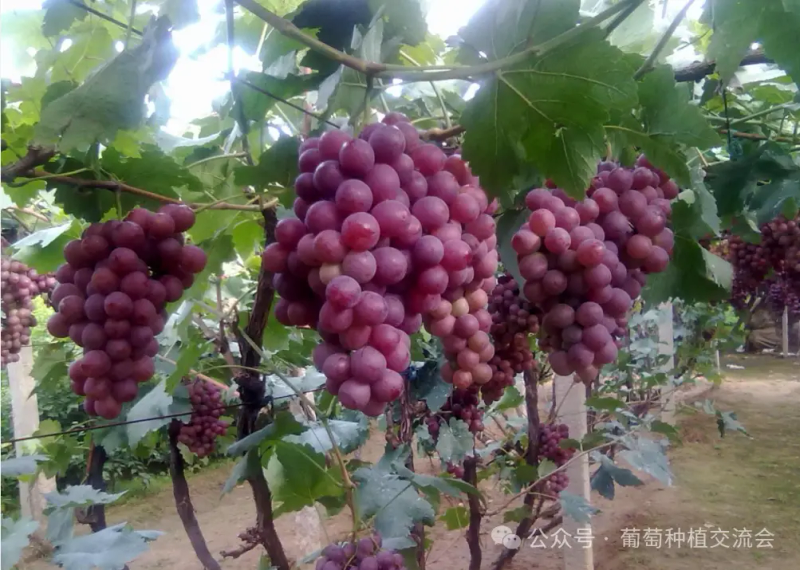
Red-tied grapes are also known as red earth and eurasia. The red-tied grapes are red or purple red, weighing an average of 1. 56 kg of ears, 3. 66 kg of ears, 10. 3 g of single grains, sweet soluble solids and of excellent quality. It was conceived by the california state university of the united states of america in the 1970s (the emperor x l12-80) x s45-48 hybrid。
I. Botanical form
In liaoninge region, red and red grapes have purple and red stripes on the top and green on the bottom; a year of light brown. The three plumes of the plume are slightly red, and the leaves have thin wool on their backs; they are fractured in their age, deep in their upper and lower parts, they are flat on both sides of their backs, they are thinner, they are purer in their teeth and they have red (or light red)。
Ii. Responsibility
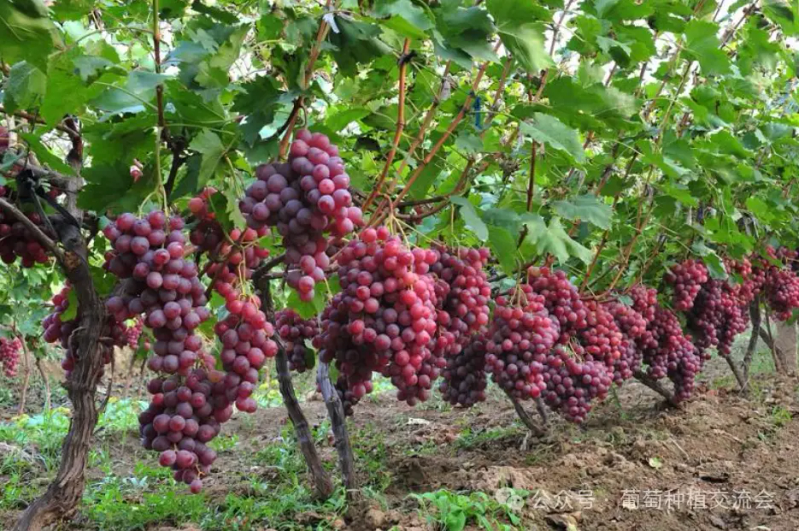
The red raisins are large, have a cone and weigh an average of 850 grams, with a maximum of 2,500 grams. They weigh an average of 11-20 grams, with a maximum of 30 grams, and they are lax and balanced; they are thick in the skin, and the fruit is red in depth; and they are hard and hard, they cut into thin pieces, sweet, clean, soluble solids above 16. 5 per cent, cut without juice, and they have the highest quality. The fruit is long, closely bound to the fruit, and it is not vulnerable to cracks; it is thick, it is strong, it is strong and it does not remove the grain; and it can be transported and stored for long periods of time until the following march。
Iii. Management techniques
1. Selection of trees
Choose to grow strong, disease-free, whole roots, full of more than three sprouts of good-quality seedlings, prohibiting the use of “elder” seedlings and sabbatical planting。
2. Integrative trim
At the time of planting, when the new roof grew to 25 centimeters, two longer and better branches were left to remove the other branches. When it grows to 40 centimeters, pulls it onto a temporary wooden stick and leaves it with one to two leaves. Repeatedly, in autumn, the branches will be prolonged and, depending on the maturity of the winter cut, 1-1. 5 m。
Two years of production of a plant, with a summer cut, should be up to 10 centimetres in length, with the exception of those that have gone to a dense and poor quality, the new branch should be fixed up to 25 centimetres, with 5 to 6 new stalks per metre and 2 to 3 fruit ears per cm above 60 centimetres of the ground, and, in winter, 3 to 4 short stings should be retained for each 1 metre extension and 1. 50 to 2 metres for the longer。
Three years old, and the branches are basically full of face. During the summer cut, branches are fixed as long as 25 centimetres, with 5-6 stakes per metre of which 3-4 result branches and 2 nutrient branches are kept, and 3-4 outcome branches are kept on the seam master chicken at winter cut。
As a result, the branches and nutrients should be removed from the growth point after the flowers have fallen, the stalks should retain a piece of leaf for the heart, while the sprouts and sprouts between the stalks should be removed with a light nail。
3. Flower fruit management
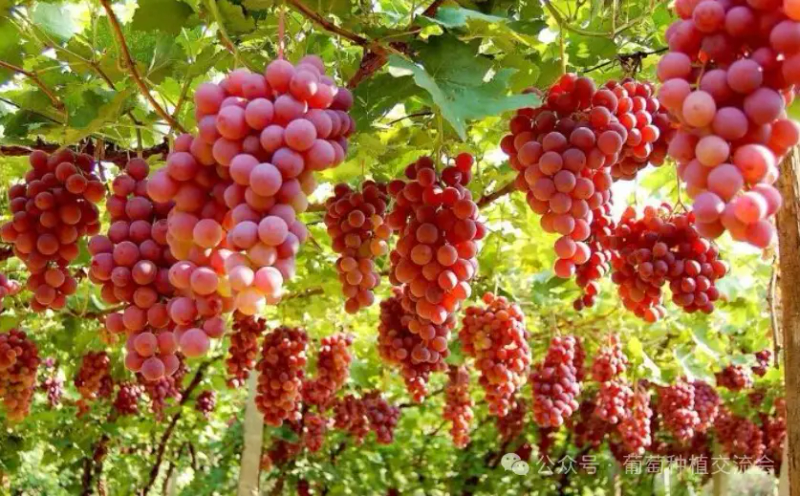
Premature graft and prolonged chickens can keep two to three fruit ears, with the rest remaining single fruit. And remove deformations and tipping. 0. 30% boron and 0. 30% urea are sprayed before flowers. (c) the removal of infertile small, deformed and permutable grains, the removal of one third-1/4 of the lower ear of the fruit, the planting of about three weeks after the flowering, and the impregnation of a fertilizer with methyl sulphate or eject. When used with a hyperbole and a microbicide, the ears are packed in time to remove the bags some 20 days before the harvest and to turn the ears to even the colour。
4. Fertilizer water management
Upon harvest of fruit per year, 3000 kg of organic fertilizer per acre of organic weight was applied with calcium phosphate. The grapes should be filled with winter water before the shelf. In the following year, urea was applied to 20 kg of acre before the budding; the bouquet appeared before the flowering one to two times; 20 kg of diamine (catalytic fertilizer) per acre was applied to the plume; 25 kg of compound fertilisation per acre was applied to the hard nucleus; and 0. 30% of potassium phosphate 3 to 4 times of phosphate was sprayed on the leaf before the fruit harvest began in mid-august to promote fruit and fresh maturing and to control water throughout the park。
5. Pest management
Precipice of 3-5 degrees petro-sulphur alloy plus 0. 5 per cent sodium pentachlorophenol mixed fluid is used to disinfect the whole garden. In june-august of each year, the fight against frost and powder disease was dominated, especially in cases of high density, temperature and humidity, with ready observation of plants and early prevention。



