


Look! Red-tied grapes grow technology: increase production and increase harvest time
Autumn gui
Red-tied grapes are called red-earth grapes of the earth, of european-asian species, nurtured by american scientists in hybrid experiments in the 1970s, introduced in the 1980s. At this stage, the country's red-ti grape-producing areas are mainly located in areas such as xianximang, lialongingye peninsula, the inner mongolia uhai, xinjiang bay city and jiang sobai. Among them, red-ti grapes are well known for their quality and size. In the development of the red-tied grape industry, due attention and attention has also been paid to the technology for the extension of their facilities and the production of productive plants. Red-tired grape cultivation areas such as xinjiang city and the inner mongolia sea have managed to optimize cultivation technology according to their natural geographical resources, resolving many of the difficulties in the technology of red-tied grapes growing late and productively. Therefore, it is necessary and relevant to conduct research and analysis on techniques for the delayed production of red-tired grapes。
1 characteristics of red-tied grapes
From a botanical point of view, when red grapes are young and young, they have red stripes on the top and generally green on the lower; after a long life, the red grapes are light brown in their whole body, and the young leaves at the tip of the branches are slightly red, and the back of the leaves are thinner, with little wool. The red raisins are ripe, the leaves are fractured, and the upper raisins are deep and shallow, and neither the front nor the back are short. Small feathers, thinness of leaves, pureness of sawn teeth on the edge of leaves, light red or red on leaves。
From biological characterization analysis, the early growth of the larvae is more robust, with the general growth pattern following the beginning of the results, and the early growth of the larvae tends to lead to a reduction in the maturity of the red-tied grape branch. When the red raisins are fully mature, the troughs are short and the buds will be prominent and full. Taken together, it's usually 70% red-tired grapes, with a second result. The fertility period for grapefruit is usually around 100 d, and it takes about 135 d from the embryon stage to the full maturity of grapefruit, which is earlier than that for dragon eye grapes。
From the materiality analysis, red-tied grapes tend to be large and mature in a conical shape, usually weighing around 850 g, with a maximum weight of about 2,500 g. The red bill of lading is rounded or egg rounded, each weighing between 10 and 20 g, with a maximum mass of about 30 g。
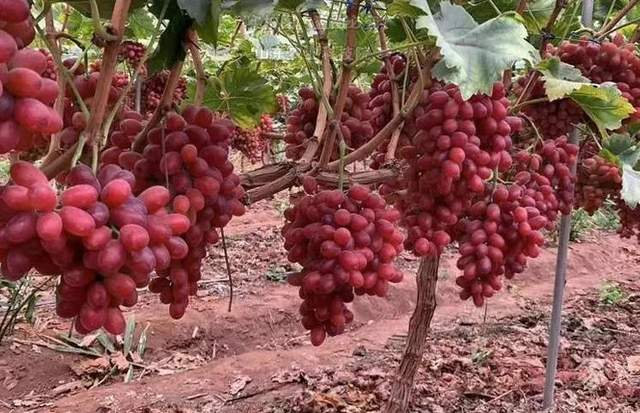
The red raisin grains are in the middle and the bottom are slightly thick, the fruit is red in its entirety, the fruit is coarse, hard, cutable, sweet, and the flavour is thick. The red raisins have a long handle and are more closely connected to the fruit, which is not easy to crack, and the brush on the fruit is thicker, so that the red raisins can be firmly grown on it. At the same time, it is easier to remove fruits from their pellets, to facilitate medium- and long-term transport and storage, and environmental conditions are generally good until march。
2 technical analysis of late production and cultivation of red-tired grapes
2. 1 plant management techniques
Cultivation is the first step in the cultivation of red-tied grapes, the effectiveness of which will have a direct impact on the growth and production of red-tied grapes, and adequate attention needs to be given to nursery management techniques to increase the rate at which young children grow. In this regard, seeding can be done before entering the greenhouse and should focus on the following points。
2. 1. 1 choice of disease-free quality seedlings
Some of these diseases, while not leading to the immediate death of red-tied prairie strains in the short term, tend to prevent the normal growth of the pediatric strains and have an impact on the yield of the pediatric plant when it matures, with a severe reduction of about 50 per cent. Problems such as inadequate sugar and poor quality will also exist in mature fruit, which will have a direct impact on the economic performance of the farmers. When growing red-tied grapes, emphasis should be placed on examining the presence of diseases in young plants, ensuring that nursery plants are built from disease-free plants and laying the foundation for increasing red-tired grape production. At the same time, when choosing the method of breeding, either the seedling or the seedling, who is above the surface and at the matrimony, must have six or so mature segments and a relatively well-developed bud, and secure the central position of the branch as a whole, the width of which should be greater than 0. 7 cm, effectively increasing the fertility of red-ti grapes。
2. 1. 2 selection of suitable plant range for tree planting shizuku
The timing of seedling planting is more suitable in the spring and provides a good nursery environment. Owing to the actual demand for late production, it is reasonable to set the spacing of the plant before planting, which is appropriate for 0. 5 m x 1. 8 m, with an average of approximately 11,250 seedlings per hectare. Before planting, 1d remove red-tied grape seedlings from the greenhouses, so that the seedlings can absorb enough moisture to enable them to grow better. The planting of seedlings requires proper cutting of the roots, mainly the removal of long and rotten roots. The upper branch of the surface may be impregnated with 5 boterosulphurizers or 20 times arsenic 20 times as much as 2-3 min, which will effectively eliminate the many pathogens and potential pests carried on the plume branch. The plant has been laid at 1. 2 m intervals to dig a 30 cm x 30 cm x 30 cm plant hole at depths below 1 cm above the surface, or to plant two buds into the ground. Upon the completion of the planting, sufficient moisture will be required to cover the black film to maintain soil and water and promote normal growth of seedlings。
2. 2 temperature and humidity management techniques
Temperature and humidity are important factors affecting the sweetness of red-tied glucose, and control of temperature and humidity management should be strengthened, favourable environmental conditions created to improve the quality of red-tied grapes and a good basis for improving the economic efficiency of fruit farmers. Temperature regulation is one of the core techniques for delayed planting in red-tied grapes facilities, with a timely shackling before early frost arrives, generally with different drops in autumn temperatures, which should be sequestered at 8°c at night. The upper and lower vents are opened during the day and at night; the maximum temperature during the day is around 30 °c, and at night it is between 12 and 15 °c, and the vents should be closed in time for the external temperature to drop to between 7 and 8 °c at night. Early in mid-october, the shacks were properly ventilated during the day, bearing in mind that temperature and humidity were not too high。
With lower external temperatures in mid-october, it is important to keep the temperature of the greenhouses at 20-25°c during the daytime and 7-10°c at night, and the relative humidity of the air at 70 to 80%. In mid-december to january, temperature protection against cold is increased, with temperatures around 20 °c during the day and around 8 °c at night, with a minimum temperature not below 5 °c. For example, in the uhai region, where the spring time is short and the temperature is rising faster, it is possible to control the environmental temperature of young seedlings at night with curtains around mid-april. As the temperature rises on the surface, the seedlings of red-tied grapes can be extended until early may。
In the u-sea region, which determines the extent of the curtains depending on temperature changes, it acts as an air vent to regulate the temperature inside the shed, and the daytime temperature of the nursery growing environment should be maintained at 20-25°c. In mid-may, in order to meet the temperature demand for red-tied grape growth, the u sea area should remove the upper balm and replace it with a grad net of 1 floor until the frost begins in the autumn, when the balm will again be pulled down around 20 september, while the downwind will be gradually closed at night to ensure the temperature of the tree. Moreover, in order to promote the accumulation of sugar and the colouring of fruit in the red-tied grapes in the u-sea region, the temperature of day and night is increased, i. E. The temperature in daywood sheds is below 30 °c, and the temperature in night sheds is controlled at 12 - 15 °c, which not only enables the successful achievement of the objectives of late production, but also provides effective assurance of the quality and quality of red-tied grapes。
The u-sea region, in order to delay the growth of seedlings, reduces the temperature by controlling humidity and recharges the body of the tree with moisture, for example by controlling relative air moisture in the interior at about 80 per cent between the budding period and the runoff period; when the bouquet reaches, the relative air humidity in the interior should be at around 70 per cent. Therefore, temperature and humidity management techniques need to combine local weather changes, choose the right time, effectively regulate the temperature and humidity of the growing environment of red-tied grape trees through practical methods, and strengthen controls over red-tied grape colours and sugar absorption, ensure the quality of red-tired grape fruit, increase the economic benefits of fruit farmers and promote better development of the local grape industry。
2. 3 fruit management techniques
The management of fruit is a key task that directly affects the production of red-tied grapes and can have a decisive impact on the quality of fruit, and there is a need to strengthen research and practice with regard to fruit management techniques to ensure that applied fruit management techniques provide technical support to achieve delayed production. The management of fruit consists mainly of the management of flowers and the packaging and removal of fruit。
2. 3. 1 flower management
In the management of the flowers, the size of the remaining flowers should be adjusted and controlled in order to improve the production of red grapes. In particular, two healthy sequences are retained in the outcome of the booming growth, and only one is retained in the outcome of the more general growth pattern, while the weaker branches of individual growth are not maintained in any order, thereby promoting adequate nutrition. When you remove too many little ears and side ears, you remove the upper too big side ears, then you choke them one quarter to one third, and remove the negative fruits of the fruit ear that are not in a condition of growth, including deformity, small fruit, insect fruit and more closely grown fruit grains, and then keep the particles in the particle phase and not squeeze each other. When red-leaved grapes grow into soybean grains, 40 to 50 are kept in small ears, 51 to 80 in medium ears, 80 to 100 in large ears, with an average weight of 10 to 12 g or 13 to 14 g each, ensuring 500 g, 700 to 1,000 g per ear, and a conical shape of the whole red-tid grape formation that eventually matures。
2. 3. 2 packages and de-packages
During bagging and de-packing, preference should be given to white paper bags of better quality, so that the colour bags do not heat up fruit surfaces with excessive temperature and affect the quality of red-tied grapes. Prior to the official start of the fruit pack, 78 per cent of the koboco-wet powder 500 times the fluid would need to be sprayed with the whole rhesus grape in advance to prevent pest problems during the fruit pack. Formal bags should avoid high temperatures and prevent burns or sunburning. The bag must first open the two corners of the bottom of the bag in order to ensure normal ventilation in the ear of the consequences of the bag. The removal of the bag is required before the harvest 10-15 d. Open the bottom of the bag and leave it in a lamp cover, three to five d before removing the bag。
2. 4 cropping techniques
The main purpose of the red-tied grapes is to ensure the space in which the fruit can grow, so that the fruit can fully absorb moisture, fertilizers and sunlight in all areas of life over the long term, with a view to achieving later and late production in order to improve the quality of the red-tied grape fruit. An analysis of the cutting technique from the angle of integration and frame should be carried out at an altitude of about 1. 5 m, with a balanced distribution of mature fruit branches at the front end and on both sides, with the number of branches being kept at 10 to 12, at a distance of about 20 cm from each outcome, with one branch capable of yielding and one branch capable of providing nutrients, and with an assurance that the branches and nutrients will be replaced every year at the time of trim, and that the red-tied grapes will always be nourished. In the case of small sheds that support red-tied grapes, the roof is kept high around 1. 5 m to avoid sunburning under red-tied grapes。
The branches are trimmed in winter and summer. During the winter trimmed, red-tied grapes needed to leave five to eight buds, and to be covered with sunscreens to allow them to enter hibernation. After the first year of the second year, one or three new ones were chosen, resulting in four or six leaf-cooked, eight or 12 leaf-cooked branches. The following steps were removed, the rest of them left behind one or two leaves, each of the results leaves two or three sprouts, and the number of leaves needs to be increased to 10 or 12/m 2. The third year has been full of huts, with 1. 5 to 2 m of chickens, with 10 to 12 branches, of which 1/2 results, with 2 to 3 sprouts per branch, cutting nutrient branches and preparation branches, and 1 to 2 sprouts. During the summer season, shears must be tied to the chickens, the new floors must be attached to the sheds, and they must be balanced with the existing branches, each occupying a reasonable space. With regard to the small size of red-tied grapes, it is possible to leave seven to eight lobes to control their excessive growth and increase the efficiency of luminous co-operation。
In grafting, priority needs to be given to removing the grafts from the nutrient branches in proportion to the outcome branches in 2:1 and to strangling the ears so that the red-tied grapes can fall down the ladder. If the fruit is growing congested, some of the fruit grains are to be sown in an orderly manner。
2. 5 fertilizer management technologies
2. 5. 1 xenofertilizer
Once the red-tied fruit harvest has been completed, it will be required to apply 1 dose of base fat. On the side of the red-tied grape plant, about 40 cm from the trunk, excavating a fertilizing ditch of 30 cm in width and 60 cm in depth. Ground-based fertilizer is dominated by artificially decomposed organic fertilizers. Fertilizers can be applied in organic fertilizers with appropriate additions to such elements as calcium phosphate and potassium sulphate, which can be filled back into the fertilized ditch after full mixing, thus contributing to the restoration of the growth of the red-tied grape plant and the healthy growth of the branches of the red-tied grape and the preparation of basic nutrient storage。
2. 5. 2 following up on fertilizers and foliage
Calcium phosphate was applied to 750 kg per hectare before the temperature recovered. Then at each interval of 12 d, one water-filled treatment with urea 105 kg until flowering. At the same time, 0. 2 per cent ~ 0. 3 per cent boron solution and 0. 3 per cent potassium phosphate are sprayed on the leaves of red-tied grapes. It is important to note that the management of fatty water must be carried out in an orderly and coordinated manner, and that the production of red-tied grapes has long been dominated by small amounts of water, rather than perfunctory, to prevent outbreaks of burning and pests. In the case of particularly drought in red-tied grape sheds, the water must be pine and weeded in time for the water to be fully absorbed by red-tied grapes。
2. 6 pest and pest technology
2. 6. 1 removal of pathogens
The timely removal of the ears, particles and leaves of red-tied grapes during infestations and pests, and their centralization and thorough disposal, will not only prevent re-infestation, but also reduce the likelihood of winterization. After the fall leaves have fallen, the branches, leaves, fruit, etc. Shall be completely removed and the pathogen shall be prevented from remaining hidden on red-tied grapes。
2. 6. 2 strengthening cultivation management
(c) provide a ventilated environment for red-tied grapes by rational trimping and timely handling of chickens, heart-crunches, stalks and leaves. Focusing on rational application and pursuit of fertilization, with appropriate increases in organic and leaf-faced fertilizer, has contributed to stronger resistance of red-tied grapes. In addition, attention should be paid to bag management and to the reduction of bacterial infestation in the ears near the ground position。
2. 6. 3 drug use control
Before the early spring red raisins sprouts, 5-percent thiphates were sprayed on the plant and on the ground, or 50 per cent of the thiomeric arsenic humid powder 200 times more, which could effectively eliminate the winter disease, while preventing anthrax, frost disease, etc. After a full spread of red-tied grapes, 75 per cent of the 100 bacterial wettable powder 600-800 times more liquids are sprayed to prevent black poxes and to combat them well。
3 concluding remarks
The technology of late production of red-tied grapes needs to be implemented efficiently, in an orderly and rational manner in order to truly achieve the goal of late production. When planting red-tied grapes, the principle of tailor-made and specific analysis of specific problems should be strictly followed, and the factors that may affect the production, quality and maturity of red-tied grapes, including weather changes, moisture, fertilizers, sunlight, temperature, humidity, plant density, fruit and ear density, pests, etc., should be fully taken into account in any plant. In this regard, a number of techniques and specific measures, such as pest control, water fertilizer management, branch cutting, fruit management, temperature management, etc., should be used to ensure that the growth environment of red-tied grapes is always in a better and manageable state of management, thus providing a sound basis for ensuring the stable growth of red-tied grapes, while providing strong support for the achievement of long-term production, the improvement of the economic efficiency of local fruit farmers and the promotion of quality development of the red-tied grape industry。



