


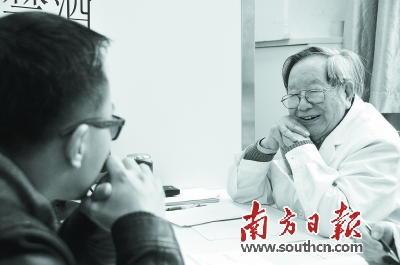
The camel resistance first spoke with the patient。
South daily reported on the old professor of the southern medical university hospital. At the age of 85, there was a strong response to the emotional evidence of the persistence of the clinic and the writing of the science blog. Many readers lament the fact that it's old and famous, and why do you say so much
With this question in mind, southern daily news journalists have conducted in-depth interviews to find answers. Before the outbreak of the 1188 events in 1931, he had spent 14 years in the flames of the sun in exile; on the eve of the establishment of the new china in 1949, he had entered university, where he had a bright student career. The particular background and experience gave him a strong and idealistic belief that he had the courage to serve his country and to live with one another。
For more than half a century of clinical, teaching and research work in the field of infectious diseases, the anti-carine resistance has saved hundreds of thousands of patients, published more than 120 articles in national and international journals, produced 1. 25 million words of hepatitis b: basic and clinical (1-4 edition), received 1 national prize for scientific progress, 3 national prizes for scientific progress, 3 awards for scientific progress in the army and 6 awards for glory, making a significant contribution to the removal of the hats of the “hepatitis b country”。
“i am a doctor and a member of the party, i have little time and much more to do, and i will leave the rest of my life to the patient until the last moment of my life.”
Hepatitis basic laboratory vowed to remove the hb hat
About 10 per cent of people in china are living with the chronic asymptomatic hepatitis b virus, and 15 to 20 per cent in guangdong province. This has had a serious impact on the health of the population and has caused considerable damage to national economic and social development。
As a result, it was the first to respond to the national call to study viral hepatitis and to start a basic laboratory for hepatitis in the south hospital, which vowed to remove our “hepatitis b” hat。
When we first arrived at the hepatitis basic laboratory in 1988, the sights were incredible to our old colleague, ho haiyan. “the conditions are so simple that only a few bottles of cans, not even on the test stand, are visible, and the carcasses mark isotopes on the surface of the bathroom. It is truly unexpected that, after more than 20 years of effort, this laboratory has now reached an advanced level in the country and has been approved by the guangdong province and the entire military for a focused laboratory.”
In this laboratory, the camel resistance led the team to fill many of the research gaps: the country's earliest introduction of molecular biotechnologies into its hepatitis b study led to the discovery of viral mutations in china's hepatitis b virus's surface antigenic infections, and led to a study on the mechanisms for the occurrence of viral hepatitis cell collapse, raising the country's hepatitis b study to a new level. The new argument for “symptomatic chronic active hepatitis” presented by the anti-salary resistance provides an important theoretical basis for the prevention and treatment of hepatitis b. According to the old companions, since graduation, the anti-salary resistance has hardly taken a single leave, with most holidays in wards and laboratories。
At the end of 1996, there was an unknown increase of over 700 pupils in a military school, with the epidemic reaching 61 per cent, of whom more than 20 were taken to a military hospital for serious infection. The then general logistics department of the liberation army immediately instructed the first military medical university (the predecessor of the south medical university) to send experts to conduct on-site research and assist in the prevention and treatment。
As the head of the entire army of infectious diseases, the camel resistance first arrived in the area of the epidemic and then was put into research. When the bells of the new year ring, the camel resistance collects the patient's urine and serum in the sick zone。
Upon return to guangzhou, a new genetic component of the virus was finally identified through more than a year of arduous and rigorous animal and molecular virology experiments。
This is the third gastrointestinally transmitted hepatitis virus found in the world following hepatitis a and e. This major discovery resulted in a heavy volume of hepatitis for human detection of new viruses。
It's a good idea to fund students to study abroad. Heart
With the knowledge that a man's power is limited, it brings with it a group of good students and a strong scientific team。
Professor huo jinlin, former student of the southern hospital and head of the infective medicines section of the chinese medical association, and chief scientist of the national hepatitis b prevention and control programme for major infectious diseases, has taken the lead internationally in conducting a forward-looking clinical study of the hepatitis b treatment route, which has saved many patients ' lives。
Speaking of grace, huo jinlin felt lucky: “we students call ourselves camels, and the teachers are our camel-camelers.”
But in the area of talent development, he is well known for giving fame, opportunities, funding and ways to create conditions for students to study。
Jokinlin recalled that in 1992 he studied at st. Mary's hospital medical school. Go ahead and give him £200. The money was saved by the resistance when it went to england as a public scholar。
Fortunately, with this money, huo jinlin survived the first month of unpaid wages in england。
To this day, huo kim lin still holds the training plan he wrote earlier in 1996. In this handwritten plan, he was told “that there must be a long-term in-clinical in-depth” and was eager to: “the market economy has to develop, the notion of “the patient needs” must not be changed, and the call for “the illness needs you” must not be refused whenever and wherever it may be”
At the symposium on advances in the fight against camel, huo jinlin said that he had given students three “keys” to produce: hard work, perseverance and a return to society, “the needs of the state and the call of the sick are in his heart”。
"we have a hospital name, and we have a principle of conscience."
It is the strong faith and generosity of an old member of the party and of the old military doctor who has supported the long line of service and dedication to the country. After 55 years of membership in the party, the anti-sorture resistance was always committed to the party's first, clean practice of medicine, to serving the country and the people with its own expertise, and was compassionately referred to by colleagues and students as “old male”。
The old man's party is particularly conscious. He does not usually speak much, but whenever he encounters a bad phenomenon, he is rightly critical. On one occasion, a comrade who had been first discovered in the clinic had given the patient high-priced medication, asked him to correct it, and seriously criticized: “our hospital name is the official, with principles, with conscience, with real medicine for the patient.”
"it's too serious, very principled." the south hospital infected professor sun sword said that, in order to prevent some manufacturers from using his influence for advertising, marketing and so forth, the anti-sorture industry had never participated in “certification conferences” or “press conferences” organized by the pharmacy, and that false publicity about hepatitis b medications had been disclosed in a timely manner. Despite having offended some merchants, he said, “it is enough to be able to deal with the sick and with the conscience.”



