With social and economic development, intellectual property rights have gained increasing importance, although there is also a strong awareness of whether their behaviour constitutes a violation, such as the presence of merchants in shivering platforms and fast-hand platforms, and trademarks have become an important check-in condition. So, if your actions during your life or business do infringe on the trademark rights of others, must civil liability be incurred? Here we look specifically at the “legal source defence”。
I. Legislative objectives of the “border of legal responsibilities”
In order to adapt to the current state of retail development in our country, which reflects both the intent to encourage innovation in the protection of intellectual property rights and the regulation of the market order, as well as the requirements for harmonious development of the industrial economy, the trademark act and the patent act provide for a system of legitimate sources of defence, based on the theory of bona fide third-party doctrine in civil law law, aimed at balancing the interests of the parties in civil legal relations, thereby preserving a stable market economy order and protecting the security of transactions。
Ii. Applicability of the “legal source defence” to trademark infringement
(i) the “lawful source defence” applies to the seller. Under article 57, paragraph 3, of our trademarks act, it is known that the sale of goods that violate the right to exclusive use of registered trademarks is also one of the violations of the right to exclusive use of registered trademarks. At the same time, article 60 of the trademarks act provides that the sale of goods that are not known to be in violation of the right to exclusive use of registered trademarks can prove that the goods are legally acquired by themselves and that they are provided for, and that the business administration orders the cessation of sales. Accordingly, article 64 of the trademarks act also provides for the sale of goods that are not known to be in violation of the right to exclusive use of the registered trademark, which proves that the goods are legally acquired and the supplier is not liable. It follows from the above that the legitimate source defence applies to the seller, who is exempt from liability even if it is found to constitute an infringement of a trademark right if the seller meets the relevant conditions。
Tort manufacturers, producers, etc. Do not apply the legitimate source defence and, once their conduct is found to be a violation, they must be held liable for cessation of the tort and compensation for damages。
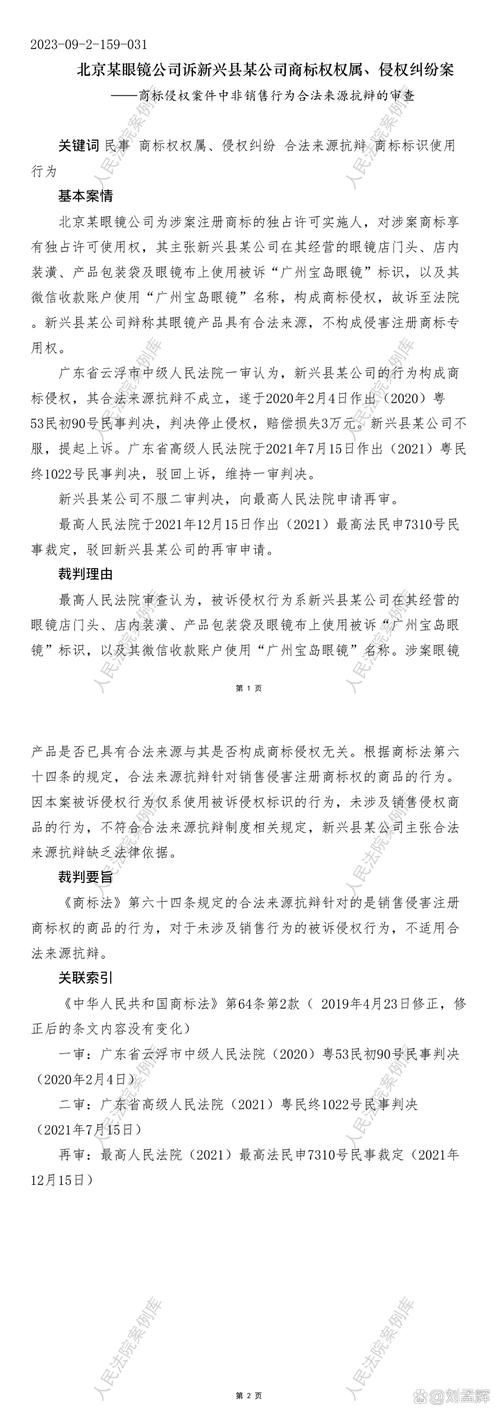
(ii) whether a “lawful source defence” can be applied to service providers is not expressly provided for in the trademarks act. But i'm from 2017. In the yongchou case, service providers could not apply the legitimate source defence. In that case, the higher people's court of the ningxiang autonomous region held that the service provided by the shing chong cai sou mau shop was a catering service, consisting of a meal and an outsider, that the use of trademarks on the shop's offers, decorations, meals, food orders and bag bags was intended to indicate the source of the service, that consumers were made aware of the service provided to them by identification at the time of consumption and that the service trademark was used, that the shing cing cai mau shop was not a seller of other people's goods, and that it was therefore not the subject of the application of the “legitimate source” defence, and that hing cing cing cai mau and shun yu were the subject of a trademark licence and a concession contract, and that it did not celebrate the sale of the catering services provided to the consumer by shun gyu, nor was the legal relationship between the seller and the source of the goods or services in the “legal source”. (extracted from (2017) civil judgement no. 232 of ning people's final), it follows that some courts have held that service providers are not entitled to a “lawful source defence”。
However, in combination with the legislative purpose of the “legitimate source defence” and article iv of the general provisions of the trademarks act, which provides that: “the application of the provisions of this act to trademarks of goods does not automatically exclude the application of this provision to service trademarks. It is certain that service trademarks are subject to more stringent and more demanding conditions for the application of the “legitimate source defence” and that, in order for service providers to apply the legitimate source defence to be exonerated from their civil liability, they must make an effort to prove their subjective good faith. Of course, it is not enough for a service provider to simply supply the trademark used for the alleged service to be authorized from a third party, but simply to provide its own authorized source of legal access to the trademark, and its legitimate source defence is difficult to establish. We, the plaintiffs, in 2019, represented in the “luccan small” series, claimed that they were authorized by other trademark holders with the words “luccan small” but did not in fact constitute a legitimate use of our “luccan small” and were found to be torts by the courts。
Conditions for application of the “legal source defence” in trademark torts
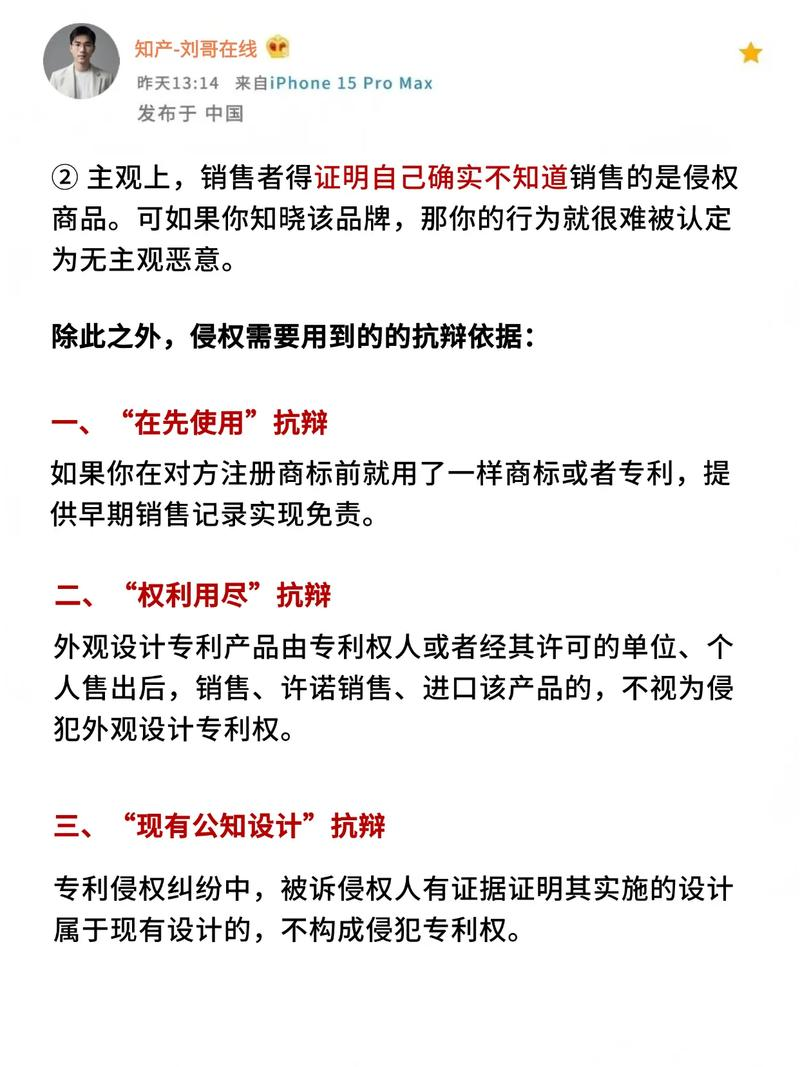
(i) subjectively uninformed, although the seller sells tort goods, it is subjectively good and does not know that it sells tort goods。
In the case of subjective knowledge, it is important to analyse the findings that the seller's subjective state of knowledge can be considered if:
First, the trademark owner has relevant evidence that he has issued a warning letter or other correspondence to the seller, but the seller continues to insist on selling tort products
Second, the trademark rights holder has not issued a related warning letter, but the seller has been dealt with by the judicial and administrative authorities for selling the products alleged to be in violation
Thirdly, the trademarks held by the trademark rights holder are of high and prominent visibility, as in the above-mentioned (2017) case no. 232 concerning the end of the ning people's republic, the higher people's court of the ningxia-rei autonomous region held that “eternity and soy” had a high profile in the catering service, and that the use of “eternity and soy” in the soy shop had no goodwill and did not meet the requirement of “intellectual breach of trademark exclusive rights” in the “legal source” defence
Fourth, the price is significantly lower than the price of the products accused of infringement and legal products。
The determination of subjectivity is, of course, in good faith, uninformed and depends on whether it fulfils a reasonable duty of discretion. In practical cases, where a seller sells goods without three products, sells tort goods without the name of the manufacturer in the physical form and in the packaging, without proof of the place of production, the date of production and the quality of the product, the product itself violates articles 27 and 36 of the product quality act. Thus, it can be presumed that the seller has not fulfilled the basic examination obligation of a seller, that there is a subjective fault in the application of the legitimate source defence and that it is not exempt from civil liability。
(ii) the seller can prove that the tort goods were lawfully acquired. Article 79 of the regulations for the application of the trademarks act provides that: (i) a supply list and receipt of the purchase price, legally signed by the supplier and approved by the supplier or the supplier, is to be found to have been legally signed, (ii) a contract for the purchase of the goods entered into by the supplier or the seller and is to have been verified as having been performed, (iii) an invoice for the lawful receipt of the goods and the recording of the invoice is to be found in relation to the goods in question, and (iv) other circumstances that can prove the lawful acquisition of the goods in question. It follows from this provision that in order for a seller to prove that the tort goods were lawfully acquired and to use a legitimate source of defence, it must provide a supply contract, a supply list, a receipt of payment, and the corresponding invoice with the upstream supplier, distributor, etc., which forms a complete chain of evidence in order to prove that the alleged tort goods sold were lawfully acquired。
In addition to this, the author believes that whether the seller has paid a reasonable price, which is also an important factor in determining whether the seller has obtained a legitimate price, is one of the important factors in the legal determination of whether or not the seller sells tort goods, and that this is one of the important factors in our national law that constitutes a good-faith acquisition. If the price of the goods varies more widely, then the subjectivity of the goods should be known to the seller and, in the case of the seller, a greater differentiation should be made as to whether the goods have been torts, legitimacy, etc., so that whether or not the seller has paid a reasonable price is an important factor in considering whether or not they constitute a legitimate source defence, which cannot be ignored。
(iii) the seller is able to specify the provider of tort goods. In order for a seller to prove that it meets the requirements of the “legal source defence”, it must provide a clear provider of goods, i. E. Upstream suppliers, distributors, producers, etc. If the seller is unable to provide an accurate commodity provider, the legitimate source defence cannot apply。
Iv. Responsibility for definitions of “letial resources” in transports
Article 60 of the trademarks act clearly states that sales of goods that are not known to violate the right to exclusive use of registered trademarks, which can prove that the goods are legally acquired by themselves and that the goods are supplied, shall be suspended by an order of the business administration. Article 64 provides that the sale of a commodity that is not known to be in violation of the right to exclusive use in the registered trademark is not liable if it proves that the commodity was legally acquired and indicates that it was provided. It follows from this provision that the seller is only liable for the cessation of the tort and not for liability if it provides evidence that it has satisfied its “legal origin”。
So, in cases where the seller is found to constitute a “legal source defence”, should the infringer, the seller, be compensated for the reasonable expenses incurred in defending the rights of the rights holder? Although the law on this issue is not clear, the author considers that tort losses are a parallel to reasonable expenses, and that the people's court should support a request for compensation for reasonable expenses where the tort is found and the law does not exempt them from liability for reasonable expenses。
The “legitimate source defence” is of great importance to the seller as an important ground for exempting civil damages under the trademarks act. A wide range of sellers should raise their own legal awareness and, in the process of acquiring goods, exercise their legitimate and basic duty of due diligence by entering into formal contracts of purchase and sale with suppliers and obtaining invoices. In the event of a lawsuit, a professional lawyer should be actively entrusted with the prosecution and should not be passive, using the safe haven granted by law to defend his legitimate rights and interests。