1. 1 history of knowledge mapping
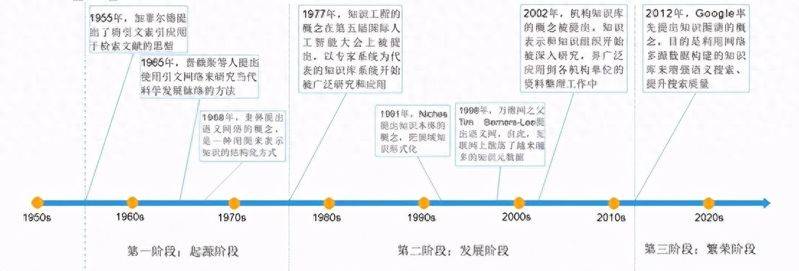
The knowledge map, which began in the 1950s, has been divided into three broad stages of development:
• the first stage (1955-1977) is the origin phase of the knowledge map, in which web-based analysis of quotations is beginning to become a common method of studying contemporary scientific developments
• phase ii (1977-2012) is a stage in the development of knowledge mapping, where semantic networks are rapidly developing and “knowledge-based” research is beginning to become an important area of computer science, which incorporates the concepts of semantic networks, the organization and expression of knowledge, making knowledge easier to exchange, circulate and process between computers and between computers and people
• the third phase (2012-present) is the knowledge mapping boom phase, with google presenting google knowledge graph in 2012, with the official title of the knowledge mapping and google improving search engine performance through knowledge mapping techniques. With the flourishing of artificial intelligence, key issues such as knowledge extraction, expression, integration, reasoning, questions and answers have been resolved and broken to a certain extent, and the knowledge mapping has become a new hot spot in the field of knowledge services, with wide interest from scholars and industry, both domestic and foreign。
The specific development history of the knowledge map is shown below。
Case notes
In recent years, home-grown technology has received widespread attention with the advent of semantic web. Many large transnational corporations have started researching home-grown technologies. Google presented a knowledge mapping project in 2012 aimed at using in-house technology to improve the accuracy of searches and more intelligent knowledge browsing. Domestic internet companies, such as 100-degree dogs searches, have also undertaken projects in this regard. Microsoft proposed probThe case project, which aims to build a large body by crawling with the information on the web page. Ibm uses semantic web technology to handle the integration of isomeral medical data and more accurate queries. In-house technology plays an important role in the well-known ibm question and answer system, watson. Oracle has achieved a strong semantic data reasoning and indexing system. It is also supported by european and american governments. The british government has launched the http://data. Gov. Uk project, which distributes information on many government websites in their own form. The us government has similar projects。
1. 2 importance of knowledge mapping
Philosophy plato defines knowledge as “justified true belief”, i. E. Knowledge needs that meet three core elements: justified, true and believed. In short, knowledge is a collection of all the facts (facts), concepts (concepts), rules or principles (rules & principles) that humankind acquires and draws from observing, learning and reflecting on phenomena about an objective world. Human beings have invented various means to describe, express and transmit knowledge, such as natural languages, drawings, music, mathematical languages, physical models, chemical formulae, etc., which can be seen in the importance of intellectual descriptions of objective world patterns to human social development. The ability to acquire, express and process knowledge is an important characteristic of the human mind and mind as distinct from that of other species, and knowledge mapping has become an important route to enabling machines to acquire cognitive capabilities based on human knowledge and will gradually become an important productive resource for future intelligent societies。
N knowledge mapping is an important cornerstone of artificial intelligence。
N knowledge mapping drives intellectual development。
N knowledge mapping is one of the core drivers of strong artificial intelligence development。
The knowledge map was presented by google on 17 may 2012 and was originally designed to improve the search engine's capabilities, the quality of the search by users and the search experience. Current artificial intelligence technologies can be simply classified as sensory intelligence (mainly image, video, voice, text recognition, etc.) and cognitive intelligence (which involves intellectual reasoning, causal analysis, etc.), knowledge mapping techniques are the main technologies in the area of cognitive intelligence, are part of artificial intelligence technology, and their powerful semantic processing and interconnective organizational capabilities provide the basis for intelligent information applications。
A knowledge map is designed to describe the entities and relationships that exist in the real world. With the development and application of artificial intelligence technologies, knowledge mapping as one of the key technologies has been widely applied in areas such as intelligence search, smart questions and answers, individualized recommendations, and content distribution。
In terms of scope of use, the knowledge map is divided into a generic knowledge map and a field of knowledge map, with the general knowledge map emphasizing breadth, with most of the data coming from the internet, while the field knowledge map is applied in a vertical area and becomes a basic data service。
1. 3 definition of knowledge mapping
Knowledge mapping (knowledge graph) describes concepts, entities and relationships in an objective world in a structured form, bringing internet information tables closer to the world of human awareness and providing an ability to better organize, manage and understand the volume of internet information. Knowledge mapping has given life to the semantic search of the internet and has also shown great power in smart questions and answers, which have become an infrastructure for intellectual applications driven by internet knowledge. Knowledge mapping, together with big data and deep learning, is one of the central drivers of the internet and artificial intelligence development。
Knowledge mapping is not a new way of expressing knowledge, but rather a large-scale application of knowledge in industry, linking objective objects that can be identified on the internet in order to form a knowledge base of objective world entities and entity relationships, which is essentially a semantic network in which nodes represent entities (entity) or concepts (concept), by which semantic relationships between entities/concepts are represented. The structure of the knowledge mapping, including the logical structure of the knowledge mapping itself and the technical (systemic) structure used to construct the knowledge mapping. The logical structure of the knowledge map can be divided into model layers and data layers, which are above the data layer and are at the heart of the knowledge map, where refined knowledge is stored, where a matrix is usually used to manage the model layer of knowledge maps, and where links between entities, relationships and the types and attributes of the entity are regulated by its supporting capacity for justice, rules and constraints. The data layer consists mainly of a series of facts, and knowledge will be stored in fact. In the data layer of the knowledge map, knowledge is stored in fact (fact) in the chart database. If with "entity-relationship-entity" or "entity-relationship-foreignity " as the basic expression of the facts, the three-chamber group would constitute a large network of physical relationships and form a “knowledge map”。
The knowledge map is designed to describe the entities or concepts that exist in the real world and their relationships, and constitutes a large semantic web map, with nodes representing the entities or concepts, while the margins consist of attributes or relationships. Knowledge maps are now used to refer to a wide variety of large-scale knowledge banks。
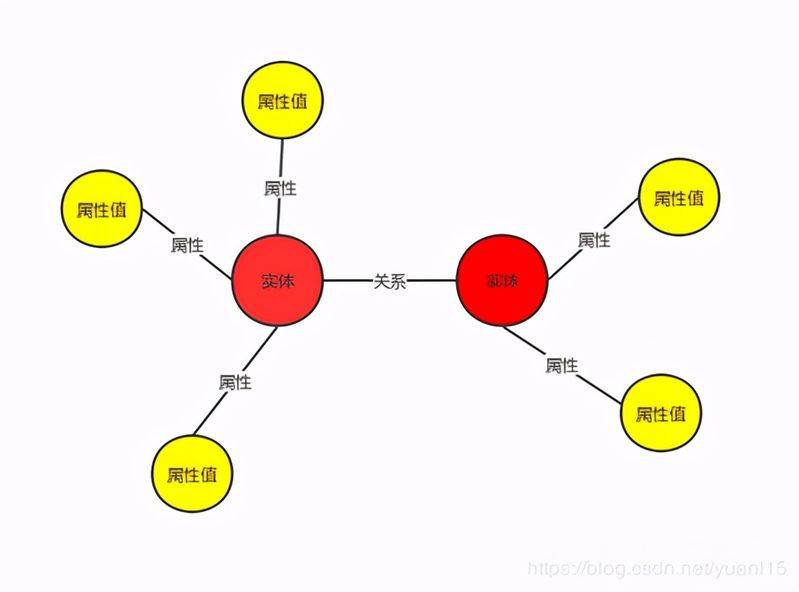
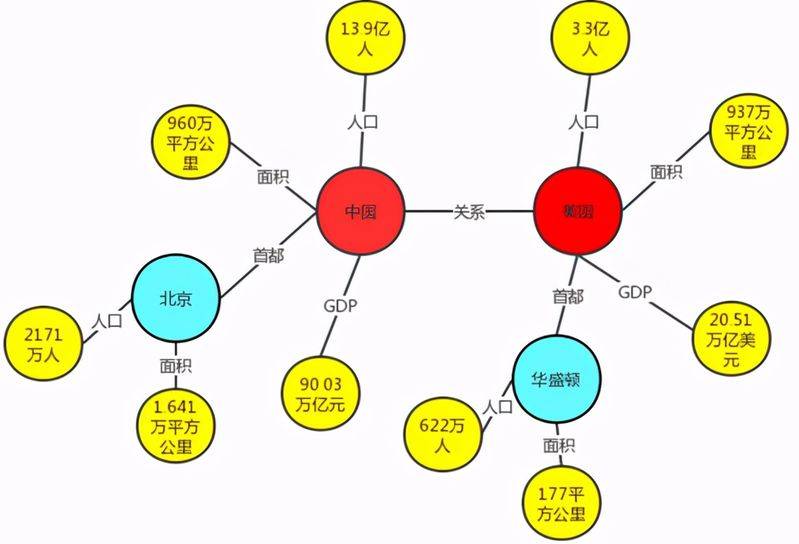
As shown in the figure above, the knowledge map contains three nodes, the basic forms of which are (entity 1-relationship-entity 2), (entity-relations-relations)。
Entity: refers to things that are distinguishable and independent. For example, one country: china, the united kingdom, etc.; one city: beijing, london, etc。
Semantics: a collection of entities with a particular identity, such as the state, the city, the nation, etc。
Attribute value: the value of the property to which the entity points. For example, china (entity) covers 9. 6 million square kilometres (attitudinal value)。
Relationship: on the knowledge map, the relationship is a function that maps kk figure nodes (entities, semantics, attribute values) to a boolean value。
Based on the concept of semantics described above, we can build a country's knowledge map as an example, as shown below: