


There is a question about the “era of fragmentation, what efficient learning methods” that has captured 2 million views over the past year。
The questioners lamented that they “time was torn apart by various apps” and that it was difficult to find a full period of study after leaving school。
Everyone in the age of mobile internet may have a similar sentiment, and how should the “breaking” of information and knowledge be seen and addressed? This requires our analysis from both social and personal perspectives。
The concept of “discretion” is derived from post-modernism research in the 1980s and is often used to describe features such as decentrization and fragmentation of new media dissemination patterns. The issue of fragmentation in media research focuses primarily on fragmentation in the use of media。
If we use the broad term “reading” to refer to the medium of audience use, the intellectual discussion of fragmentation encompasses three dimensions:
I. Debrisification scenes and the use of time, such as reading using commuters, people, workspaces, etc.
Ii. Fragmentation of reading content, such as short clips of words and short videos on microblogging, i. E. Lack of in-depth reading
3. The whole continuous reading (learning) time is disrupted and shredded by the mobile internet, as is the frequent interruption of the continuous and focused reading process by the mobile phone, which is constantly switching between the reading and the cell phone. The academic community is critical of the fragmentation of the latter two dimensions。
The use of the mobile internet has broken down the closed and exclusive nature of the scenes of work and learning, blurring the boundaries between work, learning, leisure and recreation, and making it difficult for people to keep a closed, continuous reading time and space in the face of rapid transitions from time to time. “moving terminals take advantage of all debris time, but they also turn all time into debris time, adding to the fragmentation of information consumption. The mainstream view of the academic community has always expressed concern about the fragmentation of information and the fragmentation of space and time generated by the new media, with people who fear being surrounded by trivial information increasingly falling into a situation of in-depth reading and reflection。
Concerns about the impact of fragmentation of the new media are underpinned by a preference for traditional reading patterns. Because reading and writing represent the highest level of rational use in terms of information reception and production, respectively. Reason implies “sameness, continuity and sequence”, which is linked to a particular technology, while some new technologies tend to make people irrational。
In retrospect, the emergence of new technologies for almost every generation since humans entered a highly industrialized era has triggered criticism of their “difficult” and “simple” characteristics。
In the 1930s, in the face of an increasingly widespread western society, lewis manford lamented that “reading, writing and painting are a high-level extraction of thinking and a medium for deep thought and considered action, and are now being undermined by this instant communication”. (technology and civilization, china construction industry press, 2009, p. 213) he considers that telephones are inefficient means of communication in which the energy and attention of individuals are frequently disturbed and dominated by strangers, and that reading and writing such communications that do not see each other and keep a distance may be smoother than direct and limited contact with the telephone. Munford's views on the telephone are quite similar to those of the contemporary academic community on the mainstream of fragmentation。
Under the influence of manford, mcluhan, the patriarch of the media, who in his eyes was the medium, argued that the medium was human and spiritual. He put forward the well-known idea of the “media, the message”: technology creates a new environment, “any influence of any medium on individuals and society is due to a new scale; any extension of ours is to introduce a new scale in our affairs”. While understanding the media: an extension of the human person, translated by forest press 2011, p. 18, people tend to be more concerned about content in the media, mcluhan argues that the influence of technology does not occur at the conceptual level, but changes the human perception pattern; attention should be given to the social impact of media forms themselves, such as the emergence of printing, which contributes to the rise of nationalism and individualism in europe。
Today's thinking about the dissemination of fragmentation in the age of the internet continues to follow, deliberately and inadvertently, the logic of the media environment, but ignores two important issues: the new scale of media technology and its impact are directed at society as a whole rather than at a particular group in society (e. G. Intellectuals); changes in the interpretation of media technology at the social level ultimately need to be implemented at the level of an individual's daily life, otherwise it is easy to move away from reality or “unbelievably”。
When we lament the extreme fragmentation of scenes and information by moving the internet, one may forget that the survival of such fragmentation has been a basic feature of human daily life, namely, the intentional and unintentional acquisition of debrisized information in the scenes of fragmentation. Reading and learning over a long period of time in a relatively closed environment is a particular practice for students, scholars or the intellectual class with reading habits. Such groups have grown with the development of print technology and the spread of education, but they are still not the majority and many people with higher education are not necessarily able to develop reading habits。
As a result, criticism of the fragmentation of information is more a reflection of the panic and uncertainty of the intellectual community in the face of the new media: private time is constantly being invaded and broken by the new media, and long, closed and focused reading is becoming more difficult。
We cannot assume, however, that the general public is free to talk about ancient greek philosophies instead of playing mahjong, watching television or doing nothing. Fragmentation of information is directed only at people with a reading habit, and scholars should not mistake their confusion as a problem for society as a whole。
Of course, the writer does not think that reading is not important, but rather wants you to think about the purpose of reading before critical of the fragmentation of information in the internet age. This leads to a further exploration of “how to read” and “what to read”。

Age-old reading habits are important tools for human access to knowledge, but for a long time there has been a sharp hierarchy between the cultural elite, the able-reading people and the vast majority of illiterates. The invention and promotion of print arts have greatly expanded the text of reading, made reading easier and accelerated the efficiency of society in acquiring and creating knowledge. Even today, books (including various forms of digitization) remain the main vehicle of knowledge, and reading books with a high degree of concentration over time remains an efficient learning model. In every area of knowledge, reading authority or classic books remains indispensable for learning efficiency. This model allows us to draw knowledge “dry goods” quickly, but it is undeniable that such a focused and long reading is not for everyone, but is a long-trained ability。
In the past, in response to differences in reading abilities, popular readings have softened, simplified and pushed to ordinary readers the hard-earned “dry”; today, internet platforms break up these “dry” to make them visible and even understandable to more people without traditional reading habits. In terms of this process, it is not so much a fragmentation of information as a diversification of knowledge carriers and modes of dissemination. Smartphones may be a potential threat to intellectuals to distract from learning and academia, but for most people mobile new media means an extremely important information platform that does not take up the time of study, but rather diverts boredom and improves the quality of life during leisure time, while also gaining access to information and knowledge that is not available from other sources. The fragmented reading of new media by scholars outside their areas of expertise is also an efficient way of learning about new information and knowledge。
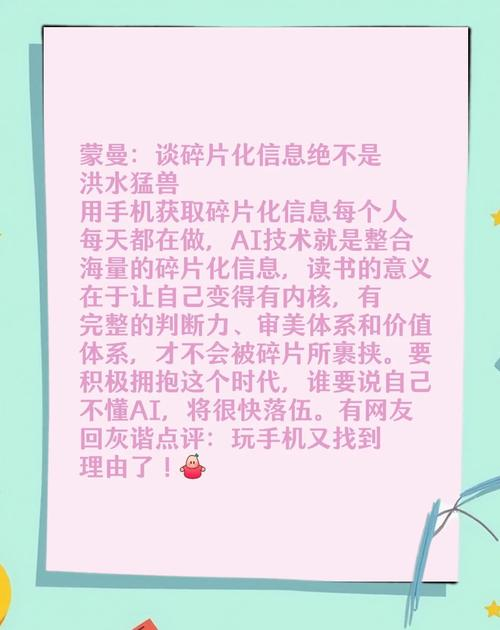
It follows that the fragmentation of information facilitated by mobile new media is not a flood beast. Rather, it expands learning for all, ranging from text, pictures to short videos, and more diversified text formats, which are particularly important for those who did not read (books) in the past. On the question of “how to read”, the new media brings to the intellectuals the addition, rather than the replacement, of fragmentation reading in traditional reading patterns as an increase of “1+1”; for those who do not have book reading habits, the new media's pattern of fragmentation transmission offers a breakthrough from “0 to 1”. In other words, the long-term focus on reading and the fragmentation of the text in the new media are channels of knowledge learning and access to information. The two are not mutually exclusive, as is the case for meals and snacks, which are best served at the same time, but are also a good option for those who cannot eat. Of course, many people feel a strong reliance on the entertainment function of the new media, and the rich choices that the information age gives to individuals in their daily lives will inevitably require that modern people have the capacity to manage themselves for a certain period of time, and at least that fragmentation should not be carried over。
Therefore, we need not dwell on the question of “how to read”, and what really needs to be focused on is “read what”, i. E. Whether the food itself is good for health or not. On the one hand, even if some people are exposed to “no use” information in the eyes of scholars, this can only indicate that their learning patterns are not improved by new media and are not worse than in the past; on the other hand, in an era of information fragmentation, we are still unable to avoid the question of what to read in traditional reading patterns, that is, how to disseminate and use useful or useful information. While people today are surrounded by a myriad of trivial and useless information unprecedentedly, it is undeniable that high-quality fragmentation information is not uncommon as mainstream media, research institutions, academics, professionals in various fields enter internet platforms in a media-based manner. Access to and use of these qualitative elements, involving the media literacy and cultural capital of every individual, will inevitably lead to a knowledge gap, and how to efficiently extract information and knowledge through fragmentation reading may be a new capability that the present generation needs to develop。
Submitted by: lu xin lei (adviser, faculty of communication, university of political science and law, china)



