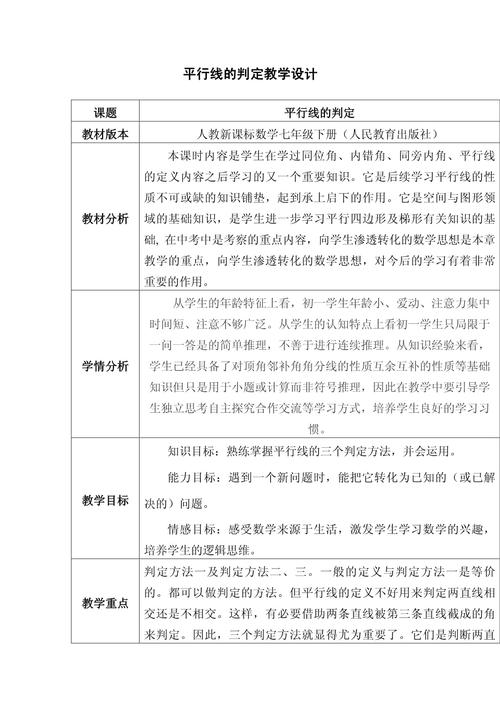
Educational background 1 for students: secondary school 2, subject: mathematics 2, course hours: 13, pre-school preparation: pre-school learning about completed after-school subjects teaching subjects: three methods of determination in parallel lines, using these three methods of evaluation, are used to make simple statements and to develop students' ability to observe, analyse, summarize, summarize and think logic. Knowledge: three methods of determination in parallel lines. The determination and nature of teaching materials to analyse graphics are issues that need to be addressed when studying graphics. The difference between the two is whether the parallel line is conditional or conclusive. Through the drawings of parallel lines that students have learned, there are two mathematical parallels drawn from the same angle, which arrive at a method of determining the “symmetrical parallel”. This method is the basic method for determining the parallels of the two straight lines, using two other methods for determining the parallels through the roll-out of the top and the adjacent corners, respectively. For two straight lines within a plane, only parallel lines are the concept of distance, and the notion that there is no distance between them. The way to seek the distance between the two parallel lines is to take any one of the two parallel lines and make any one of them as the line in the line, which is the distance between the two parallel lines. This would in fact require a distance between two parallel lines to be converted into a distance between a point and a straight line. Focus: the method of determining the parallel line: the same azimuth, two straight lines parallel. It's hard: it's a simple talk process in a mathematical language. By creating the situation, the teaching method provides students with the space to explore in a problem-driven way, leading them to actively explore. The design and development of the teaching chain is centred on problem solving, making the teaching process a self-explored learning process for students under the guidance of teachers, in which they form their own perspective. Thinking about observational analysis: direct students to do it themselves, draw a little bit of the known line outside the line, observe the process, and ask: why do the two triangles draw straight lines along the known line? Summarizing the problem: two straight lines are cut off by the third straight line, equal to the azimuth, and two straight lines parallel. Is it possible to arrive at two other methods of determining parallel lines? (1) as illustrated, two straight lines a, b are cut off by the third straight line c, and, and what is the angle of the relationship? (2) describe the nature of the parallel line. Student activities: recall and give the right answer. Ii. Teachers of the teaching process: in the previous section, we reached three conclusions on the equivalence of the same angle, the equivalence of the internal wrong angle and the complementarity of the opposite. Under what conditions can two straight lines be determined? (teachers analyse the problem as different from the problem solved in the previous section, and the subject of the book is then used by students to cross the line of line b with two triangles at a point outside line b. ) question: why does a line drawn in this way must be parallel to a line b? What's the location? Student exchange. Teachers: during the drawing process, the linea was drawn parallel to the lineb because it was maintained. The two lines (presentations) are cut off by the third line, equal to the azimuth and parallel to the two lines. Teachers: with this method of determination, when the two lines are cut off by the third line, the parallel relationship between the two lines can be determined on the basis of the equivalence of the same angle. Think of any difference or connection between this determination and the nature of the parallel line studied in the previous section? Student exchange, teacher summary. Teachers: (presentations) as shown in the chart, line a, b is stopped by line c, which is known, please add a reasonable condition to make it possible. Students discuss, communicate, discover. Depending on the student's response, the curriculum presents several different answers: (1), (2), (3), (4). It is correct to direct students to a simple reasoning based on a “symmetrical angle, parallel lines” to (1) (2) (4). Students are invited to think (3) why it cannot be used as a method of judgement, teachers' summary. Teachers: because it's the top corner, if, then, so. On the other hand, because of complementarities, if, then, so. This led to two additional methods of determination in parallel lines (presentations): two straight lines were cut off by the third line, with the same internal angle and two parallel lines. The two lines are cut off by the third line, complementary to the outer angle and parallel to the two. Iii. Application of examples leaders (present presentations): can you individ which two lines are parallel to each other, as illustrated, as known? Why? Students: exchange, discussion, answers. Teachers: because of homogeneity and parity. In order to make it equal to what? Students: communication, discussion, answers. Teachers: because it is the wrong angle, the wrong angle is the same, and the two lines are parallel. Students: exchange, discussion, answers. Teachers: when and under what conditions? Students: exchange, discussion, answers. Teachers: ... Because it is the same side corner, complementary to the side corner, two lines parallel. For the above example, three methods of determination have been used in parallel lines. These three methods are very important and are subject to regular after-school review. What did you learn in this section? What have you learned? 5. Classes practice p36 with questions 1, 2 and 3. Teachers summarize the exercise. Vi. Questions 1, 2 and 3 of group 10. 4a, group b, item 1