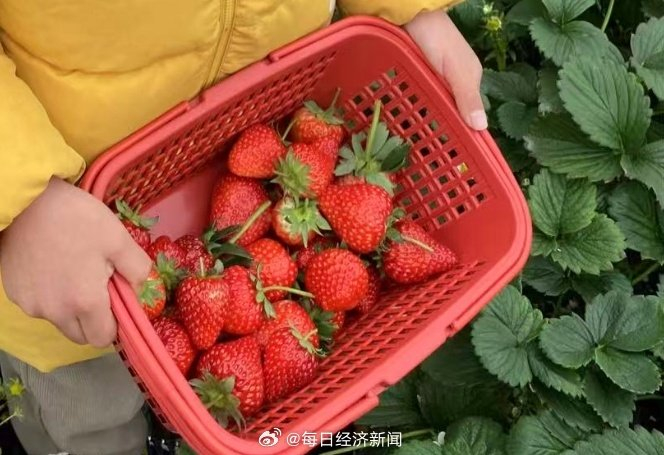
In recent days, the price of ground strawberries, such as wuhan, has rarely fallen to a “floor price” of $1 per pound, prompting a popular debate about “sherry freedom”, a phenomenon that is the result of weather anomalies, energy blow-outs and deep market patterns。
I. Extreme weather and concentration on the market: direct pushers of price divers
In late february 2026, wuhan experienced continuous rainy weather, which significantly inhibited public demand for out-of-home consumption and led to a sharp reduction in the flow of customers to the end markets. At the same time, local shed strawberries are in a productive period and the daily average supply has surged. In the case of the wuhan yellow zone, for example, single-day sales exceeded 200 tons, but the rains caused a sharp drop of more than 30 per cent in field purchases. Strawberries, which are extremely impatient berries, can be kept for only two to three days at constant temperatures, and in order to avoid the decomposition of the fruit, the merchants are forced to clear up at a loss price of “10 dollars per bowl” (about 2-3 pounds), some of which are even as low as $1 per pound. Traders at the south china market revealed that 60-70 baskets of strawberries were to be urgently disposed of in the morning, while the next-door supermarkets purchased up to 4,000 pounds a day, and the price of the goods was the only option to stop the damage。
Ii. National excess capacity: deep roots of price collapse
In recent years, strawberry cultivation has been characterized by “national expansion”. Technological innovations (e. G. Detoxification seedlings, high rises of soilless cultivation) have significantly increased monolithic production, with detoxified seedlings producing 20-30 per cent more than traditional seedlings, and increased resistance to disease. The warm winter climate in 2026 brought liao ning, shandong, yunnan and other major production areas to maturity earlier, with a “crash” of local strawberry from wuhan and a short doubling of the national market supply。
A serious homogeneity problem is hidden behind the expansion of productive capacity: varieties such as zhang yi, which account for more than 70 per cent of the country's cultivation, while high-end varieties (such as black pearls, white strawberries) continue to be priced at a high price of 100 yuan (one third of the average acre production) and are separated from the consumption of 300 yuan fruit。
Iii. Industrial chain slabs: wear and tear and grade loss exacerbate price stepping tap
Strawberry has to go through a tough test from field to table:
1. Transport losses are as high as 20 per cent: ordinary fruit farmers lack cold chain support and the rate of bumping and decomposition in off-site transport increases sharply. Local strawberry in wuhan, which takes only a few hours to pick from the booth, costs almost zero, while the end price of strawberries in the provinces is doubled by cold chains and price increases by intermediaries。
2. Inadequate classification system: high-quality fruits and secondary fruits are widely sold. Despite attempts to fine-tune the “mullaberry” brand (more than 13° fine fruit sugar), most production areas are still dependent on rough sales, resulting in medium fruit being sold at the same price as the tails。
Iv. Consumer rationalisation: market feedback from the bursting of the astronomical bubble
The consumer side's perception of strawberry is moving from “social luxury” to “day fruit”. In january 2026, black strawberries were made to 300 yuan/screech with a “frequentity + dark purple look”, but blinding measurements showed limited differences between their tastes and medium varieties, with a buy-back rate of less than 5 per cent. In contrast, 72 per cent of consumers prefer to opt for higher local cedars and refuse to pay for overpacking and marketing. This rational return has accelerated the flow of low-priced strawberries and squeezed high-price foam space。
Industry revelation: breaking the vicious circle of “fat harvest”
Short-term price fluctuations, while generating dividends for consumers, have exposed the multiple pitfalls of industrial chains:
- inadequate synergy of information: the mismatch between supply and demand caused by farming households and wind cultivation and the need to establish a national data-sharing platform for production areas to avoid the risk of centralized marketing
- deep-processed slabs: the conversion rate for secondary fruit processing is less than 10 per cent, and there is an urgent need to develop excess capacity for digestion of products such as strawberry sauce and frozen drying
- low risk resistance: promotion of “agricultural insurance + order farming” models, such as the “company + cooperative” initiative in the yellow zone, which guarantees the minimum income for farmers。
Strawberry prices' “hiller” curve mirrors the pain of china's agricultural transformation. Only by creating barriers to production and marketing, and by enhancing technological empowerment and branding, can strawberry freedom be transformed from a brief carnival to a sustainable industrial ecology。
This is generated by ai