


At the heart of aquaculture lies the construction of a water environment suitable for the survival and growth of farmed organisms, while dissolved oxygen (do) as a “lifeline” of aquatic ecosystems has a direct impact on the feeding, growth, immunity and survival of the cultured organisms, and is associated with the efficiency of the conversion of hazardous substances such as ammonia and nitrite in the water column, which is a central indicator of water quality regulation. Traditional aquaculture relies on empirical judgement or intermittent artificial testing for soluble oxygen regulation, with data lags, inaccuracy and blindness, which can easily lead to increased risk of farming. With the development of intelligent farming technology, the fluorescent dissolved oxygen sensor, with its core advantages of real-time, precision and stability, serves as a key data acquisition terminal for water quality regulation in aquaculture, providing reliable data support for precision, science-based water quality management. This paper will start with mechanisms for the impact of dissolved oxygen on aquaculture, and the system describes the technical advantages of fluorescent dissolved oxygen sensors and their application pathways and practical value in water quality management。
I. Solvent oxygen: core anchor for water quality management in aquaculture points
Dissolved oxygen is the most critical limiting factor in the aquaculture environment and its concentration levels directly determine the carrying capacity of the farming system and the productivity of farming. In terms of the biological demand for farming, most of the dominant farming species (e. G. White-to-shrimp, california weed, grassfish) have soluble oxygen concentrations of 5-8 mg/l: when the dissolved oxygen concentration is below 3 mg/l, the cultured organisms are exposed to anaerobic stress in the form of reduced food intake, slow activity and prolonged exposure to this state can lead to growth stagnation, reduced immunity and outbreaks of bacterial disease; when the dissolved oxygen concentration is less than 1 mg/l, serious accidents such as floats, ponds, etc. Result in large-scale deaths。
In terms of the ecological cycling of water bodies, dissolved oxygen is involved in the decomposition and nitrogen circulation of organisms in water bodies: under aerobic conditions, organic matter such as bait and faeces in water bodies can be broken down by microorganisms into non-hazardous substances such as carbon dioxide, water, and nitrogen can be converted from nitrite to nitrite (which can be absorbed by algae); in an aerobic environment, organic decomposition produces toxic substances such as hydrogen sulfide, methane, and nitrogen accumulates in anaerobic microorganisms, exacerbating water contamination and creating a vicious circle of “oxygen-contamination-disease”. Accurate control of soluble oxygen concentrations in water bodies is therefore a central prerequisite for achieving a dynamic balance in water quality and ensuring the safety of farming, a goal that cannot be achieved without the support of efficient and accurate soluble oxygen detection techniques。
Technical breakthrough: precision data advantages of fluorescent dissolved oxygen sensors
In the field of aquaculture soluble oxygen detection, traditional means of detection (e. G. Drip-fixing, electrodes) are difficult to meet the need for precision regulation: drip-fixing operations are cumbersome, with long detection cycles, and real-time monitoring cannot be achieved; electrodes (clark electrodes) are vulnerable to interference with water debris, faeces, heavy metal ion, etc., as well as electrodes consumption, electrolytic leakage, etc., require frequent calibration and detection accuracy and stability are difficult to guarantee. The fluorescent dissolved oxygen sensor is based on the fluorescent fluorescent accelerator, and the precision and stabilization of soluble oxygen detection is achieved through technological innovation, with the following core advantages:
(i) high detection accuracy and reliability of data
The fluorescent dissolved oxygen sensor is detected in accordance with the stern-volmer equation (i0/i = 1 + ksv.) to generate fluorescent from led-based fluorescent substances on the surface of the probe, the dissolved oxygen molecule and the energy transfer of the activated fluorescent material result in fluorescent fluorescent fluorescent, and changes in the fluorescent strength are associated with strict linear levels of dissolved oxygen. The detection process is physical and does not have chemical effects on water samples, avoiding interference with electrochemical reactions in electrodes. Experimental data indicate that detection errors in fluorescent dissolved oxygen sensors can be contained within ± 0. 1 mg/l, are far better than traditional electrodes (+0. 3 mg/l) and remain stable in hydroponics with high turbidity and high organic content, providing a reliable data base for water quality regulation。
(ii) rapid response, real-time capture of concentration fluctuations
In aquaculture, soluble oxygen concentrations are subject to sudden fluctuations due to factors such as feeding, water exchange, the activation of oxygen-added equipment and weather variability. The fluorescent soluble oxygen sensor has a response time of only 3-5 seconds, allowing instant capture of the dynamics of soluble oxygen concentrations and avoiding the delay of traditional detection methods. For example, after feeding, there has been an increase in bio-absorption activity, a rapid decline in aqueous aerobics, and fluorescent sensors can monitor this change in real time, triggering timely aerobic regulation instructions; and traditional artificial or electropolar tests, which may miss the regulatory time due to slow response, may result in an aerobic stress disorder in the cultured organisms。
(iii) low-carry-free calibration, suitable for breeding complex environments
The core components of the fluorescent dissolved oxygen sensor (fluorescent probes) are sealed with inert materials, without direct contact with the water sample, with no expendable components, with a useful life of up to 1-2 years; daily maintenance is carried only by organisms that wash the surface of the probe with water on a monthly basis and do not require frequent replacement of electrodes, resupply of electrolytics, and significantly reduce transportation costs and operational difficulties. At the same time, sensors support single-point air calibration, which can be completed by lay breeders without the use of complex standard solutions, a simple and fast calibration process. In addition, sensors have good water-resistant, corrosive properties, which allow long-term immersion and continuous work in water farming bodies, suitable for a variety of complex farming environments, such as ponds, plant culture, and circulatory water farming。
Product overview
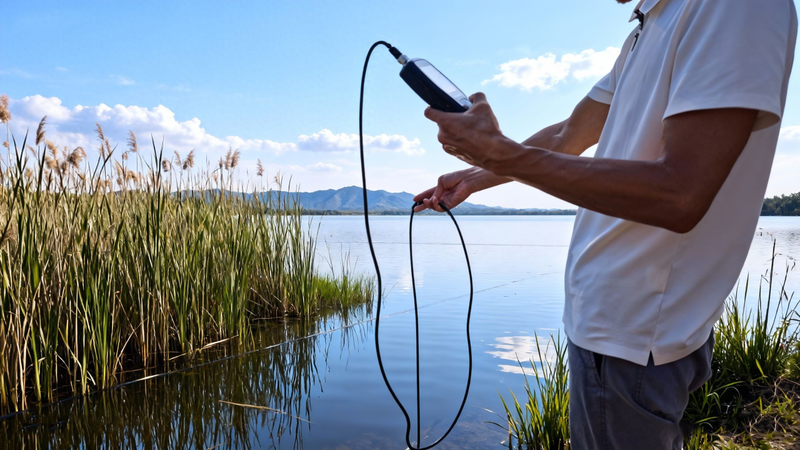
Portable fluorescent fluorescent oxygen instruments in the intellectual environment are based on optimized fluorescent central techniques, carrying self-developed non-expendable high-performance fluorescent film, counteracting the dissolved oxygen concentration by detecting fluorescent signal phase differences caused by oxygen molecules, without electrolytic fluids and frequent calibration, addressing pain points such as traditional electrodes, oxygen consumption, pollution-prone points from their sources, rapid response speeds (t90 /2000/40s), measuring precisions of ± 0. 1 mg/l in the 0-20 mg/l scale range, and automatic compensation for temperature and even salinity from built-in high-precision sensors, which can stabilize at temperatures of -20°c ~ 50°c and complex conditions such as high salt, acidine, etc. The instrument, which is also equipped with an industrial-grade fixed installation and light quantitative handheld equivalent, not only has an industrial-grade design for anti-conservation sealing, anti-pollution, fixed monitoring needs in the chemical, pharmaceutical and water treatment industries, but also portable features such as water-protective grade 500g, ip68 and above, suitable for aquaculture inspections, field emergency monitoring, etc., while supporting the real-time uploading of data and management of multi-equipment networks, helping a wide range of areas to optimize soluble oxygen precision monitoring and process optimization and significantly reduce transportation costs。
# dissolved oxygen analyser #



