Cross-border electricians are the “winds” of current foreign trade. In the first half of 2024, china's cross-border electricity producers imported and exported rmb 12. 2 trillion, an increase of 10. 5 per cent over the same period, which is 4. 4 percentage points higher than the overall increase in foreign trade during the same period. From the central to the local level, this year all levels of government have accelerated the adoption of pro-bono policies for the development of cross-border electric operators。
However, cross-border electricians have told researchers at the institute that “the early dividends of cross-border electricians have gradually disappeared since this year” and that “the difficulty of operating has become more difficult and the profit margin has been much lower” and that, according to operators, many of the previous “minor” tracks have also begun to fall into “price warfare”。
What is behind the low profits of the cross-border electrician? What are the reactions of low-cost trends at the production and consumption end? Since march and october of this year, researchers at the institute have been interviewing 30 small and medium-sized electric operators and relevant government authorities from shanghai, hangzhou and yiu, in an attempt to answer the above questions。
The transborder electrician, blue sea, became red sea. Why are the profits thin
Since this year, there has been a marked downward trend in cross-border electrician dividends. According to ceo, a commercial trading company in ningbo city, cross-border electricity suppliers are caught in a low price domestic roll, and the submersible market remains the norm when it came to sea in 2024. “the cross-border powerer dividend has further disappeared, and new entrants have become more difficult to operate and have lower profit margins.”
According to hugo's cross-border data, in 2023 only 27 per cent of vendors indicated that profits were higher than in the same period of the previous year, 14 per cent indicated that profits were equal to the same period of the previous year, and 59 per cent indicated a decline in profits. In the first quarter of 2024, 12 per cent of the sellers indicated that their profits were the same as during the same period of the previous year, while 44 per cent of the sellers ' profits were the same decline. At the same time, the cost of nearly 70 per cent of vendors has risen in comparison to the same year, and 50 per cent of vendors have not performed as expected during the year-end boom。
The gradual decline in the profits of cross-border electric operators is primarily related to the surge in the number of businesses. As of 25 september 2024, china currently had 74,780 businesses in its business information containing “cross-border e-commerce”, of which 61. 8 per cent had been established in the last three years (2021. 9-2024. 9) and 65. 7 per cent were micro-enterprises. Figure 1 shows the number of newly established cross-border electric operators from 2017 to 2023. The rapid increase in the number of enterprises operating across borders, which began in 2020, and the decline in the proportion of enterprises written off each year, show that cross-border generators are still at the stage of business influx。
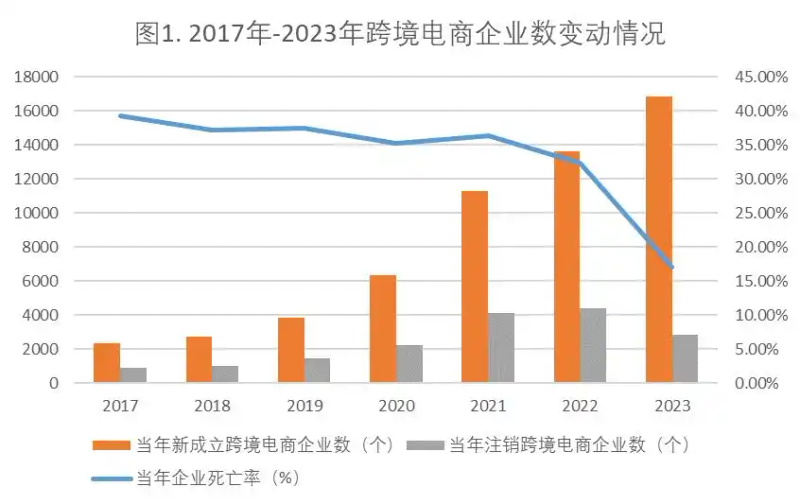
Data search time was 25 september 2024. Researcher at the institute, shaqiy, map; in january-september 2024, 11857 new businesses were cancelled and 490 businesses were cancelled; and the enterprise mortality rate was = the number of new cross-border electric operators established in that year/the number of enterprises written off in that year
The chief of the electronic commerce section of the iu market development committee explained to the institute that the increase in the number of businesses was related to the current high employment pressures in other sectors, while the entry threshold for cross-border electric operators was low and promising. In recent years, a large number of young people have come to yiu to learn how to run a cross-border electrician, “to report to a training course or to work with a boss for some time and soon to be able to do so”. To further complement the talent of the cross-border electricity traders, the uu also launched the “train for 10,000 cross-border electricians”. According to data from the yiu municipal market development commission, in the first half of this year, the total number of households in the country was 65460,000, 40 per cent of which were engaged in cross-border electronics。
In addition to an increase in the number of businesses, low profits are also affected by commodity homogenization. According to the department of commerce's study on international trade and economic cooperation, industries represented by textiles, light work, footwear etc. “have problems of overcapacity in low-end products, monoculture structure, low-level duplication and insufficient incentives for innovation”. Such products are the main source of goods for cross-border electricians. According to chinese customs data, in 2023, cross-border electronics exports consisted mainly of clothing, footwear and jewellery, household slings and kitchen appliances, mobile phones and various digital products and accessories, household office appliances and accessories。
Another piece of evidence on the relationship between “china's cross-border electrician” and “cheap homogeneity products” came from overseas research. The british market information company omnisend, which recently conducted a poll of 4,000 people from the united states, the united kingdom, canada and australia, found that their main purchases on chinese electric power platforms, such as temu, shein and others, were clothing shoe bags, household products, electronics 3c and cosmetics; 82 per cent of the respondents stated that the main reason for buying in chinese electric power was “cheap” and “discount”。
At the same time, exports come mainly from guangdong, zhejiang, fujian and jiangsu, which are also the main concentrations of the “cross-border electrician + industrial belt” strategy. That is, it is likely that the source of the goods from different businesses is similar or the same plant. “in particular, general goods (general goods that are not specifically required for transport, handling or custody)” an italian businessman told the institute that “it is not too different for everyone's product and route of delivery”. Moreover, “the profits of the general goods are generally low, and there is always someone who can accept lower profits than you to gain more of the natural flow of the platform, and you have to reduce the price.”
The competitive nature of electric power platforms often increases price competition for homogeneous goods. One of the italian merchants informed the institute's researchers that the platform system automatically recommends lower-cost products of the same kind when consumers stay on the page and when closing accounts. In addition, since the beginning of the year, the platform has competed for a “full hosting” model, whereby a vendor uploads a commodity, the platform will measure similar products across the network and provide a reference price for the commodity. These technologies allow price information to be quickly “matched” between different businesses and consumers。
Finally, the low profitability of cross-border electric operators is also influenced by consumption dynamics abroad. For example, most businesses reflect a slow recovery in the global economy, sales for the “black friday” shopping festival in 2023 were less effective than expected, while consumer markets in europe and the united states were weaker, leading to a sustained low-cost stock-taking phase in the first half of 2024。
“universal” profits will continue to decline until economic profits are zero
In the “blue sea” period (i. E. The outbreak period) for cross-border electric operators, there are fewer chinese businesses, and there is a degree of pricing capacity relative to more favourable prices offered by overseas competitors. A businessman who sells curtains through a cross-border electrician platform told the researcher: “the locally customized curtains in the united states cost 30,000 yuan (about 200,000 yuan) for a house, but only 20,000 yuan for domestic platforms. I'll sell it on amazon. I'll sell it for $15,000, okay? I'll make enough money to eat anything in this big market." this is a typical “earner-to-earth differential” thinking, but it cannot last。
With the semi-hosting/all-hosting, out-boarding of china's electric power company platform, the spread of the “one-day” model, and the improvement of facilities such as the “oversea warehouse”, the threshold for entry into cross-border electricity suppliers has been lowered, attracting an increasing number of chinese businesses; and the sale of similar commodities by “subsequents” at lower prices has led to prices increasingly similar to those in china's supply chain. As the general manager of shanghai faraway trading ltd. Commented, fan woo: “the important criterion for being a cross-border electrician is the choice of a small chinese track; when the chinese come in, they quickly lose their money”。
According to economics theory, cross-border electricians are close to the ecology of a “full competitive market”. In a fully competitive market: there are many buyers and sellers in the market; the goods offered by each vendor are largely the same; and enterprises are free to enter or exit the market. In the long run, fully competitive commodity prices will be balanced at the same level as the average total cost, when the economic profits of enterprises are zero. Among these, economic profits include accounting profits and hidden costs (or opportunity costs, which refer to other possibilities that the merchants have abandoned in order to engage in cross-border electricity suppliers)。
In other words, the industry's profitability would be reduced to a level where there would be a similar accounting gain for being a cross-border electrician with the same input and doing other things. As more and more enterprises enter, the loss of profits is normal, and profit margins are likely to continue to decline to a similar level as domestic trade, at which time the market size of cross-border electric generators will stabilize。
At present, the export markets of cross-border electric operators are moving towards a long-term equilibrium, with a relative advantage over domestic trade, although profitability has declined. As to when the final point of balance will be reached and where accounting profits at the point of balance will cease, many factors still work。
There are internal factors, such as the speed at which the market for cross-border electric generators is moving towards full competition (depending in part on advances in technology, knowledge and infrastructure in the industry); changes in the economic environment and in the return on inputs in general in china and other industries (which determine the level of apparent and hidden costs); and the maturity of some business models (i. E. Premature business models are more risky, entailing transaction costs, such as low-cost receipt-receipt declarations by freight forwarders, followed by high fines resulting in financial chain breaks)。
There are also external factors that are squeezing the “low price” model of living space, such as the adjustment of tariff policies in regions such as the united states, brazil and the european union since 2024, as a result of the development of china's cross-border electricity suppliers. On 13 september 2024, the government of the united states of america announced that it would adjust the exemption for small goods (previous to exemption for parcels of less than $800). On 1 august 2024, the new federal government tax reform regulations entered into force, imposing a 20 per cent tariff on imports of $50 and less (the previous parcels were exempt from tax). At the same time, there are reports that the eu intends to impose import tariffs on goods with a value of less than 150 euros purchased from electrician platforms outside the eu in order to curb the surge in cheap imports from cross-border electricians in china。
In overseas narratives, customs duties have been modified to “closure tax loopholes”: chinese electrician platforms tend to understate the value of goods, while customs are unable to inspect all packages, leading to large tax losses; this has led to displeasure on the part of local electricians and local fast-fashion brands as “increased unfair competition”. But there are also scholars who believe that this is a form of protectionism. In any case, however, this is a trend to curb the “low price” strategy, whereby overseas countries cannot afford to watch chinese low price packages fill their local markets。
Out of low prices, hard to build and more complex across borders
In the above-mentioned profit pressures, while there are still businesses that sell cross-border power agreements as a “roll-to-roll” type, more people are discussing the use of electric power channels to get out of low prices and branding. “the end point for an electrician to go to sea should not be extremely low prices, but brands to go to sea”。
For businesses, moving out of a fully competitive market to become a minority supplier of differentiated goods and not easily imitated by others. There could be attempts to increase investment in brand-building or to sell products containing more intellectual property. However, both of these attempts in electric power platforms have encountered some challenges。
First, online marketing models focus more on visual marketing and on comments already made, so it is difficult to communicate effectively to consumers the advantages of new products that are not visible. Numerous vendors complained to researchers about the suitability of the internet for selling “good-looking but undiscovered” products and “durable-lasting” products. So raising prices by improving product quality rather than appearance design is a more difficult way to go. “my materials are actually better used, but consumers don’t know. Just looking at the pictures is like that poor material. I also invested in a lot of traffic, which ended up being blocked by other traders.” to reflect the material advantage of the product, the business had to increase marketing costs - – new photographs and videos were taken, several new live lectures were added, “opener tests” for internet red people were purchased, more favourable awards were put in place, etc。
Second, it is not easy to protect intellectual property rights on electric power platforms, particularly in the general category of heavy-looking design mentioned above. For example, in the case of jewellery, where the incidence of copying is more serious, not only does legal proof of the uniqueness of appearance design and evidence of copying prove to be challenging, but most small and medium-sized businesses do not have the financial resources and energy to apply for patents and pursue copying。
Some have chosen not to sell online even to protect intellectual property and brand values. The founders of a buddhist cultural adornment brand in the iu small commodity city deliberately avoided the use of cross-border electric power platforms and retained traditional off-line trade. "my product advantage is mainly in design and touch," she told the institute, "but once a picture is made on the internet, not only do the guests not feel the quality of the gems, but there will soon be products of the same design but even worse materials."
For cross-border electricians, the protection of intellectual property rights online has become more complex — the trend towards product design and the intensity of efforts to combat intellectual property violations vary from platform to country. For example, the protection of intellectual property rights on the european and american electrotechnologies platforms is stronger and rewards innovation design; domestic investment and asian-african electrotechnologies are often more tolerant of similar products (the china market regulatory authority is taking steps to raise awareness of the protection of intellectual property rights on the platforms, but the concrete effects remain to be seen)。
Thirdly, business people from yiu and hangzhou have told researchers that selling high prices abroad requires competition with local brands, which often operate under wire and are better marketed locally, and that most chinese goods are “lively unfamiliar” and difficult to “open”. Moreover, consumer preferences for access to overseas markets are more difficult for small and medium-sized producers. A hangzhou furniture european electrician said to a researcher at the institute: "how do i know what couch they like? Those who have not lived in europe for four or five years do not even know the direction of innovation. If we want to go, our comparative advantage is really only price advantage.”
Fourth, china’s electric brands, which are now in the air, are further shaping the stereotypes of “first-class prices, second-class quality, and services” abroad, making it more difficult for chinese manufacturers to create “quality and taste” brand effects。
Consumers involved in china's cross-border electricity suppliers complained about the concentration on the return of goods for exchange, logistics and user services, and there are increasing comments that china's low-priced and small commodities are “not durable”. But low-priced and beautiful pictures still attract a growing number of overseas consumers. In a survey involving 4,000 people, omnisend, a british market information company, found that, while only 6. 4 per cent of respondents expressed confidence in china's electric billboards, 48 per cent of respondents used to shop in chinese electric operators。
Shein, temu, tiktok shop and aliexpress received d, b-, f- and d-, respectively, on the united states business improvement bureau (better business bureau) rating; for reference purposes, american electricians amazon and ebay reached b and b+. This suggests that there is much room for improvement in the “commercial reliability” of chinese electric operators in the eu-us business evaluation guidelines。
Overall, the low profitability of cross-border electric operators since 2024 is a normal phenomenon of industry development towards full competition. As multiple factors develop within the cross-border electrician sector, the industry's accounting profits will gradually adjust to equal opportunity costs (i. E. The return on doing other things with the same input)。
Cross-border electronic commerce became china's new export that consumed low-end production capacity, making “low prices” extremely high, or “new business cards” in china's supply chain, helping china's brand to go out to sea, to be seen。
..
Cities have been born as a result of gathering。
Public policy in a city, the habitat environment and the culture of custom shape the background of citizens ' lives。
Urban watch, which focuses on public policies, responds to public concerns and addresses urban issues。
Shechwie