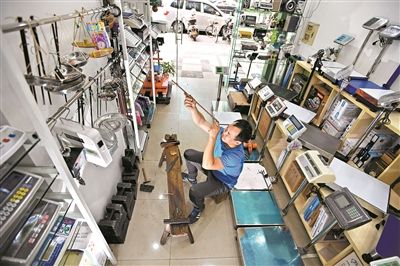
Master mackenzie's store has various scales。
It's the hardest and most important thing to do。
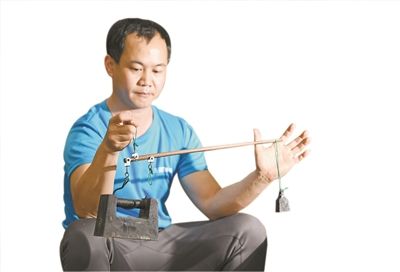
Master mackenzie says that being a man is a matter of weight, so be strict with yourself。
If you need a statement from your family that you can go into a supermarket or get a net purchase with a full-blown electronic scale, you can buy a cheap few dozen dollars. Today, in the direction of electronic precision instruments, a long wooden pole with a black and dark scale has long been out of the lives of the vast majority of people. In the next few decades, can children understand the meaning of the word “scale” when they read the words “the human heart is the balance” in literature? Will the practice of the pearl triangle, in some parts of the world, of placing a weight on the wedding with the blessing of the new man, the “supposition of the scale” continue to prevail
In a pristine street shop in mount sun-de-dang, the craftsman mcshinyan used his 60-year insistence and that of his father-in-law to tell us that, at least now, the traditional scale of china is still there。
In a small street in the vicinity of the sundyna bell building park, the passers-by always looked out for its sign, with only one word — “scale”. It's no mistake. It's an old shop in modern cities where hand-made scales are already rare. There's a craftsman in the store who insists on hand-made scales. Twelve years; if the time of his master's scales was added, the two students insisted on the scales for more than 60 years。
In his counters and shops, he was covered with various scales. Mackenzie said that a good scale of wood, even with the years of grinding, will not change its accuracy and accuracy, just as a human being's good faith carries with it life. More importantly, china's traditional scales are “carriers” of its excellent culture. Mr. Ban, vice-president of the guangdong association of collectors, said that, while the electronic scales had a great advantage over the traditional scales, they still had a great “real cultural significance and would not easily disappear”。
Learn to weigh it: it's been bleeding to five fingers
Yesterday, journalists met mcshenliang at the scale shop. “the manufacture of hand-held wooden scales requires dozens of tools and more than 10 processes to complete.” according to mackenzie, traditional manual scale processes are complex, including selection materials, milling, rounding, copper-sets, eye knocks, and school scales. “... The logs of scale are also very well chosen, and all i have chosen are the logs of kuntian, which are harder and less likely to affect the quality of the scale.”
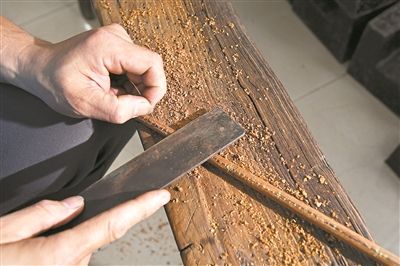
Come on, he pulls out a big, small scale stick from a tool rack on the side of the wall, scratches it again and again with the tools, and from time to time picks it up and looks at it. "the scales must be rounded to the point where they can slide to the point." according to mackenzie, each process of hand-made scales requires fine sculpture and fineness, and does not allow for a half-heartedness. The scale of wood is a test of patience, focus and accuracy, and master mac said, “the pole must be flat, straight, and tactful when it is done, and mistakes are made when there is little attention”
One of the most difficult and important steps in the scale is drilling holes and points of “scale stars”: first, drawing a straight line from the end to the end of the scale, then drilling a small hole in the line, according to the prescribed criteria, inserting a thin line of aluminium in the hole, cutting the aluminium wire with a “fast knife” specially used for the calibration, and then hitting it gently, leaving a “scale star” on the scale。
It is understood that the scale, whether large or small, drills more than 600 small eyes and nails more than 600 star eyes on the scale, and that if the eyes do not go straight, the calibration does not go straight, which directly affects the accuracy of the scale. Mcshellian said that it was all hand-made and had to be done with one breath, and that each one of them had a small slip, and the scales had a deviation. "the scales, the pens, are different from the scales that the masters have set." he pointed at the scale and said to the press, “look at the pen, you know who made the scale”。
However, the scale is not easy. At the beginning of his encounter with the scale, mcshellian also suffered a lot. Because you don't know how to push, it's normal to scratch a pole for more than an hour, often with a pain in the finger; you drill a hole when you click a “scale,” and you bleed when you don't look at it, “i used to have five fingers attached to the stop and cut my hands when you cut the line.” and sometimes, because of an error in a process, the entire scale has to be done from scratch。
The scale is like the heart: learn to be human
When it comes to learning to weigh hand, it starts with mrs. Long. “it was only after meeting her that she knew her father was a weigher, 48 years ago, and i admire it.” mcshellian, who has been a child of hands-on modelling, has taken over the hand-made scale. The master-in-law, who taught mcshenliang, praised him for his "the spirituality of learning to weigh, and he became a teacher in less than two years."
The master of dragons, who made the scale of the scale, witnessed the "failure" of the scale. “when the reforms have opened up, families need to have a few scales, when business is good and 20 or 30 scales are made a day”. It was the “gold age” of hand-made scales, and since 2000, as electronic scales became more widespread, hand-made wooden scales were almost lost to the historical stage。
The scale, which has been in china for more than 2,000 years, has been a necessary countermeasure for civil society. “the logstick scales have been used in civil society since the time of the qin dynasty's unification of measures”. The historical origins of the scale of wood are as many janes as mcshenliang and master dragon. “the scale of wood is divided into large, medium and small models by the length of the scale and the size of the scales. Large scale scales typically weigh 150 kg, and the smallest scales are mostly used in chinese pharmacies to catch chinese medicine.” and at mackenzie's counterware store, these scales can be seen in different sizes。
In the 12 years of making the scales, mackenzie believed that he would be more patient, more focused and, in the process of subduing, he would learn the true meaning of being human, that the scales would have a “pinning effect” and that “the process of making the scales would also reflect the spirit of honesty, hard work and perseverance of the people of the right faith”. Mcshellian smiles, “in education, i also ask children to be as strict and as careful as they are in scales, and to be generous in the delivery of goods”。
Despite the fact that few people are now buying scales, mcshenliang insists on making it manually and on maintaining the sincerity of a craftsman. In his view, every scale sold represented trust and integrity. In addition, he hopes that young blood will be involved and that the practice will continue and be recognized by more people。
Expert: manual scale has "many relevance"
Apart from very few places, such as traditional chinese medicine in drawer-type counter scales, manual scales are in modern society, comparing precise and convenient electronic scales with no advantages。
However, in the eyes of experts, there are still many “relevances” to the scale of hand-held scale, which, according to a fellow student of the guangdong association of collectors, is in the beads language culture, as well as the term “balance” in chinese culture; in terms of the meaning of collection, the scale of hand-held poles is now generally no more than a hundred yuan renminbi, but there are many “doorways” in which “the star-point font on the scale, for example, is a different type of chinese writing font, a good scale, and, together with the star-point font, each is unique and has a significant collection value”
The chinese traditional culture, which is carried by hand-bar scales, is more important to his son. These words, which we know well, are based on china’s traditional scales, “if one day the chinese scales are lost, how should we explain them to our children?” pan continues to say. In some areas of the pearl triangle, folklore also relies on scales, and journalists have learned that marriage in nakayama prefers a chinese scale for a “wedding” and that the meaning of “the scale” is a blessing。
Mr. Pan concluded by saying that mcshen liang's insistence was commendable and that “there will be good returns in the future to the rare chinese trader”