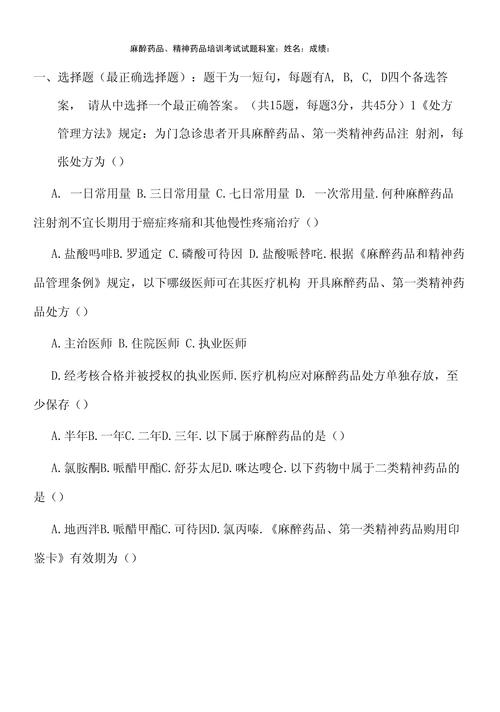
The following is the answer for a. Tramadol b. Caffeine c. Fentanyl d. Methamphetamine: c. Fentanyl is a typical narcotic drug, which has a strong sting effect and is used clinically for surgery, etc. Tramadol belongs to the second group of psychopharmaceuticals; caffeine is also the second group of psychopharmaceuticals; and metamine is used mainly for migraines, etc., and is not a narcotic drug. 2. Psychiatry is classified into categories i and ii, based on () a. The price of the drug from source b. C. The answer to the chemical nature of the drug d. To the extent that the drug produces human dependence and endangers human health: c. Depending on the degree of dependence that drugs produce and the risk to human health, psychopharmaceuticals are classified into categories i and ii, with the first category being relatively more dependent and hazardous. 3. Medically toxic drugs are () a. Drugs which, after continuous use, are susceptible to physical dependence, b., which is highly toxic, treats at a comparable dose to the dose of poisoning, c., which uses inappropriate drugs that can cause poisoning or death to the central nervous system, excites or inhibits it, d., which acts on the outer nervous system, excites it or inhibits it, and b, the answer to the continuous use of drugs that can generate dependence. This is the definition of a medically toxic drug, highlighting its acute toxicity and the similarity of the dose of treatment and dose of poisoning. Option a describes narcotic drugs; option c describes psychotropic substances. 4. Which of the following drugs is not the answer of the pharmaceutical group a. Ephedrine b. Pseudoephedrine c. Nucleine d. Diazine: d. Texipan is the second type of psychopharmaceutical and is not a drug-preventable chemical. Ephedrine, pseudoephedrine and radine are all drug-prone chemicals that can be used in the illicit manufacture of drugs. The conditions that should be met by the targeted wholesale enterprise for narcotic drugs and the first category of psychotropic substances do not include (a) a. B. Capable of managing enterprise safety through the network and reporting operational information to the drug supervisory authority, c. Unit and its staff for a period of three years, act d. Capability of guaranteeing the supply of narcotic drugs and type i psychotropic substances required by medical institutions in the area of responsibility, in violation of the legal and administrative regulations governing drugs: c. The unit and its staff should have acted within two years without violating the provisions of the law and administrative regulations on drug control, rather than three years, so option c was wrong. Other options are the conditions that should be met by the targeted wholesale enterprise. 6. The requirement not required for medical institutions to obtain a stamp is (a) a. B., a full-time narcotics and type i psychopharmaceutical manager. C., a medical practitioner qualified for prescription of narcotic drugs and type i psychotropic substances. C., a facility and management system to ensure the safe storage of narcotic drugs and type i psychotropic substances. D., an answer to a clinical subject related to the use of narcotic drugs and type i psychotropic substances: d. Medical institutions require, inter alia, specialized drug and group i psychiatric managers, medical practitioners qualified for prescriptions for narcotic drugs and group i psychotropic substances, facilities and regulatory systems that guarantee the safe storage of narcotic drugs and group i psychotropic substances, as well as clinical subjects related to the use of narcotic drugs and group i psychotropic substances. 7. As regards storage management of units used for narcotic drugs and type i psychotropic substances, it is wrong to say that () a. Should have a special bank or a special storeroom for b. Should have an anti-piracy facility and an alarm c. Should have a safe d. Collection and an exclusive counter should have a single-man locking answer: d. Repository and counters should have double-lock management, not single-lock management, so option d is wrong. Other options are the correct storage management requirements. 8. The prescription dose of a medically toxic drug should not exceed () the a. 1-day b. 2-day extreme and the d. 5-day extreme: b. The prescription dose for medically toxic drugs should not exceed the 2-day limit to ensure safe use. 9. Pharmaceutical-based production enterprises, businesses and pharmaceutical-based production enterprises that use pharmaceutical-based production-oriented chemicals should establish a special account book for pharmaceutical-based preparations for toxic chemicals, which should be kept for a period of not less than () (a) b. 2 year c. 3 year d. 5 year answer: (b) from the date of expiry of a pharmaceutical-based chemical. Dedicated books should be kept for not less than two years from the date of expiry of the life of the drug-based vulnerable chemicals, facilitating the traceability and regulation of the movement of drug-based vulnerable chemicals. 10. Print paper for prescriptions for narcotic drugs and type i psychotropic drugs is () a. Light red b. Light yellow c. Light green d. White answer: a. The printing of prescriptions for narcotic drugs and the first category of psychotropic substances is in light red and the top right corner is marked with “magne, precision” to facilitate the distinction between different types of prescriptions. 11. With regard to type ii psychotropic drugs, the following statement is correct: (a) a. Can sell b. To minors in pharmacies, and c. Prescriptions can be sold to minors for one year. D. Transportation does not require proof of transport: a. Type ii psychopharmaceuticals can be retailed on prescriptions issued by medical practitioners in authorized drug retail enterprises, option a is correct. Type ii psychotropic substances may not be sold to minors; prescriptions should be available for two years; the transport of type ii psychotropic substances requires corresponding proof of transport. 12. The acquisition and operation of toxic drugs is the responsibility of the drug operators designated by the following departments: (a) a. General directorate of national food and drug control, b. Provincial food and drug control administration, c. Municipal food and drug monitoring administration, d. District food and drug monitoring administration, b. The acquisition and operation of toxic drugs is the responsibility of the drug operators designated by the provincial food and drug supervisory authority. 13. If a medical institution requires the use of narcotic drugs and type i psychotropic substances, it shall obtain, with the approval of the health authorities of the people's government, the answer at the municipal level, d. County level, of the “class for the purchase of narcotic drugs, group i psychotropic substances” (a). If a medical institution requires the use of narcotic drugs and type i psychotropic substances, it shall obtain a medical certificate for the purchase of narcotic drugs, group i psychotropic substances, with the approval of the health authorities of the people's government at the district level. 14. The following is not a case of abuse of narcotic drugs and psychotropic substances () a. The medically prescribed use of narcotic drugs for pain relief b. The non-medical use of narcotic drugs c. Self-additional increases in the use of psychopharmaceutical drugs d. Reuse of psychopharmaceutical drugs in pursuit of pleasure: a. The medically prescribed use of narcotic drugs for pain relief was a legitimate medical use and was not an abuse. Use for non-medical purposes, self-inflicted dosage, repeated use in pursuit of pleasure, etc. Are among the abuses of narcotic drugs and psychotropic substances. 15. A licence to purchase a drug-prone chemical is valid as () a. 1 month b. 3 month c. 6 month d. 1 year answer: b. Licences for the purchase of drug-prone chemicals are valid for three months and require the completion of related operations, such as purchases, during their validity. Ii. Multiple choice questions (3 points per question, 30 points). 1. Special drugs include () a. Narcotic drug b. Psychiatry c. Medical toxicity d. Answers for drug-prone chemicals: abcd. Special drugs are narcotic drugs, psychotropic substances, toxic pharmaceutical products for medical use and chemicals such as drugs that are vulnerable to poisoning, which are subject to special requirements and regulations. 2. The following is in the first group of psychopharmaceuticals: (a) a. Triramid b. Clostamine c. Asterogen d. Buprenorphine answer: abd. Triazolam, ketamine and buprenorphine belong to the first group of psychotropic substances. Assron is the second type of psychopharmaceutical. 3. The unit for the use of narcotic drugs and group i psychotropic substances, when purchasing them, should () (a) purchase b. From the point production firm, c. Purchase of d. Fill in the answer to the request form for the purchase of narcotic drugs and group i psychotropic substances, bcd, with the c. Purchase of narcotic drugs and group i psychotropic substances with the c. The units used for narcotic drugs and the first category of psychotropic substances cannot be purchased directly from the designated producer, but should be purchased from the scheduled wholesale enterprise, and must be purchased using the " drugs and psychotropic substances in the first category " , which is supplemented by a " request for procurement of narcotic drugs and group i psychotropic substances " . 4. The management of medically toxic drugs should be strictly enforced. () a. Is exclusively responsible for b. With a lock on c. Dedicated book d. Specialized prescription answer: abcd. Medically toxic drug management should strictly enforce systems of personal responsibility, locking of cabinets, special books, special prescriptions, etc. To ensure safe use of toxic drugs. The regulatory requirements for drug-prone chemicals include () a. The establishment of a special account book b. Double-lock management for the sale of c. Two-party signature system d. Transportation has a specific transport certificate answer: abcd. The management of drug-prone chemicals requires the establishment of specialized books, double-lock management of stockpiles, a dual-signature system for sales and a specific transport certificate to prevent them from entering illegal channels。6. As regards prescriptions for narcotic drugs and psychotropic substances, it is true that (a) a. Medical practitioners should use special prescriptions for prescriptions for narcotic drugs and psychotropic substances b. For prescriptions for narcotic drugs and group i psychotropic substances, the person making the prescriptions should be carefully checked, signed, and the prescriptions for c. Narcotic drugs and group i psychotropic substances should be registered as a single dose of d. Category ii psychotropic substances, generally not exceeding 7 days ' answer: abcd. That is correct. Medical practitioners are required to make special prescriptions; assigners, checkers are required to check carefully and register; prescriptions for narcotic drugs and type i psychotropic substances are prescribed as a single dose; and prescriptions for type ii psychotropic substances generally do not exceed seven days. Among the security measures to be taken by medical institutions in the management of narcotic drugs and type i psychotropic substances is () a. The installation of a specialized gate b. The installation of alarm c. The installation of safe d. The answer to the control system: abcd. In the management of narcotic drugs and type i psychotropic substances, medical facilities should be equipped with specialized anti-piracy doors, alarm devices, safes and security measures such as a monitoring system to ensure the safe storage and use of medicines. 8. The following cases are in violation of the special drug regulations: a. Failure to purchase, store or store narcotic drugs and type i psychotropic substances, b. Failure to maintain special prescriptions for narcotic drugs and psychotropic substances, c. Failure to report the import, inventory, use of quantity d. Downsale, transfer, lease, loan, alter the answer to its exclusive licence: accd. These are violations of special drug regulations and are punishable accordingly. 9. The operators and users of mental medicines prohibit () a. Overdose sales of mental drugs b. Sales of psychotropic substances c. Sales of psychotropic substances d. Unauthorized psychopharmaceutical answers to minors without a pharmaceutical production licence b. The operation and use of psychopharmaceutical drugs in establishments is prohibited, such as overdose sales, sales to unlicensed establishments, sales to minors and unauthorized transfers of psychotropic substances. 10. Intoxication first aid measures for medically toxic drugs include () a. Catalysing b. Stomach c. Analytic d. Application of antitoxin answers: abcd. First aid measures for medically toxic drugs include vomiting, gastric washing, cavity to reduce the absorption of poisons, and the application of antidotes according to the nature of the poison. 1. Experimental research units for narcotic drugs and psychotropic substances may carry out their own research without the need for authorization. Answer: wrong. The laboratory research unit for narcotic drugs and psychotropic substances carries out the relevant experimental research activities, which require the approval of the national directorate of food and drug control. 2. Medical institutions may return narcotic drugs and group i psychotropic substances to targeted wholesale enterprises. Answer: correct. If there are any remaining narcotic drugs and type i psychotropic substances in a medical facility, they can be returned to the targeted wholesale enterprise as required. 3. The manufacturer of a medically toxic drug may sell its own poison. Answer: wrong. The manufacturer of medically toxic drugs is responsible for the acquisition and operation of drugs by the designated drug operator and cannot sell them on its own. 4. Manufacturers of drug-prone chemicals may sell them to unlicensed establishments. Answer: wrong. Pharmaceutical-based producers of toxic chemicals can only sell them to licensed purchasers to prevent their diversion to illicit channels. 5. Prescription of narcotic drugs and group i psychotropic substances is granted by the committee on drug management and drug therapeutics of medical institutions. Answer: wrong. Prescription rights for narcotic drugs and the first category of psychotropic substances are provided by medical institutions with the required training of medical practitioners in the knowledge and regulatory management of the use of narcotic drugs and psychotropic substances, which are certified and certified. 6. Retailing enterprises for type ii psychotropic drugs may sell type ii psychotropic substances without prescription. Answer: wrong. Retail enterprises for type ii psychotropic drugs are required to sell type ii psychotropic substances on prescriptions issued by medical practitioners. 7. Medical institutions shall register expired and damaged narcotic drugs and psychotropic substances and apply to the district-level drug supervision authorities in the locality for their destruction. Answer: correct. This procedure shall be followed in medical institutions for the treatment of expired or damaged narcotic drugs and psychotropic substances. 8. Poisons shall be marked on packagings of toxins. Answer: correct. Toxics must be marked on packagings of toxic drugs to alert users. 9. Transport enterprises for narcotic drugs and psychotropic substances may not have the corresponding transport qualifications. Answer: wrong. Facilities for the transport of narcotic drugs and psychotropic substances must have the appropriate transport qualifications to ensure the safety of the transport process. 10. The production, operation and purchase of drug-prone chemicals are not subject to supervision by the pharmaceutical supervisory authority. Answer: wrong. The production, operation and purchase of drug-prone chemicals are subject to supervision by the drug regulatory authority to prevent their diversion into illicit channels. Brief answers (10 points each, totalling 20 points) 1. Briefly describe the “five-part” management elements of narcotic drugs and group i psychotropic substances. Response: the “five specialized” management of narcotic drugs and category i psychotropic substances is as follows: - responsible for: designated persons responsible for the procurement, storage, custody, distribution, allocation and use of narcotic drugs and category i psychotropic substances, clarifying their responsibilities and ensuring their professionalism and accuracy. - locked cabinets: narcotic drugs and type i psychotropic substances are stored in specialized cabinets, which are equipped with safes and are managed by double-locks, and only responsible specialists are allowed to open and operate as required. - special accounts: a special account is established to record in detail the quantities, dates, batch numbers, usage units, names of patients, etc. Of the warehouses of access to narcotic drugs and type i psychotropic substances, in order to keep the accounts in line and facilitate traceability and monitoring. - special prescriptions: special prescriptions for narcotic drugs and the first category of psychotropic substances are used, the format and content of prescriptions are strictly regulated, and doctors must be trained and given the right to prescribe them, and they must be properly preserved. - register of the use of narcotic drugs and type i psychotropic substances, including the name of the patient, age, sex, diagnosis, drug name, dose, method of use, date of use, etc., in order to measure and analyse the use of drugs and prevent their abuse. 2. Description of key points for management of the use of toxic drugs for medical purposes. Response: the main points of management of the use of medically toxic drugs are as follows: - prescription management: medically toxic drugs must be supplied and allocated on the basis of an official prescription signed by a doctor. When prescriptions for toxic drugs are issued by a medical practitioner, the dose should be strictly controlled in accordance with medical needs, and the prescription should not exceed a maximum of 2 days per dose. The prescription shall be maintained for a period of two years. - management of redeployments: the transfer of prescriptions must be carried out with careful responsibility, accurate measurement and medical specifications. For a prescription that does not indicate a “basic” toxicant, the gunpowder should be paid. If the prescription is found to be in doubt, it must be re-evaluated by the original prescription physician. - supply management: the acquisition and operation of toxic medicines for medical purposes is the responsibility of the drug operators designated by the various levels of the medical administration; the formulation is the responsibility of the state pharmacy and the medical unit。any other unit or individual