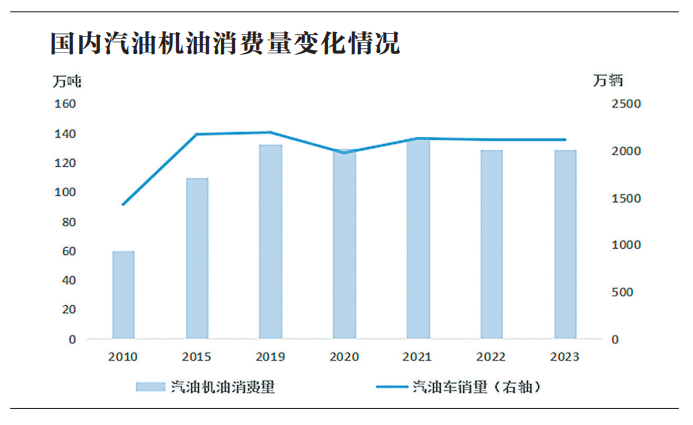
The demand for lubricant oils is closely linked to the volatility of economic growth, with lower car movements in 2022 and epidemic control, and reduced the consumption of sunken lubricant oils to 6. 37 million tons, a 3. 7 per cent decrease from the previous year, returning to the level of 6. 3 to 6. 5 million tons during the platform period。
At the same time, high costs have driven the price of lubricating oil to upwards and the overall lubricating market has shown a downward trend in profit margins。
Breaking through difficult conditions, critical to development features and high-end basic oils, has actively expanded the marketing channels for lubricant products。
The text was provided by yang morning
Trail one, sales down
The steady decline in car sales has resulted in negative fuel growth for fuelwood
The rate of increase in the holdings of petrol vehicles continued to decline and to slow down the consumption of petrol oil. Of the approximately 2,686 million vehicles sold in 2022, an increase of 5. 3 per cent over the previous year, 1,711,000 were sold as petrol vehicles, a decrease of 2 per cent from the previous year; the recurrent impact of the epidemic was limited in the area of residential and tourist travel, which made it difficult to increase the mileage, and the consumption of petrol oil fell by 5. 5 per cent, or 1. 29 million tons, almost at 2020 levels。
Consumption of diesel oil declined slightly. New energy alternatives and highway restriction policies have been combined, with 2. 03 million diesel vehicles sold, a decrease of 0. 7 per cent over the same period, an average annual reduction of 0. 4 per cent in the mileage of diesel vehicles by 2017-2022, a 5. 6 per cent decline in diesel oil consumption and a decrease in consumption to 1. 32 million tons by 2022。
Traffic oil consumption continues to be in a slow decline. In 2022, 3. 42 million tons of lubricant were used for transport, a 4. 3 per cent decrease from the previous year. The trend towards the electro-mobilization of transport tools has affected the expansion of diesel-fuel machinery, combined with the longer oil-replacement cycle associated with the improvement of the quality of lubricating oils, which began in 2018 with a slow downing of transport oil, with only a slight increase in consumption in 2021 and continued to enter a smooth downlink in 2022. The consumption of motorbike, boat and rail lubricants decreased by 7. 9 per cent, 0. 8 per cent and 2. 7 per cent, respectively, in 2022。
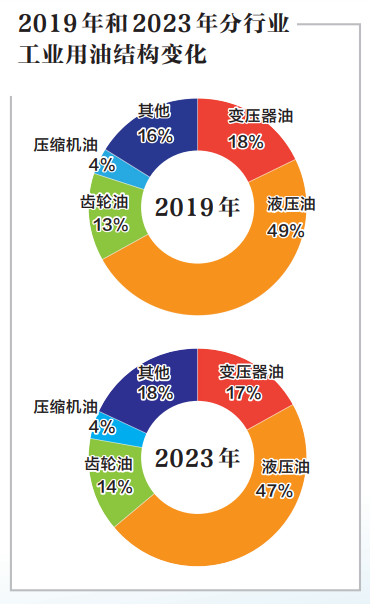
The unexpected slowdown in economic growth led to the first decline in industrial oil use in seven years
The slowdown in economic growth affected industrial oil use. Gross domestic product (GDP) growth in 2022 was higher than expected and significantly lower than in 2020 and 2021, with industrial value added falling by 6 percentage points to 3. 6 per cent from 2021 and only slightly above 2020. Industrial lubricants were hit, with an estimated consumption of 2. 63 million tons in 2022, a decrease of 3 per cent from the previous year and the first since 2015。
The impact of the engineering and machinery industry has been greatest. From the downstream industry, the engineering and machinery industry accounted for the largest share of lubricants and the industry with the largest decline in lubricants in 2022, with consumption of 1. 03 million tons, a 4. 5 per cent decrease from the previous year. Capital and real estate investments in 2022 fell short of expectations, the need for engineering machinery was weaker and the number of hours of operation of the mainframe plant equipment was lower; the excavators also went down the boom cycle starting in 2017, with a 25 per cent reduction in sales。
Tragedy two, profit drops
Rising costs drive up the price of lubricants. In 2022, the price of our base oils rose by 40 per cent, from $7114 per ton in january to $9970 per ton in november. Lubricating oil producers have repeatedly issued price increases driven by various cost increases, including higher prices for base oil and rising transport costs. Market prices for lubricating oil began to rise in february 2022, especially in the case of industrial oil prices, which were relatively relevant to the price of base oil, with some brands having posted 4-5 price increases in the first half of the year, with a cumulative increase of 30 to 50 per cent and an average rise of 20 to 30 per cent across brands. In 2023, basic oil prices declined with oil prices, but remained at a high level of 9,000 yuan/t, making it difficult for the prices of lubricants to fall back。
The domestic lubricant industry as a whole has seen a narrow margin of profit. It is difficult for industrial lubricant users and car lubricant users to fully absorb the effects of the increase in the price of raw materials in the context of the chain of raw materials production, lubricant producers, and the entire lubricant market has shown a downward trend in profit margins. In 2022, domestic profits on basic oil installations were around $140 per ton, a decline of 70 per cent compared to 2021 and a marked decline in profits. At the same time, logistical transport costs, storage costs and distribution cost pressures have increased during the post-epidemic period, and transport stress and freight costs have been further exacerbated by special regulations for overload transport vehicles and for dangerous chemical transport vehicles. The increase in the price of diesel fuel has also resulted in the spread of the cost of transport, exacerbating the cost of logistics transport. Moreover, our country has announced its efforts to achieve carbon emissions by 2030 and to achieve carbon neutrality by 2060, and the “bicarbon” policy has imposed more stringent demands on the quality of lubricants products。
It's gonna be a fast-growing phase
Characteristics and high-end base oils will lead to rapid development
It is projected that primary oil production will remain unchanged overall in 2023, with production increasing by 100,000 tons to 4. 3 million tons, mainly from increases in primary oil production in categories ii and iii and above。
The search for variables in constant terms requires greater attention to the production and use of specialty base oils. In the light of the demand for basic oils in the light of the development of lubricants, the intensive propulsion and discharge and energy-saving requirements of new energy vehicles, which are under pressure from quality upgrading and low viscosity, low viscosity requires more use of base oils in iii4/iii+4; industrial machinery and machinery have a trend towards precision and electrodynamicization, and high-quality gear oils, bunker oils, lubricants, etc., still require the use of heavy-quality base oils of type i, such as 750sn, 900sn, bs, and, in particular, high-composite bs。
Lubricant products moving towards high-quality, customized, low-carbon
The lubricant industry faces two paths to industrial upgrading and the development of new and emerging industries. It needs to meet the demand for ready conversion of product lines, the adjustment of “high-quality” lubricant oil, and customer “tailored” lubricant products; the need to meet low-carbon emissions, reduce waste and reduce efficiency; the need for modern and efficient production units adapted to high levels of automation; and the need to diversify the quality of lubricating oil in high-end vehicles and smart precision equipment in emerging industries。
China's petrochemicalization has continued to push forward the “three new” strategy, accelerating the breakthrough of new high-end lubricant oil and grease technologies and materials in new and emerging areas, accelerating the transformation of autonomous technologies and leading to the continuous upgrading and upgrading of industrial chain development. In the context of the rapid development of the new energy industry, the great wall lubricant has also introduced a range of products to accompany new energy vehicles, wind power, photovoltaics and hydrogen energy. Based on the precision temperature control of power cells and new safety needs, the introduction of electric car heated fluids, special brake fluids for new energy vehicles and other new energy vehicle oil technology and products provides technical support for the autonomous and safe development of new energy vehicles in china。
Rapid development of new energy vehicles drives engine oil in the direction of low viscosity
High-end sedan engine oil is low in viscosity. As emissions and energy-saving requirements continue to rise, car oil is under pressure to upgrade quality and lower viscosity. More than 10 automobile companies, such as toyota, mercedes and ford, have invited lubricating oil companies to simultaneously develop a new generation of engine oils such as 0w20, 0w16 and 0w8, all of which require the use of base oils of iii+4 (more than 130). The production of base oils in iii+4 is more demanding for raw materials and, in the case of foreign companies, requires the use of high waxy paraffin-based crude oil (e. G., national petroleum malaysia, sk indonesia joint venture, etc.)。
The development of new energy vehicles promotes the research and use of dedicated lubricants. China's new energy vehicle sales are projected at 9. 4 million in 2023, an increase of 34 per cent over the previous year, and the penetration of new energy vehicles has increased from 28 per cent in 2022 to 34 per cent. New energy car fuel transformer oil will be a very important part of the increase in the car lubricants market, with demand of approximately 16,000 tons, representing about 15 per cent of the total tank oil。
Industrial lubricant towards long-lived life
China's hydraulic fluids are moving in the direction of long-lived, high-environmental conditions. The main areas of hydraulic oil applications include engineering machinery, metallurgical, apostille machinery, machine beds, petrochemicals, auto manufacturing, agro-machinery, aerospace, etc. With the development of hydraulic equipment and increased market requirements for environmental protection, safety, etc., the market's demand for long-lived hydraulic fluids, ultra-high-pressure resistant hydraulic fluids, ultra-low-temperature hydraulic fluids, energy-efficient hydraulic fluids, environmentally friendly hydraulic fluids and food-grade hydraulic fluids has gradually increased。
Gear oils are moving in the direction of stress resistance and longevity. As industrial gear moves in the direction of small size, light weight, high-speed heavy load and high power, industrial gear oil, which is a key component of gear design, requires wider use temperatures, better extreme pressure resistance and longer service life。
There's still a lot of room for the extension of lubricant products
Online upscaling of vehicle maintenance operations needs to be improved. In 2022, there was a low-end high-end substitution of national product plates and a trend towards national production substitution imports, and it is expected that the share of national product plates will continue to increase. Maintenance operations in front-line cities have increased by 19 per cent, in the second and third-line cities by about 15 per cent, and in the fourth and fifth-line cities, where relatively low levels of access to high-end lubricant products remain largely open. The proportion of the consumer population is young, rising from 13. 9 per cent in 2019 to 18. 7 per cent in 2021, an increase of 4. 8 percentage points. As the national culture flourishes, consumer groups, which are dominated by young groups, will be increasingly recognized, dependent and loyal to the national product。
Exports will also be the direction of domestic product sales. In 2017-2022, our exports of lubricant products continued to increase, from 110,000 to 170,000 tons and our exports of basic oil from 40,000 to 150,000 tons. As the quality of oil produced domestically and the variety structure is improved, high-end domestic goods are not only competitive domestically, but are also regenerated by the impact on overseas markets and will become a new route for future sales of lubricants-related products。
China's petrochemical lubricating oil companies seized the opportunity to recover from the overseas market economy, firmly implemented the outreach development strategy and achieved a sustained and rapid expansion of their operations abroad。
Knowledge link
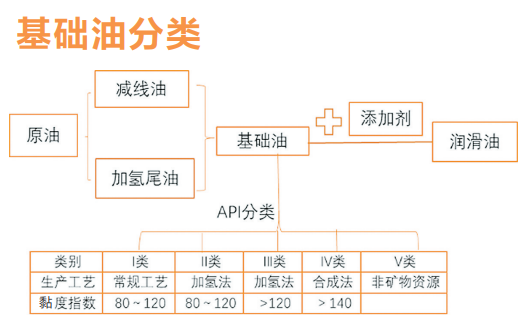
Basic oil classification
Lubricating oils are liquid or semi-solid lubricants used in various types of vehicles, mechanical equipment to reduce friction, protect machinery and processors, mainly for lubricating, auxiliary cooling, rustproofing, cleaning, sealing and buffering. The base oils are combined with additives, which account for 70% ~99%。
According to the api (american petroleum institute) classification criteria, the base oils can be classified into five categories, with performance optimized by grade, according to the viscosity index (the degree of viscosity with temperature changes)。
Need for oil companies to develop lubricants operations
In the middle of the nineteenth century, demand for lubricating oil increased with the development of steam-powered machinery fueled by coal, especially after the widespread application of combustion engines in the late nineteenth century, the supply of natural lubricating oil was no longer sufficient to meet total demand. It coincided with the time when oil was being developed and the production of petrol fuel was accompanied by the refining of oil-based mineral lubricants。
The refinery is supported by a variety of functional additives through its traditional primary oil production process, which produces lubricants that meet the lubrication requirements of machinery in the vast majority of cases at that time. The refining industry subsequently developed and applied the hydrogen-added basic oil production process, which allows the production of api ii and iii basic oils, in line with energy conservation and environmental trends in the automobile industry。
From the perspective of the refining industry, which is the blood centre of the modern industry, all the lubricants products required for its operation are indispensable. In contrast, lubricating oil also provides a substantial return on the benefits of refineries over a long period of time。
Lubricating oil is a recognized high-value-added and high-technology product, both for basic oil and lubricants. The profit returns from the production of base oils have long been higher than those from fuel, and companies such as chevron have been tracking the market prices of base oils and fuel oils for long periods of time, considering the marginal benefits of base oils to be significantly higher than the production of gasoline and diesel fuel for most of the time。
Most of the products of lubricating oil are profitable, especially small and highly skilled varieties. The oil used for stainless steel processing had been as high as rmb 375,000/t, a special sensor oil imported could be up to rmb 1 million/t, and the pacemaker's magnetic fluid seal oil could be up to rmb 100/g. Even with large quantities of engine oil, the maori is higher than diesel fuel。
Among oil products of oil companies, the market price volatility of lubricants is smaller than that of fuel oil varieties and is a stabilizer of the business economy. As a high-technology product, which is the only product produced by the refining industry that can be sold in supermarkets like ordinary commodities, lubricating oil can also have a significant brand effect on oil companies。
Importance of lubricants
Lubricose is an important category of petroleum products, producing only 2 per cent of crude oil processing, but with a wide variety of varieties and high quality performance requirements, and complex processing processes. According to the survey, about one third of the one-time energy needed for human activities is consumed by friction, with 80 per cent of equipment being worn out, and friction and wear usually account for 2 to 7 per cent of a country's GDP. In 5 per cent, the country's GDP in 2022 was 121. 020 trillion yuan, resulting in losses of 6. 05 trillion yuan for friction and wear. Lubricose oils can significantly reduce friction and contribute to energy conservation and depletion, which are essential for sustainable national economic and social development。