The status of the dow theory, which is considered to be the noose of market technology research, can be seen. Despite this, the doctrine has also been criticized by one of the opponents, but it has finally been recognized by many market figures as proof that the truth can stand the test. The dow theory consists mainly of three core ideas and five very valuable theorems. The core is derived from common market patterns, with the inference that the market is more straightforward。

The dow theory has three core ideas, namely, the doctrine of triple motion, the principle of mutual validation and the principle of speculation. And the doctrine of triple sport is called the core of the core and is one of my own important theoretical underpinnings and confidence in upholding value investments。
It's the first and third principle of core thinking
The dow theory divides market dynamics into three types of movements, basic, secondary and daily. Theoretically, the basic movement can be predicted, the secondary movement predicts that there is a certain probability that it will be “deceptive”, while the daily movement is rarely followed。
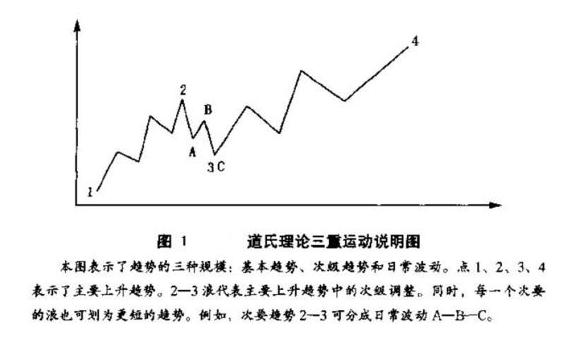
Core ii. Mutual validation principles
The principle of mutual validation, through relevance, validates the validity of conclusions, and the relationship between the market and our predictions, by recognizing the market and re-awareing it, constantly repeating the cycle of theory and practice. Validation is used to illustrate the correctness of projections and not to rely solely on one indicator or instrument to absoluteize market forecasts。
Core idea three. The theory of speculation
Markets already include our expectations of markets, our expectations being an integral part of them, and speculation is therefore an integral part of them. It can be said that markets can be predicted precisely because we are predicting markets, so the projections are projections。
The five theorems of dow's theory
The three-pronged logic of the five theorems, which revolve around the three core ideas, is an integrated application of the three ideas and a step-by-step approach. These include: three dynamic definitions, empty, multiple market definitions, empty markets and three stages, multiple markets and three stages, secondary regression definitions, etc。
Theorem i, short-term, medium-term, long-term trends
There are three trends in equity indices and in any market: short-term trends lasting from days to weeks; medium-term trends lasting from weeks to months; and long-term trends lasting from months to years. These three trends are bound to coexist in any market and may be in the opposite direction。
The operational principle is to look at long-term trends, to adjust medium-term trends and to find a good place to maximize results in the short term and not to change shares frequently。
Theorem ii, empty or multiple markets
Also referred to as the main trends (primary movements), which represent the general trend, commonly referred to as multiple or empty markets, which may last for less than a year or even years. The correct determination of the main trends is the most important factor in the success of speculative behaviour. There is no known method of predicting the duration of major trends。
For those involved in the stock market, 40 per cent of the success has been achieved, 70 per cent has been successful, and 30 per cent has been successful。
Theorem iii, empty markets and their three phases
The main empty market (primary bear markets) refers to long-term downward trends, which are mixed with important rebounds. It comes from a variety of adverse economic factors, and this trend will end only if equity prices fully reflect the worst possible situation。
The empty market is going through three main stages:
Phase i: market participants no longer expect stocks to sustain overinflated prices, which can be described as foaming periods;
(b) second stage: sales pressure is a recession reflecting the economic situation and the surplus of the enterprise, which can be described as a period of proof of recession;
Phase three: sales pressure is a disappointment pressure from sound stocks, and many people are eager to cash at least a portion of the stock, whatever its value, which could be called despair periods;
When there is some market experience, you can judge by some macro-indicators, historical statistics, etc., which stage is currently in the empty market and then begin to set up stocks during the desperate period, paying attention to the layout, not to the whole buy-in (non-mainstream perspective, it is the common practice of institutions to wait for the trend to be clearly reset and to consider themselves)。
Theorem iv, multiple markets and their three phases
The main multi-market (primary bull markets) refers to the multi-market as a holistic upward trend, with mixed secondary reversals, with an average duration longer than two years. During this period, investment and speculative demand increased and stock prices were pushed up as a result of improved economic conditions and increased speculative activity。
There are three main stages through which multiple markets can go:
Phase 1: people regain confidence in the future, known as the recovery period;
Phase ii: equity response to known corporate surplus improvement, known as the boom certification period;
Phase iii: speculation booms and a marked rise in stock prices - a period in which stock price increases are based on expectations and hopes, known as periods of speculation;
Theorem v, secondary regression
(a) secondary regressions, i. E., significant declines in multiple markets or significant increases in empty markets, usually lasting from three weeks to several months; the range of reversals during the period ranged from 33 per cent to 66 per cent of the main trend after the end of the previous regression。