The evaluation of property consists mainly of methods such as comparative law, income law, cost method, hypothetical development method, long-term trend method, etc. The first four methods are more commonly used in real estate valuation operations, and the latter is less used。
Let us briefly describe the meaning of these valuation methods and the circumstances applicable to them。
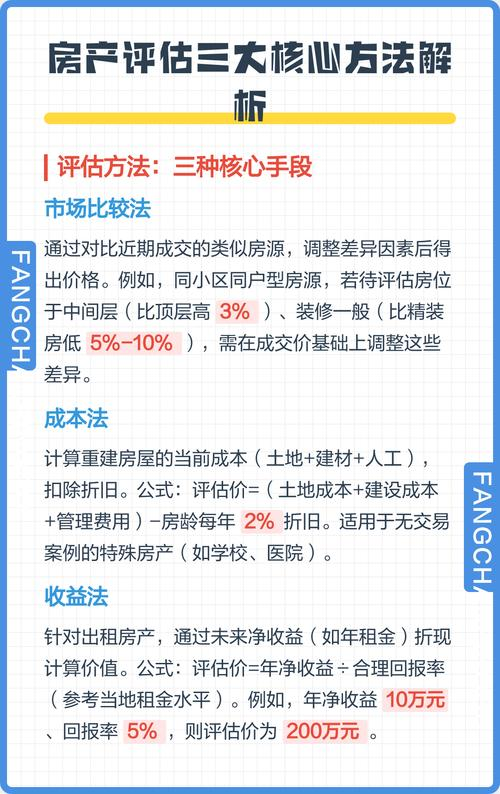
1. Comparative law:
It is the method by which the value or price of the object of valuation is obtained based on the traded price of the property similar to that of the object of valuation。

The comparative approach applies to real estate that is more numerous, often traded and comparable in the same type of property. It's like home, writing buildings, shops, etc。
Proceeds law:
It is the method by which the value or price of the object of valuation is derived based on the expected proceeds of the object of valuation。
The law of proceeds is generally used for profitable real estate: like writing buildings, shops, parking lots, gas stations, warehouses, etc。
3. Cost method:

It is the method by which the value or price of the object of valuation is derived based on its replacement or reconstruction costs。
For real estate, where there is little trade or no economic gain, such as schools, hospitals, libraries, parks, docks, etc。
4. Assumptions of development:
The rationale for this approach is the same as that of the law of proceeds, which is the principle of expectation, but is less used。
It is generally used for land available for development, construction in progress, redevelopment of property for upgrading or conversion。
In real estate evaluation practices, priority is given to the comparison method, which assesses the least price or value error, the most reference value and the simplest. Its basic formula is: the real estate valuation price = the transaction price after comparable examples have been established transaction correction factor x market condition adjustment factor x real estate condition adjustment factor。