(director, international intellectual property research centre, beijing university, professor, faculty of law)
It must be recognized that our internet platform enterprises, in the course of their development for more than two decades, have made an indelible contribution to the promotion and realization of national strategies, such as optimizing the allocation of resources, promoting cross-border integration and popular innovation, promoting industrial upgrading and expanding consumer markets, especially employment. In recent years, however, the number of disputes over intellectual property rights (iprs) between major platform enterprises has become equally numerous and should be pursued in good faith。
The current system of jurisdiction in civil proceedings in our country upholds the principle of duality: both by facilitating easy access to the proceedings and by facilitating the efficient conduct of proceedings and decisions by the people's courts. In this case, the principle of territorial jurisdiction to determine the jurisdiction of the competent court by place of residence or tort is a direct manifestation of the implementation of the “two-way principle” in the current system of jurisdiction。
In practice, however, some platforms have begun to seek a breakthrough on the “two-way principle” in an attempt to gain an undue advantage in litigation, by maliciously creating jurisdictions that do not otherwise exist. Typical examples of such acts include the false listing of defendants who have no real connection to the case, the establishment of specialized companies for the prosecution of a series of cases, the creation of false contractual links such as places of contract or performance, for example, by falsifying evidence, and the breaching of the level of jurisdictional limits through a high subject matter of litigation. The essence of the act, which appears to be a legitimate choice of competent courts, is a distortion of the legislative intent of the jurisdictional system and of its original functions, stemming from its main purpose of increasing the burden of litigation on the accused and impeding the exercise of his or her procedural rights, rather than achieving the convenience of the proceedings and facilitating the effective settlement of contentious disputes。
The prevailing view in the country's judicial practice regarding the actions of the plaintiff party in the civil action for intellectual property, which creates a link of jurisdiction and attempts to arbitrarily select the competent court, is a cautious one, as is evident from the part of the intellectual property representation case currently before the supreme people's court。
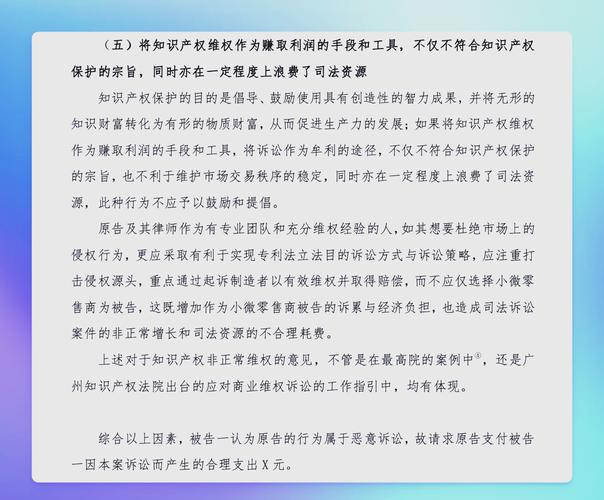
For example, the supreme people's court, in the jurisdictional objections to the irregular competition disputes between guangdong manel clothing co. Ltd., zhou lo lwin and nueva braun trading (china) ltd., and nanjing oriental business limited ltd., concluded in 2017, made it clear that the jurisdiction of the supreme people's court cannot be established in cases of infringement of intellectual property rights and cases of unfair competition by online purchase of the place of receipt of the goods. The case expounded the different controversial attributes of contract cases and cases of infringement of intellectual property rights and unfair competition, arguing that, in cases of infringement of intellectual property rights and unfair competition, the parties acquired the goods against which they had been charged by way of internet shopping, although formally distinct from “contracts of sale and purchase by means of information networks”, its claims of infringement were not only for this particular product, but for all the products of a particular right; they were also not only for the other party to the contract, but could be for the other party concerned with the product, which might constitute a violation under the law. Taking into account the above-mentioned differences, the supreme people's court ultimately requested that the competent court be redefined。
The result of the ruling is amply indicative of the affirmation and adherence by the highest judicial organ of our country to the general principle of territorial jurisdiction “to determine the competent court by place of residence of the accused or by tort”, which is not without inspiration for subsequent and effective regulation of the malicious creation of jurisdictional links by the business of the platform。
Since the revision of our civil procedure law in 2012, it has been made clear that civil proceedings should be based on the principle of good faith. In article 15 of the opinions of the supreme people's court on the further protection and regulation of the exercise of the right of persons to administrative litigation, issued by the supreme people's court in the field of administrative litigation, “abuse of the right to sue, malicious actions, etc.” has been clearly identified as the focus of the people's courts at all levels, since it crowds out judicial resources and also affects the normal exercise of the right of citizens, legal persons and organizations of illegal persons to sue, undermines the authority of the judiciary and impedes progress in the rule of law. In combination, in the area of civil action for intellectual property, the malicious creation by the platform enterprise of a jurisdictional link in order to obtain an undue advantage is clearly contrary to the principle of good faith in civil procedure law and constitutes an “abuse of the right to sue, malicious suit” and should be stopped and severely combated。
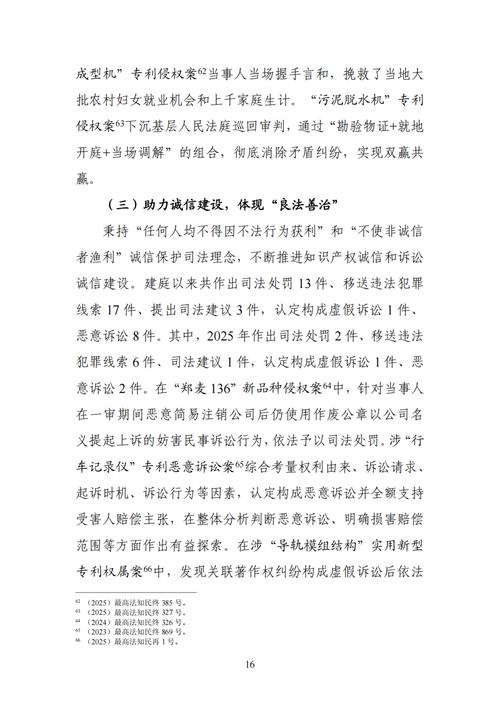
What, then, are the means by which internet platform enterprises should effectively regulate the malicious creation of unfaithful actions to govern connections in civil intellectual property cases? In the short term, people's courts at all levels should clarify the basic principles of jurisdiction and the corresponding rules through individual decisions, and refer cases, as appropriate, to specialized courts (such as the four major intellectual property courts and the three main internet courts) at the site of the enterprise against which they were brought, in order to maximize the centralized order of proceedings in cases involving the internet platform and to ensure uniformity in the application of the law in similar cases involving the internet platform。
In practice, in article 13 of the opinion on the comprehensive enhancement of judicial protection of intellectual property, issued by the supreme people's court in 2020, “enhanced rules governing disputes over intellectual property and the regulation of malicious procrastination of proceedings such as the creation of jurisdictional links and jurisdictional objections” has been clearly identified as one of the priorities of the courts of our people in the new period for the overall enhancement of intellectual property protection. In the long run, the consistent development of rules governing jurisdiction in intellectual property disputes involving web platforms at the authoritative level has led to a more precise interpretation of the basic principles and corresponding rules for the establishment of jurisdiction in such cases, with a view to ensuring uniformity and rigour in the application of the law in the cause of the governance of intellectual property rights in cyberspace, thus facilitating a more regulated, healthy and orderly trajectory of our internet platform enterprises. It is believed that, with the clear knowledge and continued impetus of the highest judicial organs in the country, the rules will be finalized。