


In international trade, letters of credit, collection and remittance are the three main payment modalities, which are linked and distinct. Today's article will introduce some of the common terminology related to foreign trade payments
L/c
L/c is the abbreviation of letter of credit that we often refer to in international trade. The letter of credit is a written guarantee issued by the issuing bank to the beneficiary, at the request of the applicant, for a specified amount, to be paid at the designated place within a specified period of time with the required documents. In short, the l/c is in essence a certificate of conditional liability of the bank to the seller on behalf of its client (i. E. The buyer). L/c is generally accepted by businessmen in various countries because of bank credit as a guarantee。
Example
Normally we coAs soon as we get there, we're gonna have to go back to workNo, it's not.
Normally, we use letters of credit for international sales because they can provide us with bank guarantees。
We prefer to have the payment made by a cI'm sorry, i'm sorry.
We would like to see payments made through the confirmed and irrevocable letters of credit。
Colletion
In the sense of “receipt”, this refers to a settlement whereby the exporter gives the document or other payment certificate, as well as the consignment note, to a bank in the place where it is located, entrusting the bank to collect money from the importer through the bank where the importer is located. In short, collection is a way for the seller to collect money from the buyer through the bank. D/p and d/a are two common terms associated with collection。
1. D/p
D/p is dAbbreviations for “payment orders”. Under the d/p formula, the importer cannot obtain the shipping documents until he has paid for the goods to the bank in which he is located (the collecting bank)。
Example
Absolutely, you said that pay is to be made by d/p, but this is not our practice.
You said earlier that the payment was made by payment orders, but we do not usually follow that approach。
We accept 60 days d/p if you guarantee the reconstruction of the buyers secured.
If you guarantee the reliability of the buyer in question, i can accept the 60-day forward payment order。
2. D/a
D/a is dThe abbreviation of documents against acceptance means "payment of the contract". Under the d/a modality, the importer can obtain the shipping documents only if he or she takes a pledge on a bill of exchange submitted by the exporter, and the importer makes a payment to the correspondent after the bill of exchange expires。
Example
I'm sorry, but we cannot accept d/a.
Sorry, we can't accept the receipt。
I think you can trust us and agree to pay by d/a.
I think you can trust us and agree to pay by way of a signed payment。
Remittance
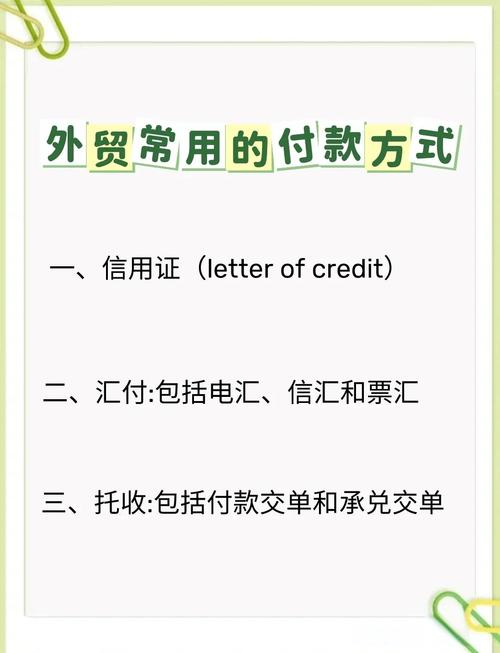
Remittance means “remittance” and refers to a settlement by which a bank accepts a client's (buyer's) assignment to deliver the money to the payee (seller) using the appropriate payment certificate, through the bank's own remittance network. In short, remittance is a way in which a buyer pays the seller through a bank. Remittances can be divided into m/t, t/t, d/d forms depending on the method of transfer of funds。
1. M/t
M/t is the abbreviation of mail transport, which means "message". In m/t, a transfer is made at the request of the sender, using an airmail instruction to send in and release a certain sum to the recipient。
Example
It will accommodate two days later by m/t.
If paid by mail, it would be available in two days。
You can decide if you take m/t accounting to your own needs.
You can decide whether to use a wire transfer according to your needs。
2. T/t
T/t is an abbreviation of telegraphic transport, meaning “twice transfer”. In t/t, a transfer is made on the application of the money remitter, by means of a wire transfer or swift (swift, in this case the financial telecommunications network it provides) to a transfer abroad, instructing it to release a certain amount to the payee。
Example
According to the company's reconstruction, you should pay by t/t.
According to the company, you should pay by wire transfer。
We ask for new customers.
We ask new customers to pay early by wire transfer。
3. D/d
D/d is the abbreviation for “remittance by banker's demand draft”. In d/d, remittances are carried out on the application of the money remitter, by a prompt bill of exchange issued by the bank from which the money transfer was made, by means of an outreach or proxy bank, which ordered the money to be paid to the payee designated on the bill of exchange or to the holder of the bill of exchange obtained through an endorsement by the payee。
Example
You can choose to pay by d/d if you want.
If you like, you can choose to pay by money transfer。
M/t, t/t, and d/d are all counted in this transport.
In this transaction, wire transfers, wire transfers and money orders are all methods of payment acceptable to us。



