If you want to continue seeing mr. Chen's original dry product, set my public name as the "star", or you won't see me
"why did i do the analysis of the data and the leadership dissatisfied?" is a problem that bothers many students. In particular, there are times when leaders are reluctant to “report too detailed and focused”. And sometimes the leader gets tired of saying, "it's too thick, you have to be careful."
The key is that data analysis is first and foremost a report with clear reporting logic. As for data, it merely made the report more credible and realistic. What are the common logics of reporting? Based on one's familiarity with the content of the report, there are seven types, one by one, as follows:
Type i: introduction reports
The introductory report applies to persons who are not aware of the situation and is used for their first reporting. The introductory report is generally structured in total points and presented from several angles. For example, a presentation of activities, some members and product lines. At this point, the reporting framework is as follows:
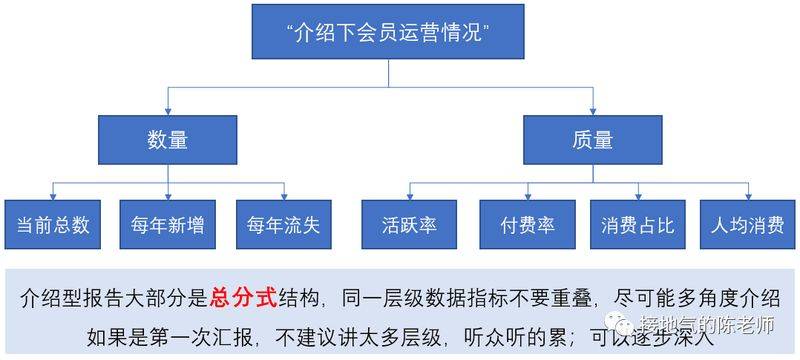
Note that many of the reports directed at the boss start with an introductory report, since the boss is likely not to know the details of the business, and needs to be clear from several angles. At this point, the indicators must not be too detailed, otherwise they would be “ununderstood” and “too thin”。
Type ii: surveillance reports
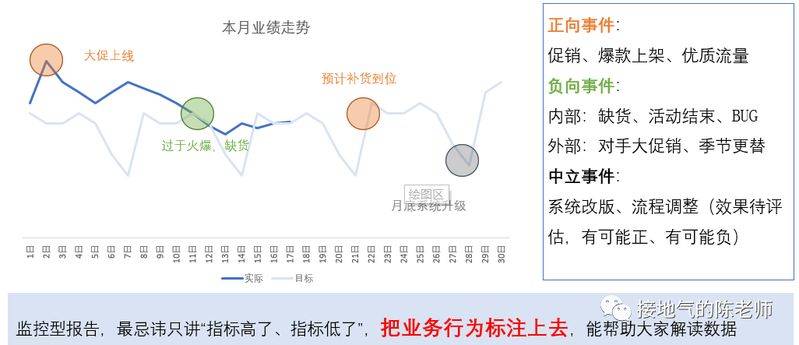
Monitoring reports are used to inform people with a certain level of knowledge of business developments. The content of the monitoring reports depends on the needs of the leaders, some of whom prefer nothing more, some of whom prefer to focus, and others who have less content and retain only key indicators。
The key to monitoring reports is to map trends in relation to operational actions. The most taboo feature of the surveillance report is the digital flow book: this week the ratio has increased by x per cent, the ring has increased by y per cent, the time rate by z per cent, the kpi completion rate by x per cent, and it is obvious that there is no conclusion at all. In making the monitoring report, it is important to monitor the correlation between fluctuations in indicators and specific business behaviour and to facilitate the judgement of those who read the report。
Type iii: exploratory report
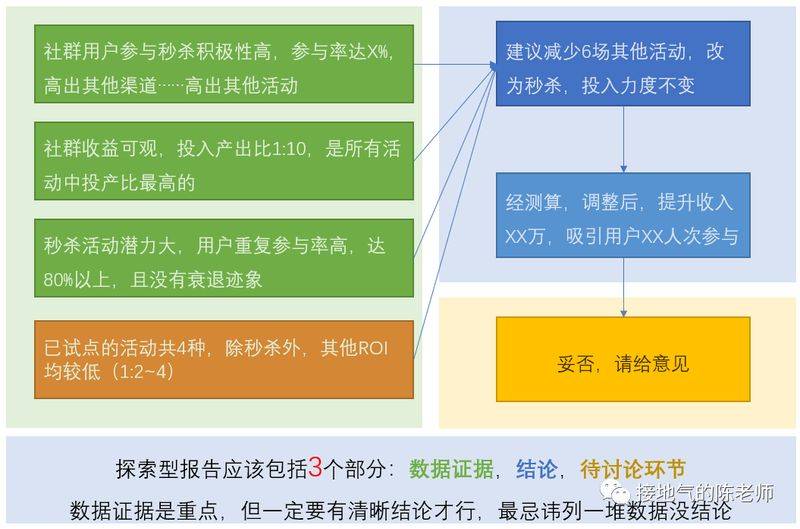
The exploratory report applies to those who have a certain level of knowledge and point the way forward. Note: this is a “tip”, a “recommendation”, not a conclusion. The exploratory report must therefore be more logical and explain the logical relationship between the data it had enumerated and the conclusions given. The final tips/recommendations are also based on solid data。
The logic of exploratory reports can be many, the simplest: positive or negative examples
1. Positive examples: operations with xx behaviour, performance improved
2. Inverse examples: business that did not perform xx acts with poorer performance
Recommendation: promote xx behaviour and improve overall performance
Of course, the more examples are available, the more compelling the case is
Type iv: diagnostic reports
The diagnostic report applies to those who already know the problem, explaining its causes. The simplest diagnostic method is structural analysis + indicator dismantling/fiction analysis, which points to a problem with xx operations. However, a more detailed diagnosis may require a more complex logic and even a comparison of the abtest/labelled clusters to produce results. So diagnostic reports can be written in depth. If the current analysis is not in depth, it will not be closed, but rather as a process debriefing, listening to your views before deciding how to proceed further。
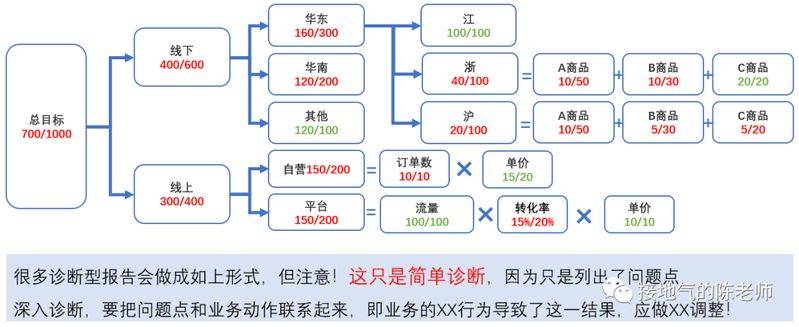
Attention! Diagnosis reports only work for people who understand the problem! If a person does not understand the context of the problem, then an introductory/monitoring report is given. Otherwise, the report is often sprayed: “i don't understand!” “why do we have to deal with this!”
Type v: test report
The test-type report applies to explain the test results to those who already know the problem well. The test report is only useful to people who know the problem very well! If a person does not understand the context of the problem, then an introductory/monitoring report is given. Otherwise, you'll get sprayed after the report
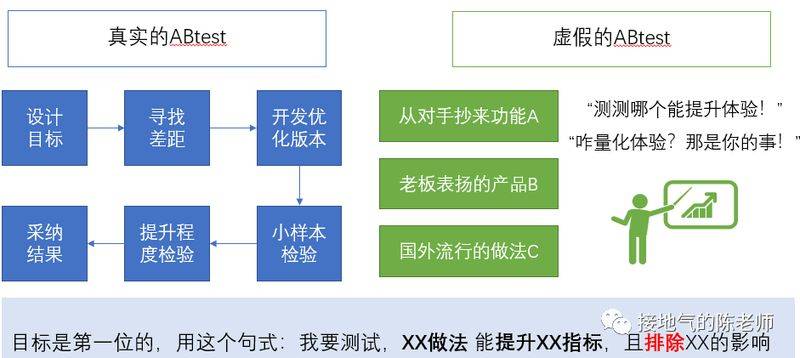
The structure of the test report itself is simple and clear:
1. Issues to be addressed
2. Approach to testing programmes
3. Test results
4. Post-test recommendations
This is the main reminder. Don't forget the question! Even if some of the tests are because, "i have a good idea," "i see my opponent doing this," "i heard the leader say this," it would be better to have a clear and quantifiable question point/test target. If we don't wait until the test is over, we can't get the report out
Type vi: forecast reports
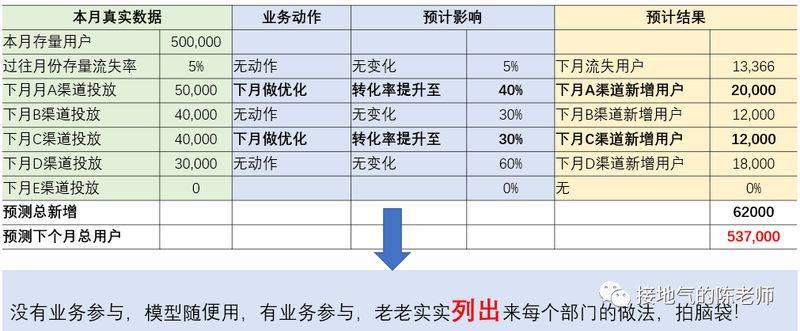
The test-type report is used to provide a forecast of the problem to those already well-informed. Particular attention is paid to the preparation of prognostic reports and to the level and appetite of the audience。
1. Would the audience like to be involved in the prediction process
What are the listeners worried about the future? Points
Do you have your own judgment
It must be clear in advance。
Otherwise, when talking about prognosis reports, they are often called off and sprayed: "you don't match forecasts and business expectations!" "you don't take into account the important questions of business concern!" "i ask you, if there's a situation xx, are you sure?"
Type vii: evaluation reports
The assessment report applies: a comprehensive assessment of the problem is given to those already well-informed. Note that, as in the case of the predictive reports, it is the level and appetite of the audience that determines the success or failure of the assessment reports。
1. Whether the audience has its own assessment
2. Importance of the views of the audience
3. Whether the audience prejudges the assessment
It has to be clear
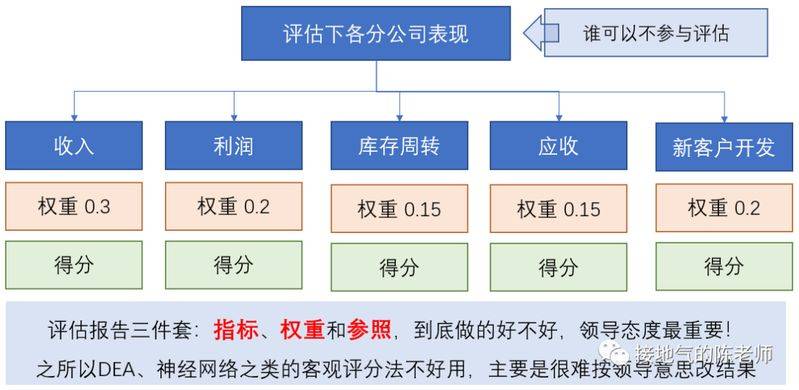
In particular, when assessing sectoral interests, such as outcomes of major projects, such as product performance. It would be preferable to look at the attitude of the audience before writing the report. In the case of sectoral interests, the assessment methodology is shared with the public in advance and the indicators, the criteria for reference are discussed in advance. That's the result. You're willing to lose. The most important thing is that there is no single method in advance, and then you're getting low on the results, and you're even changing the targets on a temporary basis。
Integrated application
When reporting, think clearly:
To whom do i report? (leader/colleague)
What am i talking about? (seven main types selected)
Did he know what i said? (unknown first introduction)
4. Whether his comments will influence the results (especially projections/assessment reports)
This is a targeted approach that allows data reports to cut each other's throats, answer each other's questions and reduce them。
Some reports are complex and long overdue. The longer the report, the better to think, "what's my central idea?" and to avoid the meaningless production of data。
The most common, for example, is to offer a programme to the top leadership and several modules will be arranged to ensure internal detail:
1. Background (introduction report)
2. Presentation of current trends (monitoring reports)
3. Presentation of current issues (diagnostic report)
4. Presentation of the programme (exploration report)
5. Presentation of expected results (projection report)
At this point, while the overall report is long, it must not be forgotten: it's essentially an exploratory report, and we have a plan to lead anli! Other sectors could be scaled down, and the exploration component must be clear, otherwise it would be in vain. In doing so, the other four parts could be condensed and the exploratory part retained。
The end