3. 2 analysis of adult grape growth process 3. 2. 1 grapes growth cycle and study area non-nuclear white grapes phase
3. 2. 1. 1 grapes annual growth and development cycle
Changes in the growth patterns of grape plantations over a year are called annual cycles. It is done through the rotation of long periods of nutrition and hibernation. The regular alternation of growth and hibernation, mainly due to temperature constraints, produces grapes in temperate areas, with significant seasonal variations in the annual growth and development cycles, which are summarized in two main periods: long-term life and hibernation. Depending on the needs of production management, there are generally eight periods。
1. Tree fluid flow period
The period of fluid flow of the trees is also referred to as the period of flow. Before the spring bulge and when it swelled, many non-colorable and transparent liquids, i. E. Grapes, flowed from the new cut or wound of the vine. The occurrence of the lesions suggests that the root systems begin to absorb the moisture and nutrients in large quantities to produce long-term signs of entry。
The flow of different kinds of grapes varies sooner or later. In general, european grapes begin to show signs of injury when temperature rises from 7 to 9°c in the root system; american species and riverine grapes range from 7 to 8°c; mountain grapes range from 4. 5 to 5. 2°c; european sons of bitches range from 4 to 4. 5°c; and european and american bastards range from 5 to 5. 2°c。
The flow is closely related to the activity of the root system, which produces pressure to increase the flow from the root, known as the pressure, which causes the flow. The root is about 1. 5 bar。
During the course of the injury, no new absorbent roots have been found in the root of the grapes, which are largely dependent on the fine and adjunct roots that occurred in the previous year。
Absorption fluids are mainly water with very little dry material content. There is little harm to grapes in planting, but too much harm still needs to be avoided. The injury ceases after the spread of the leaves。
2. Premature
From the beginning of the winter bud to the beginning of the leaf, known as the bud. When the average temperature of day and night has stabilized at more than 10°c, european grapes begin to bloom. Because of the growth point activity, the buds are split and the leaves grow outward. The sprouts at the top of the branch tend to start early. In addition to being affected by the temperature and humidity of the year, the growth of the plant is extremely high。
3. Newborn long-term
The period between budding and new stoppage is called the new life. The growth rate of the whole growth process varies. In the early stages of growth, the temperature is low and slower, with subsequent increases in new growth. And when the sprouting grows to a certain length, the sprouts of the armpits begin to grow and grow。
4. Flower period
From the beginning to the end of the flowering period, which lasts from 6 to 14 d, is also the main period determining the production of grapes。
When the average temperature reached 20°c that day, grapes began to bloom, and the branch grew relatively slowly. Temperature and humidity have a significant impact on flowering, and high temperatures and dry climates are conducive to flowering and can reduce flowering periods. On the contrary, it can be prolonged if it encounters cold and rain weather. The persistence of low temperatures also affects sit-ins and production during the year. In addition, poor tree status, inadequate storage or new breeders affect the growth of flowers, pollinating and sitting fruit. Winter buds began to divide during this period。
Long-term fruits
Grape berries are produced for the long term from the end of the period until the fruit matures. General experience 2. 5-3 months. During this period, when the berries diameter was about 3-4 mm, there was a fallout peak. The fruits grew rapidly during this period; the growth of the fresher is slowed and the growth of the thicker, and the base begins to become woody and changes in colour at the end of the period. In the winter sprouts, the blooming buds began to divide。
This period saw a gradual acceleration of growth and a constant emergence of new sides, reaching a full-year growth peak in july, at which point the absorption of the roots reached their highest levels。
6. The maturation of berries
The berries maturity period refers to a period from the beginning to the full maturity of the berries. The external mark of this period is softer and more flexible fruit grains, greener and lighter colourless varieties, coloured varieties beginning to colour, and the growth of fruit grains rapidly accelerating to a second peak. A series of biochemical changes have occurred within the fruit grains, such as a sharp increase in sugar content, a decrease in acid content, the gradual formation of aromatics in the fruit skin and a steady decline in mononin. Seeds turn green into tan and skin becomes hard。
The increase in the growth of the main stopper tends to stop slowly, and the increase in the coarse grower continues to flourish; the increase in the secondary grower lasts longer than the new. The flower sprouts are divided mainly in the upper middle of the fresh, and the main sprouts of the winter sprouts begin to form the foundation of the first and second sequences and cease to divide at a later stage。
The maturity period for berries varies from one species to another, usually between 20 and 30 d or more。
7. Leafing period
Leaping period means a period of time during which the leaves fall asleep is received from the harvest. The light co-operation of the leaves is still strong after harvest, so that the products are transferred in large quantities to the inside of the branches, resulting in a rapid increase in starch and sugar in the branches and a gradual decrease in the moisture content. It is a thickened and wooded cell wall of wood, a pelvis and a marrow ray, forming a layer of wood embolism, and a dry bark of several layers of cells outside the pelvis of the pelvis。
New maturity and pre-winter exercise are closely linked. The more mature the new, the better it is possible to gain greater resilience through pre-winter exercise. The exercise of the chickens was carried out during a period of complete termination and cooling of the upper part of the ground。
In the early years of ripening, the vast majority of the growing growth of new and subsoils has largely ceased, and the foundation of luminous sequencing has ceased to form. And then there's another peak in the growth of the root systems。
With lower temperatures, the ionosphere is gradually formed in the folate base, the leaf blades are ageing and there is a large accumulation of calcium in the leaf, while the nitrogen, phosphorus and potassium levels are reduced. The leaves are gradually falling from the foundation of the branch to the upper part, but in the northern part of the country, some varieties are often released early due to early frost and it is difficult to see natural leaves falling. There are also cases where the ionosphere is out of reach because of sudden cooling, and it is not normal。
8. Rest periods
From the fall of leaves until the spring of the following year, the grapes were dormant。
Rest can be divided into two periods: natural hibernation and forced hibernation. Natural hibernation is controlled by internal factors, and plants cannot start growing even if the external environment is appropriate. Through natural hibernation, certain low temperatures are required. The length of time required for cooling varies for different varieties. When natural hibernation ends, grapes can germinate if the temperature and humidity are appropriate. However, in the north, when natural hibernation ends, temperatures and temperatures are often low, and grapes are still growing irregularly, entering forced hibernation。
During hibernation, leaves fall, branches cease to grow, and complex internal biochemical and biological activities take place in a weak manner。
3. 2. 1. 2 nuclear-free white grapes phase of the study area
The non-nuclear white grapes, the eurasian species and the origin of central asia, mainly in iran, turkey and afghanistan, are the main dry varieties of our new frontier. Natural fruit cones, symmetrical shoulder, average osmosis 380g, max. 1200g, with a tight, thin, but non-defeating ointment; an elliptical oste, with an average of 2. 0g; green yellow fruit, thin skin, sweetness, small juice, sugar 22%, acid 0. 4%, drying rate 20-30%, high quality。
On the basis of the annual growth cycles of grapes, the growth stages of non-nuclear white grapes in the two study areas were surveyed, as follows:
(1) the area north of the flaming mountain (sun): late march to early april, grapes rise out of the ground, budding in mid-april, flowering in mid-may, fruiting in late may, mid-july, ripening in mid-august, harvest in mid-august and late august, winter cut in late september to early october, raisins in mid-october, squirting in mid-november, and wintering in mid-november。
(2) the region south of the flaming mountain (tarupan): the grapes came out of the earth in mid-march, began to bud in early april, began to bloom in early may, started to sit in fruit in mid-may, started to mature in late june and early july, started harvesting in mid-august, winter cut in mid-september, raisins in late september, saplings in mid-october, covered winter in late october。
3. 2. 2 grapes and their growth
3. 2. 2. 1 grapes and their growth characteristics
The vines are chicken-born, characterized by longness, tenacity, loose tissue, softness and rapid growth, commonly referred to as "fang" or "fang"。
The tops of the grapes include the main stem, the chicken, the branches, the parent branches of the result, and the new branches (result branches, developmental branches). The main stem is the part from the ground to the part of the main part of the chicken, which is the part of the main part, and the side part of the chicken which is the part of the main part. As a result, the chicken is made of a mature chicken from the previous year, which has been trimmed in winter, and is made up of the trunk, the chicken, the chicken, the chicken, and the chicken, which is the result, and is called a boned chicken. Born on the chicken, the female branch and the preparatory branch form the branch of the result. If the results are robust, proportionate and well distributed, they will form the basis for a productive plant. As a result, both the female branch and the preparatory branch are the first to mature, and the buds on these chickens are the new ones that were drawn in that year, the fruit branch with the ears and the growth branch without the ears. The sprouts of new leaves, or the buds of winter, are called the sprouts or sprouts of winter, divided into one sprouts, two sprouts, three sprouts, and so forth. Quest can also occur on the bystand, with flowering results commonly known as two, three, etc。
The vines consist of festivals and festivals. In terms of morphological structure, there are cortex, tenacity, formation, wood and marrow. The grapes are long, their marrow is larger, they are made up of polygonal cells and die one year later, in which they are filled with air. The wood section has a thicker catheter. It is long, it has rolls, it has cross-rests, it has thicker cells, it has solid institutions and it has a large stock of nutrients。
Grapes are grown in a single-axis and fake-axis alternation. The first growth was the sprouting branch of the bud, which stretches upwards and is called single-axis growth. With the increase in the number of nodal periods, the formation of layers and the promotion of the thickening of the tubing, when the new dome grows to three to six knots, the sprouts at the top pull out new dots, crowd out the sprouts and extend them forward instead of the sprouts, at which point the sprouts become rolls (or bouquets), which are called false axes. Because single-axis growth and fake-axis growth alternately grow, new rolls must have a regular distribution。
Grapes grow rapidly and can be pumped several times in the course of the year, depending on the variety, climate, soil and cultivation conditions. Newly growing and weak factors determine the amount of nutrients stored in the tree, while sufficient nutrients are growing stronger; poor soil, and under-nutrition in the tree, make new growth weaker。
3. 2. 2. 2 nuclear-free white grape growth characteristics of the study area
A single non-nuclear white grape in the study area usually has 2 to 3 chickens and very few have 1 or 4 chickens. By surveying 30 grapes, single grapes averaged 2. 73 chickens。
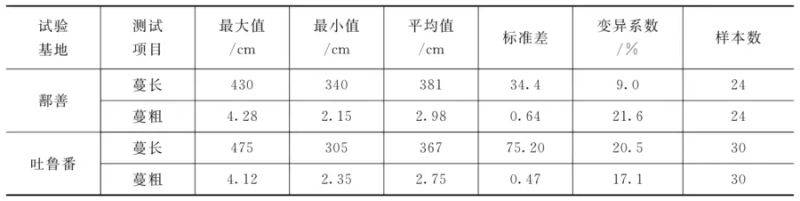
Table 3-12 is the basic development of grapes at the test base. As can be seen from the table, the average length of grapes in the age range of the zenung test base is 381 cm, with a coefficient of less than 10, with a weak variation, which is more even because of the size of the shed, and the average length of chickens in the zhuang test base is 367 cm, with a variation factor of between 10 and 100, which is moderate and uneven. At 80 cm from the base, the average length of grapes at the xinjiang test base was 2. 98 cm and 2. 75 cm at the torupan test base. Both test bases have coefficients ranging from 10 to 100, which are medium variants, with an uneven cortex。
Table 3-12 basic development of adult grapes