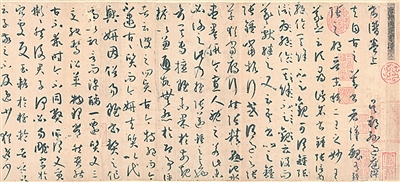
The figure is the book book book (locally) of the tang dynasty court。
"'"
The figure is the book book book (locally) of the tang dynasty court。
Calligraphy, a unique form of art of chinese civilization, carries the spiritual code and aesthetic ideals of the chinese nation, crumbling the spiritualistic philosophy of life and cultural aspirations of the chinese people, with important artistic values and deep cultural vocations。
Chinese calligraphy is a spiritual epic that continues to transcend itself. An ancient book is the most edifice of this epic, the "heart method" and the "footsteps" that concretize the philosophy and talent of the ancient sages. Today, we are looking back at the bright source of this galaxy's ideas, and we are deeply involved in combing the aesthetic river, from an “image-like” to an “orthodox”, to build a bridge between ancient intellectual wisdom and contemporary creative practice and to explore the ways in which the arts of calligraphy are emerging. The recent exhibition of calligraphy by the chinese calligraphy association “the beauty of han: the history of chinese calligraphy” is the practice of this concept. It translates an ancient essay into a contemporary ink creation by combining the “core interpretation” of the multidimensional narratives of “precision” and “ink presentation”, allowing the audience to visualize the flow of calligraphy aesthetic ideas and to become a vivid example of the theory that nourishes creation and the tumulture of ancient times。
The origin of calligraphy is deeply embedded in the mind and practical record of the ancient “images”. From the great mystery and seriousness of oracle, to the high crown and balance of qin xiaoxiang, the early booking of chinese awe of the order of the universe, and especially of the "embroids of the acronyms of the acronyms", is concocted with the fear of nature of nature. The two han books show a long trajectories of retrenchment and wave-stretching, a horizontal movement, a downward shift in gravity, and the “coverage” of the book as “carrying”, reflecting also the philosophies of farming civilization's attachment to the land and the chinese culture's “heavy material”. This stage can be considered a period of “law and space”. As the body of human consciousness awakened, the aesthetic focus shifted from the external nature of nature to the inner heart's hair, namely, “bookwriters, scattered”, “books, drawings”. “singing the hymns”, the ethos of the king's calligraphy is the projection of “human awakening” between pen ink. The “tangshan law” is a strict legal norm that deepens man's designs from the outer to the intrinsic “bone force”, completes the aesthetic core of “human” and establishes the status of calligraphy as the essence of independent art。
Along with artistic self-consciousness, systematic calligraphy came into being as a beacon to guide the aesthetic process. The book book book of the tun-sun has raised the doctrine to the same level as the spirit of the heavens and the earth. The discussion around the main areas of “form and god” and “law and mind” and “heart and hand” forms the backbone of chinese intellectual thinking. The ancients described the pen by the word “silver”, the word “cray sand”, the word “dry-jumping, tiger-deep”, and the expression “blowing out of the cuffs, coming into the shadow of the moon” by the word “groom”. It can be seen that ancient literature is not a dry dogma, but the birth of wisdom full of life experiences and poetic images. This poetic and critical language, which refers directly to the inner core of art and spirituality, is a summary of techniques and, above all, aesthetic standards, creative mind and cultural ideals. They pass on their profound understanding of pens and ink to future generations, like messengers who travel through time and space. Looking back at these pages of the "long-song-sing" chapter, we are dealing not only with techniques, but also with the aesthetic heart and cultural self-confidence of the "looking at the past."。
Contemporary calligraphy also faces challenges while highlighting artistic attributes. If there is a gap between theory and practice, or if the commentators are monotheistic and ink-drive, or if the author is technical and not theoretical. Partly created or trapped in a mechanical imitation of ancient law, lacked the spirit of the times and the expression of personality; or pursued new forms, different from the cultural roots of the calligraphy body. It is particularly urgent and useful at this time to re-integrate into ancient literature and to engage in an in-depth dialogue。
The purpose of the dialogue was to “activate”. The first is “in the light of the present”, that is to say, in the light of contemporary horizons, to reinterpret and discover the depths and values of ancient books. How does the traditional beauty of “middle” respond to modern vision? Where is the boundary between “students” and “new”? How does “in words” and “in words” balance in the information age? The wealth of dialectics in ancient writings can shed light on the current confusion. It is the "hands of the hand" exhibition that is designed to “live” the ancient wisdom and feed contemporary creativity. The second is to look at and promote current creations with traditional aesthetic standards, based on ancient knowledge. The ancient literature emphasizes that “the learning of books is in law, and its beauty is in people”, and that the ultimate goal is “technological advancement”. This warns us that calligraphy must not stop with showmanship, but rather pursues learning, nurturing and the spirit of the times through pen ink. The bookwriters need to study the techniques in a deeper, more structured way, to connect the spirit of chinese aesthetics with contemporary aesthetics, to combine personal exploration with contemporary cultural charisma, to avoid the “emptiness” of penthouses, and to create deep, living work that reflects the weather of the times, is popular with the people, and displays the chinese spirit。
The legacy is not retrospect, it's new. A new foundation lies in an in-depth understanding of traditions — both the words of the millennia pen, myths, rules, etc. — and the spiritual and value orientations of the chinese aesthetics, such as “medium and “natural” “books like others”. The modern “new” should be born of nature in the context of “keeping up”, as evidenced by the contemporary transformation of content and form, which can be written in deep-earthed classics and can draw on the contemporary discourse; and the exploration of new forms of expression with respect for the principles of calligraphy. This is also reflected in the multifaceted exploration of creative paths, the integration of traditional monuments and innovations; and the expansion of the communication discourse, using new media to bring calligraphy into the public and convey the cultural spirit。
Promotion of an in-depth dialogue between ancient writings and contemporary creations aimed at building a system of calligraphy based on chinese thinking and finding a path to development that is more chinese-american. It requires that we write not only by hand, but also by mind, and by thought, so that pens and pens can pass on the beauty of the han, and so that we can embrace the thoughts of the times and the spirit of the nation. Thus, in the light of the light of the new era, calligraphy, a thousand years old, can produce a much more obstinate branch that, with its unique linear rhythm and time and space poetry, tells the world how an ancient people have settled their minds and created meaning in their most subtle abstract art. It's not just the mission of art, it's the expression of cultural vitality。
Daily people's journal (28 december 2025 edition 08)
(copyline: bai woo, vega)