In the complex supply chain management of cross-border electricians, how the overseas warehouse order management system (oms) and the warehouse management system (wms) work together efficiently has been the focus of industry attention. This paper explores in depth the inventory management strategy of the overseas warehouse oms and wms, whether they share a set of inventory data or manage them independently. The articles provide a detailed comparison of the strengths and weaknesses of the two programmes from the multiple dimensions of system architecture design, business needs, data consistency and performance optimization, and analyse their applicability in the context of actual cases。
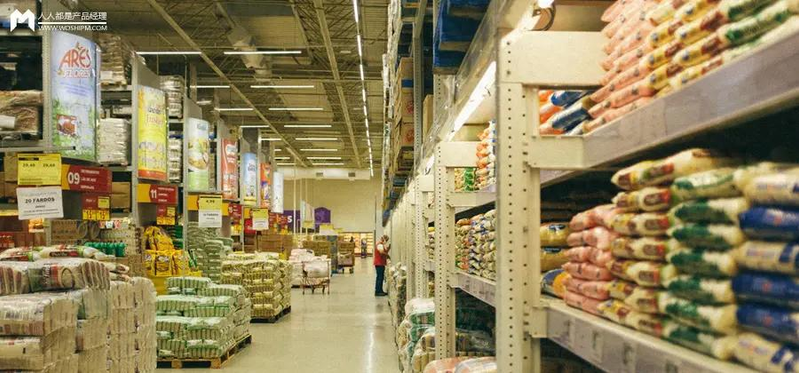
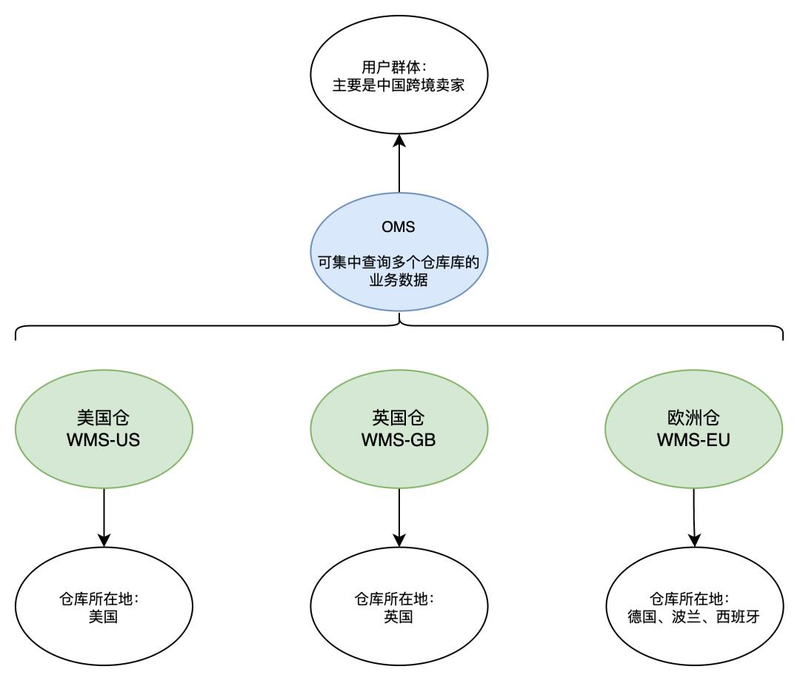
In previous articles, i have repeatedly referred to oms in the overseas warehouse omb, which refers to the wms client, which is provided to users who need cross-border vendors/businesses. Wms, for use by warehouse operators, covers the internal operations of the warehouse and manages the business processes from receipt, loading, storage, selection and packing to delivery。
Many product managers will find a critical issue in the design of overseas warehouse omb-related systems, especially in relation to saas products: does oms inventory and wms inventory use a data set or are they stored separately
I had to deal with this problem many times a few years ago, when there was not much to refer to, but rather a combination of actual business scenes and some mainstream players, and finally a combination of oms and wms inventory decoupling, separate storage on both sides and a separate set of such programmes。
To date, the big language model's ai tools and product capabilities have been very powerful, and after several rounds of late-night communication with it, it has given me a number of enlightening suggestions that have made me more aware of the strengths and weaknesses and scope of application behind different programmes. I think it's a very representative issue, and it's worth thinking and exploring by industry-related practitioners, so this is the article on "the spectator," so let's break up the oms and wms inventory design options
I. Operational background notes
Physical warehouses in offshore warehouses may be located in several countries around the globe (e. G., the united states, germany, australia), and wms in warehouses need to serve local operators to ensure low delays and high availability. At the same time, most of the customers (cargo owners) serving in these warehouses are located in china, and they need to manage their stocks and orders at the global warehouses through a single oms portal。
This raises a classic problem frequently encountered in the design of the system architecture, especially the inventory module: wms physical inventory information recorded in wms and oms inventory information presented to customers should be managed using the same set of databases and data sheets (set of inventories), or should separate data tables be maintained to maintain consistency through synchronization mechanisms (multiple sets of inventories)
This is not a simple “yes” or “no” issue, but involves a trade-off between operational needs, systemic performance, data consistency, deployment architecture, development maintenance costs, etc. At the core of this question is how to ensure data accuracy and consistency in the oms global client view while meeting the localised, high performance operational needs of wms, and to select the most appropriate storage and management structure for inventory data
We need to weigh the following two main options: a unified inventory model: oms and wms share the same bottom-line inventory database and core inventory table. Stock-segregation: oms and wms have separate inventory databases (or at least separate core inventory tables), which are linked by business documents to manage their respective stock increases and decreases。
Why is there a “set or set” of architecture
The problem arises from the inherent characteristics of overseas warehousing operations and systems deployment, and we need to understand the respective operational needs of wms and oms and the requirements of the system's characteristics before we can better understand why this controversial issue arises。
Factor 1: localization of wms and centre and needs of oms
Localized needs of wms: warehouse operations are extremely demanding for real-time responses to systems. The picker scans a bar code and the system requires a millisecond feedback. If wms is deployed in remote central servers, network delays may lead to inefficiencies or even inaccessibility. As a result, wms often needs to be deployed close to the warehouse (e. G. On a server in the country or region where the warehouse is located) or to adopt a technical structure that can guarantee low delays in access。
Focused needs of oms: clients (cargo owners) usually wish to view and manage their inventory and orders in all cooperative warehouses around the world through a unified platform. This means that oms needs to provide a central access point to aggregate data from different wmss。
Factor 2: strong demand for data consistency
In wms, warehouse personnel are able to view the inventory that is refined to the level, batch, container, sn dimension, which helps the warehouse to perform refined storage, inventory management and operations. In the oms, the customer (owner) does not need such a sophisticated dimension inventory, but rather an inventory of the commodity dimension, which needs to be known in particular scenarios, as well as the inventory of the sn。
While the size and sophistication of the stocks that the two need to demonstrate are not the same, it is important to ensure that the stocks are consistent at the same size. Ideally, the inventory data of oms and wms should be consistent, as inconsistent data may lead to overselling or non-issuance of customers, leading to serious operational problems and a decline in client satisfaction。
For example, wms had a physical inventory of 100pcs, but oms demonstrated 120pcs for some reason, which would probably result in oms overselling 20pcs stocks, causing many losses and distress。
Factor 3: performance and expansive demand
Combining the two stocks into a single database (especially in a transnational network environment) may affect each other's performance or may be difficult to optimize in a targeted manner。
Element 4: need for system decoupling and evolution
Wms and oms, as two different product domains, have some variations in the rate of functional evolution, the frequency of the iterative series, the user group, etc. Over-alignment may lead to system maintenance difficulties, and changes in one system may inadvertently affect another。
The combination of these factors makes the design of the oms and wms inventory data a challenge that needs to be carefully weighed, and which may be less relevant to product managers in terms of how specific technologies are achieved, but what are the impacts and effects of different technology options, or need to be focused by product managers。
Programme i: harmonization of stock models (set)
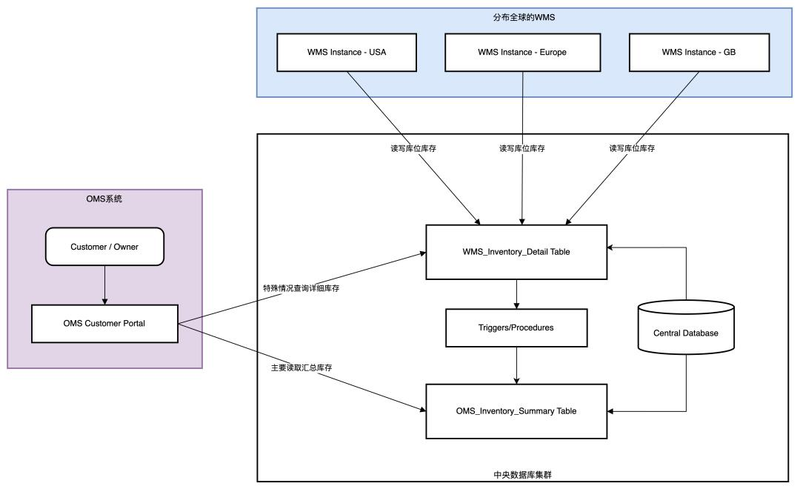
In the harmonized inventory model, oms and wms share the same bottom source of inventory data, usually a centralized database cluster. The core idea of such a structure is the single source of data, where all inventory data exist in only one place, avoiding data redundancy and inconsistencies。
Database level:
The harmonized inventory model is usually achieved in two ways:
1) single table mode:
2) link table pattern (more commonly):
Design a number of closely related tables, such as:
Data flow process
When wms carries out inventory operations (e. G. Entering, out, moving): wms directly updates wms inventory detail table database trigger or storage process automatically updates oms inventory summary tableoms querying oms inventory summarry table to obtain up-to-date inventory status in exceptional circumstances, oms can also directly query wms inventory detail to obtain more detailed inventory information
Strengths
Disadvantages
Apply scene
The unified inventory model is particularly appropriate for the following scenarios:
In the harmonized inventory model, oms does not directly increase or reduce “real inventory”, but is primarily responsible for pre-allocation and business process control of the inventory, the final change being driven by wms operations. This design ensures data consistency and is consistent with the division of responsibilities in actual business processes。
While the unified inventory model provides the strongest assurance of data consistency in theory, the challenges of performance and usability cannot be ignored in practical applications, particularly in the context of global distribution. The selection of this model requires an adequate assessment of business needs, technical capabilities and infrastructure conditions, and preparedness to address potential risks。
Programme ii: separating stock model (multiple stock sets)
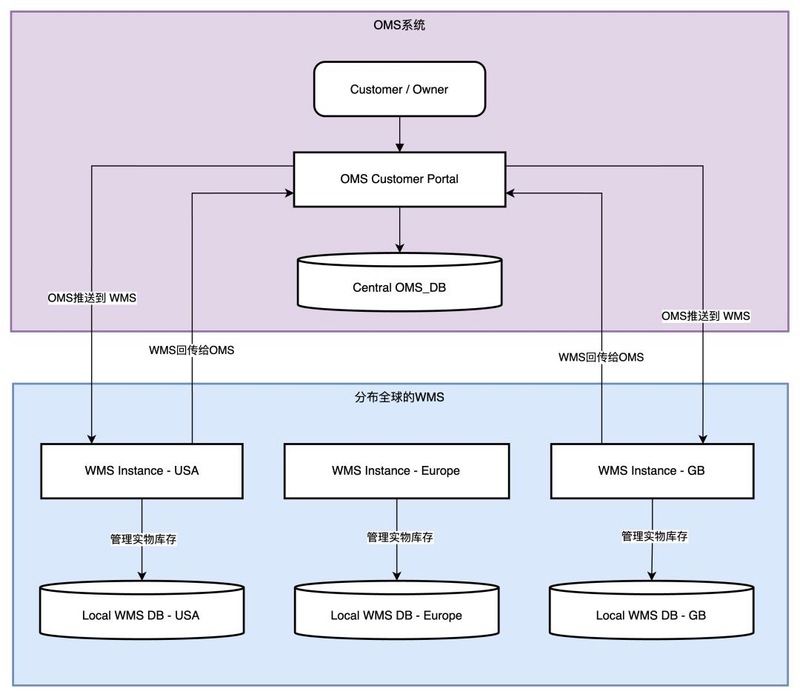
Under this model, each wms example (or regional wms cluster) has its own independent database of detailed physical inventory of the warehouse it manages. At the same time, the centralized oms system has an independent database of logical inventory views for clients. Rather than simply mirroring the data, the data are consistent through business documents and event-driven approaches。
Wms end:
Oms end:
Data synchronization mechanism
Unlike simple “data synchronization”, the change in inventory is driven by business documents and events between oms and wms under this model:
1) entry process:
The customer/cargo owner sends the bill of entry to the wmswms to complete the actual receipt and confirm the amount of the deposit (the actual quantity received) back to omsoms to increase the available inventory in the system based on the confirmation of the bill of entry
2) outlet process:
Through oms orders, oms inspects available inventory and pre-possessssssssss it to wms operations for wmswms to complete collection, packaging, shipping, etc., return to omsoms to reduce the available inventory in the system based on confirmations from the form
3) inventory adjustment process:
The wms inventory, quality check, etc. Resulted in the inventory adjustment wms creating the inventory adjustment sheet and the implementation of the adjustment to wms sending the adjustment results to omsoms to modify the inventory in the system accordingly
Strengths
Disadvantages
Apply scene
The separate inventory model is particularly suitable for the following scenarios:
Problems and solutions
In addition to some of the shortcomings mentioned above, in considering this option, attention should also be paid to the problems that may be encountered in the practical application of this option, which is a more high frequency and a more central knowledge point。
1) batch management issues:
2) inventory inconsistencies:
3) business process issues:
4) system integration issues:
Some of the issues mentioned above, of course, can also be identified in the practical operation of the operation, as follows:
(1) periodic stock reconciliation mechanism:
2) batch information partially synchronized:
3) a robust document synchronization mechanism:
4) harmonization of operational rules:
In general, the separate inventory model is the mainstream option for most globally distributed offshore warehousing operations, but needs to be fully aware of its limitations in terms of batch management, data consistency and to address these deficiencies through well-developed business processes and technical tools。
Iii. How do you choose? Key considerations
Seeing here, you might ask, "vitamins, so much, which one?" the answer is: there is no absolute silver bullet, and the choice depends on your specific business landscape and constraints。
The selection of a uniform inventory model or a separate inventory model requires consideration of the following key factors:
1. Size and geographical distribution of operations
Preliminary conclusion: the wider the distribution, the larger the size, the more suitable to separate models
Performance requirements
Preliminary conclusion: extremely demanding wms performance, giving priority to separation models
3. Data consistency tolerance
Preliminary conclusions: zero tolerance is inconsistent and small, with uniform models selected; final consistency accepted, separation models selected
4. Technical capacity and resources
Preliminary conclusion: selection of manageable options based on team skills and experience
5. Future expansion
Preliminary findings: high growth expectations and selection of an expanded separation model
Summary
Returning to the original question: “does the overseas warehouse oms and wms stock have one or more sets?” this question has no one-size-fits-all answer。
The harmonized inventory model, with its natural data consistency advantage, is an option if the performance and deployment challenges are overcome in a small, geographically concentrated scenario. However, its requirements for the centre's database are extremely high and the system is closely aligned and extended。
With its good performance, decoupling, expansive and fault-segregation capabilities, the separate inventory model is better suited to the current large-scale, globalized offshore warehouse operations. The central challenge is to build a stable, efficient and reliable data synchronization mechanism to ensure eventual data consistency。
For most modern, large-scale and geographically distributed offshore warehousing operations, separate stock models are often more mainstream and recommended options. However, it requires that product and technical teams take full account of the complexity of data synchronization at the outset of the design of the system and invest sufficient resources to build and maintain the mechanism。
As supply chain product managers, we cannot make structural decisions on the basis of individual preferences or single dimensions alone. It is important to understand business needs in depth, assess technical feasibility, weigh constraints (performance, cost, consistency, expansiveness, team capacity) and focus on future developments。
It is hoped that today's sharing will provide some valuable reference for your decision-making on this issue。