There are many cases of "pulmonary in situ cancer (ais)" and "mia" in post-pulmonary surgery pathological reports. When these terms are used, a lot of people panic, and the word “cancer” is so obscurantistic that there is always a fear of bad prognosis. A heavy study of the 2021 international authoritative magazine journal of thoracic online (visiting for nearly 10 years, covering 524 patients) tells us: these two types of tumors are actually moderates in the lung cancer family, with rates of survival far beyond imagination. Today, the key messages of the study are read in common language to help you understand the “life truth” of lung cancer at an early stage。

Understand: what is in situ lung cancer (ais) and micro-impregnated gland cancer (mia)
In order to understand survival rates, it is necessary to understand where these two tumours are “special”. In 2021, the who lung cancer classification classifies in situ lung cancer as pre-cancer pathologies because its cancer cells grow only along the pulmonary bubble wall, do not break through the pulmonary bubble structure, and do not violate the vascular, plethora or lymphocytic tube, as if the seeds had sprouts on the surface of the soil, were not immersed in deep soils and did not spread。
Micro-impregnated gland cancer: a little step forward from ais, albeit through the base membrane, most areas are walled up, with only a very small amount of penetration of the surrounding tissue (maximum immersion range of 5 mm), which is equivalent to a small rooting of the seed, which is still difficult to move。
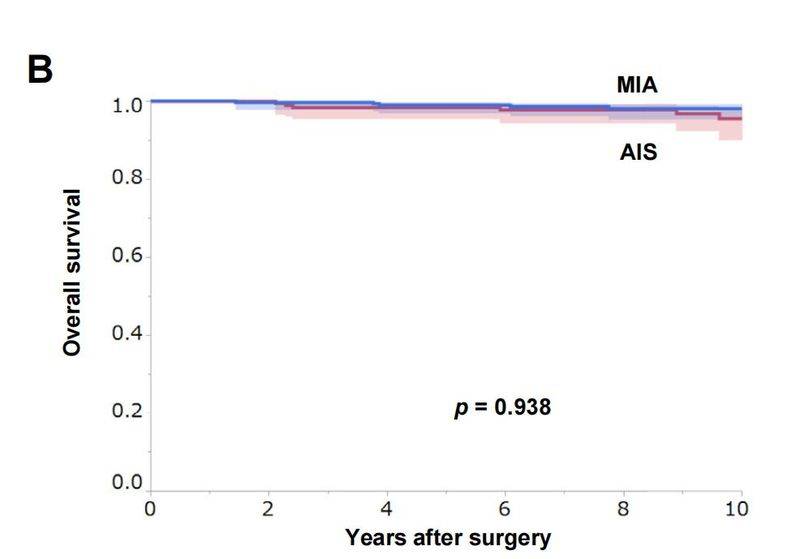
There is no significant difference between the estimated total survival rate of people with prostate cancer and micropregnosis
Core data 1: high survival rate
In the study, 524 patients were subjected to root surgery, with a median duration of up to 100 months:
1. A relapse rate of 0:
In neither ais nor mia have there been one case of a re-emergence of original tumour in a follow-up for almost 10 years。
2. 100% disease-specific survival rate:
“the disease-specific survival rate” means the “probability of dying from this lung cancer only after excluding other causes of death”. Studies show that:
10-year disease-specific survival rate for ais patients: 100 per cent
10-year disease-specific survival rate for mia patients: 100 per cent
In other words, no one will die because of ais or mia, if they have a cure。
The overall survival rate (including other causes of death, such as heart disease and other diseases) is 95. 3 per cent and 97. 8 per cent, respectively, for ais and mia。
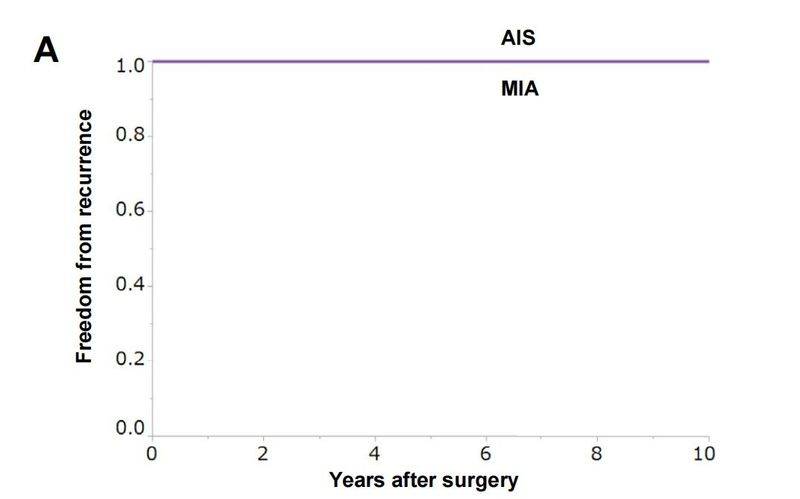
No re-emergence of lung cancer has been observed in patients with prostate cancer (ais) or micro-impregnated gland cancer (mia)
Core data 2: who gets ais/mia more easily
The study also identified 524 patients and found two obvious patterns:
1. High percentage of women, non-smokers
Sex: 65. 3 per cent of women (342/524), compared to 34. 7 per cent of men
History of smoking: 63. 5% are non-smokers (333/524), with only 36. 5% smokers。
This is different from our impression that lung cancer occurs mostly among male smokers, with ais and mia preferring “females” and non-smokers。
2. Tumours are small
In the study, the average pathological diameter of ais and mia was 15. 2 mm, of which ais was 13. 8 mm and mia 16. 2 mm. It also reminds us that the two-cm glazing knots found during the medical examination are to be wary of ais/mia。
Core data 3: don't ignore “second primary lung cancer” and post-operative follow-up is important
Although the ais/mia itself does not recur, there is an important reminder from the study that new lung cancers (the second primary lung cancer) may occur。
The second primary lung cancer incidence in 10 years was 5. 6% ais and 7. 7% mia。
The article points out that the second primary lung cancer may be related to the following factors: (1) genetic susceptibility, with some being inherently more sensitive to lung cancer
(2) common risk factors, such as long-term exposure to second-hand smoke, air pollution, cooking smoke or family history of lung cancer, have not disappeared as a result of the removal of a tumor。
Common question answer: find ais/mia, what to do
1. Identification of ais/mia requires immediate surgery
Not necessarily. In the case of flat-sharp glass knots (0. 8 cm in diameter), doctors may recommend “periodic observation” (e. G. Review of ct every 3-6 months), because such knots grow very slowly, and do not change for many years, and over-surgery is a waste of lung function; if the knot increases, the density changes (realistic components are produced), the surgery is no later. If, however, there is a high level of suspicion of the sub-factor of the tumor, or if the patient is under severe stress, the procedure remains the preferred option and has little impact on life after the operation。
2. Does post-operative need chemotherapy, targeting treatment
No need. Research has shown a 10-year post-operative relapse rate of zero, and chemotherapy, targeting and treatment are not only useless, but also have side effects, which are overtherapy. Only very few cases (e. G. Pathological errors, actual leaching cancer) may require follow-up treatment。
Can a normal life be achieved after an operation? Does it affect life
Absolutely. The ais/mia survival rate is 100 per cent for 10 years after the operation, and the overall survival rate is over 95 per cent for 10 years, with little difference between healthy people. After the operation, as long as smoking is avoided, air pollution exposure is reduced, healthy diets and exercise are maintained, work and live as normal people and life expectancy is not affected。