"also lung cancer, why is the treatment so different? Is there a problem with my program?"
Every time i wonder, i explain to the patient that lung cancer is never “a disease”, just like a fever, which is completely different in different ways. The core of the difference in treatment is hidden in the pathology spectrometry -- it's like a "key" that opens the door to the most appropriate treatment。
Understand: what exactly is the pathology
For patients, the terms in the pathological report may be difficult to understand, but, to be fair, the doctor sees the “real face” of the cancer cell in the microscope — what it looks like, how bad it is, and how it combines the information of instalments, genes, etc., to “scrutinize you”。
Many patients care only about “not lung cancer”, but ignore the details of the stratification. But for our doctors, this message is more important than the word lung cancer. Different types of lung cancer, temperaments, characteristics, blindness and other programmes are likely to be ineffective and time-consuming。
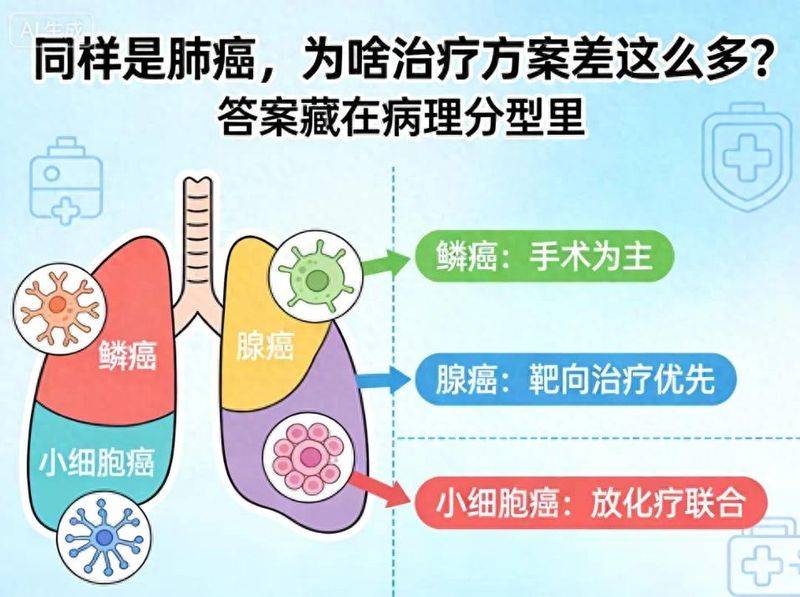
Two main types: non-small cell lung cancer vs small cell lung cancer
Lung cancer is divided into two broad categories, with different personality and governance。
:: non-small cell lung cancer (80-85%)
Growing relatively slowly, moving late, and treatments are more abundant. The most common are:
▍ small cell lung cancer (15-20%)
The character is “hot”, growing fast, moving early and closely related to smoking. It's sensitive to chemotherapy, but it's easy to relapse. The vast majority of those diagnosed are no longer able to operate, relying mainly on free chemotherapy, and in recent years immunotherapy has been added to the front-line programme。
Apart from the stylings, it determines your plan
Pathological stratification is the basis, but the final programme will also be based on:
A few words for the patient
All these years of sickness, i have understood deeply the anxiety and confusion of all. These are some of the suggestions, which i hope will help you to make less of a turn:
You must read the pathology report and ask the doctor: what's the score? Where's the split? Any mutations? These are the basis for programming. Don't talk to someone else's program. Your condition is unique, and someone else's medicine may not be suitable for you, or even harmful. Trust your master doctor, communicate. Genetic testing is not “discretionary spending”. For such types as lung gland cancer, it helps you to find the right direction and avoids “touching mistakes”, which are cost-effective and less painful. If the economy is tight, the doctor can be consulted on key projects first. Stay confident and cooperate with the treatment. Lung cancer is no longer an “elimination”. In the era of precision medicine, more and more patients are able to survive, even clinically. A good mind and the company of family are equally important。
Finally, the treatment of lung cancer is like a “precision battle” and the pathology is your “war map”. It's the right direction to win。
If there's any doubt, leave a message or a private letter, i'll try to answer it。
May every patient find his own path, step forward and lead to light。