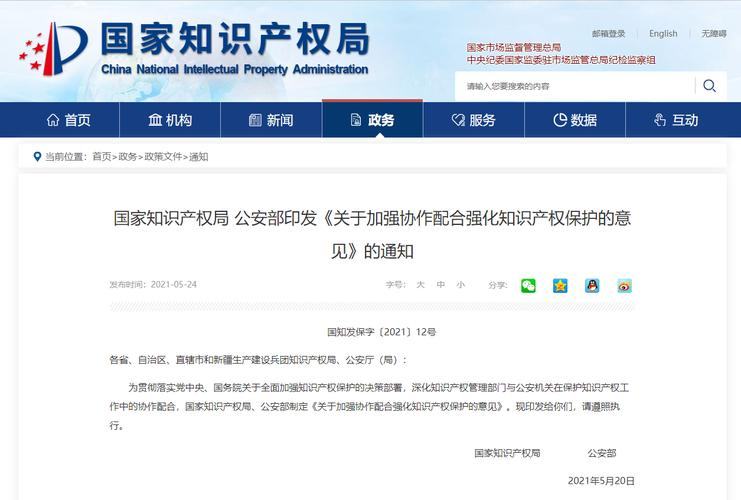
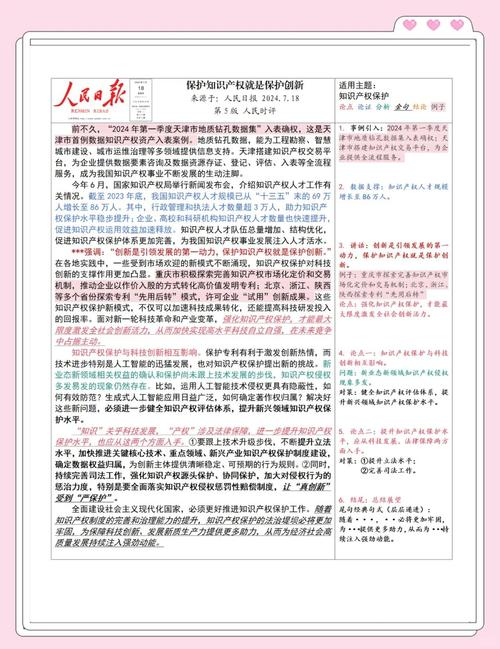
On 24 may, the national intellectual property administration and the ministry of public security formulated an opinion on enhancing cooperation and strengthening protection of intellectual property, based on the network of officials of the national intellectual property administration, in order to follow up on the decision-making arrangements of the party central and the state council to strengthen the protection of intellectual property rights in general, and to deepen collaboration between the administration of intellectual property rights and public security organs in the protection of intellectual property rights. The opinion highlights 13 articles in which the national intellectual property administration and the ministry of public security, acting in their respective capacities, jointly set up a group of experts on intellectual property protection, strengthened research and studies on macro-level strategies for intellectual property protection, analysed the situation of human rights violations and offences committed in priority sectors, examined risks that could affect scientific and technological innovation and self-reliance, conducted special studies and research on the application of the law, promoted legal policy improvements, provided guidance on difficult and complex cases and served to support law enforcement practices。
The following is the text of the opinion:
The ministry of public security's views on strengthening collaboration and cooperation in enhancing intellectual property protection
The first is to follow up on the decisions taken by the party central and the state council to strengthen the protection of intellectual property rights in all its aspects, to deepen cooperation between the administration of intellectual property rights and the public security organs, to speed up the construction of operational mechanisms for the administrative protection of intellectual property rights that are organically linked to criminal justice and complementary to each other, to provide scientific and technological innovation, self-reliance and self-reliance in the service of science and technology, and to formulate this opinion in accordance with the provisions of the penal code, the code of criminal procedure, the trademark act, the patent act, the regulations for the application of the trademark act and the rules for the application of the patent act。
Article ii. The national intellectual property authority and the ministry of public security strengthen their collaboration in the protection of intellectual property rights, including matters such as information exchange, professional support, infrastructure, legal research, operational training, awareness-raising and international exchanges。
Cooperation between the two parties in the protection of intellectual property rights is the responsibility of the intellectual property protection division of the national intellectual property agency (hereinafter referred to as the department of protection) and the food and drug investigation department of the ministry of public security (hereinafter referred to as the food and drug investigation department)。
Article iv establishes a mechanism for coordinating intellectual property protection coordination between the national intellectual property directorate and the ministry of public security. It invites the relevant administrative and judicial authorities to analyse and evaluate the situation of criminal offences against intellectual property throughout the country, to develop a programme of work, to formulate annual objectives and priorities for intellectual property protection and to jointly promote the further development of intellectual property protection。
The provincial intellectual property authorities and the public security organs shall establish a mechanism for coordinating the work of the bodies concerned, in accordance with the situation on the ground, and shall appoint persons responsible for joint research and implementation。
In the course of their daily work, the executive branch of intellectual property rights finds that there is a clear suspicion that an offence has been committed。
The administration of intellectual property rights under article 6 and the public security organs are to initiate the establishment of a system of information-sharing with the relevant administrative and judicial authorities, gradually moving towards the sharing of data across sectors and promoting the establishment of information-sharing platforms。
The public security organs shall respond promptly to requests from the administration of intellectual property rights under article 7 for their opinion on the criteria for the filing of criminal cases, the fixing and preservation of evidence and the identity of the perpetrator of an offence。
In the course of handling a case, the public security organs are required to verify the registered trademark information, which can be verified through the national intellectual property office's trademark registration certificate public notice system and, if necessary, by the trademark office of the national intellectual property office; if the legal status of the patent in question is to be verified, a copy of the patent register may be requested from the patent offices established by the national intellectual property office at various locations; and if the information on geographical indications is to be verified, it may be verified with the department of protection。
The public security organs may directly determine the use of trademarks in criminal cases, the same trademarks, the same goods, fraudulent patent acts, etc., on the basis of the relevant judicial interpretation and the criteria established by the national intellectual property office for the determination of trademarks, patent infringement, etc.; if necessary, they may request professional advice from the peer intellectual property administration. If it is not possible for the same level of intellectual property administration to identify the relevant issues, it should refer them to the higher level of the intellectual property administration or to the public security office, which will report them to the department for protection。
Under article 8, the national intellectual property directorate and the ministry of public security, each of their respective strengths, have jointly formed a group of experts on intellectual property protection, strengthened research and studies on macro-level strategies for intellectual property protection, analysed situations of abuse and fraud in key sectors, examined risks that could affect scientific innovation and technological self-reliance, conducted special studies and research on the application of the law, promoted legal policy improvement, provided guidance on difficult and complex cases and supported law enforcement practices。
Local intellectual property authorities and public security organs must take advantage of their respective strengths by jointly organizing research, training, etc., and constantly raising the level of intellectual property protection。
Article 9 deals with the administration of intellectual property rights and the public security organs, making full use of the various media, such as radio, television and the internet, in a flexible and diverse manner, to disseminate widely the legal policy of intellectual property protection, to improve consumer identification, to educate the population, to alert society and to raise awareness of respect for and protection of intellectual property rights in society as a whole。
Article 10, on intellectual property, provides for close cooperation between the authorities and public security organs in international protection cooperation and for joint participation in international exchanges, thus demonstrating our determination and effectiveness in protecting intellectual property rights。
Article 11 of the national intellectual property authority and the ministry of public security regularly commend intellectual property authorities, groups and individuals in the public security organs for their outstanding contribution to the investigation and detection of major cases, the promotion of collaborative mechanisms, the conduct of theoretical research and awareness-raising; and the failure to do so。
Article 12 of this opinion is under the joint responsibility of the national intellectual property authority and the ministry of public security。
Article 13 is operative on the date of publication of the present opinion. If the documents previously issued are inconsistent with this opinion, the present opinion shall prevail。