History is a very important discipline。
How important? History is the memory of a nation。
We all know that today's events will be forgotten tomorrow and that his life will obviously be greatly affected。
Similarly, if a country is not well equipped to analyse its own history, it will always make mistakes in reality, or even fall in the same place。
So there is one sentence: “history makes sense”。
However, the phrase “way to read history” does not mean that a person who reads more than a few history books is wiser than that. The key to reading history is the method and the ability to summarize and analyse. It's not wise to remember a bunch of years。

Analysis of historical patterns, however, is difficult and faces many difficulties. What's the problem
The first is the difficulty of historical information。
In some countries, the difficulty of analysing history is that it is too short, too little information to sum up. The difficulty in china's history is that it is too long and too much information to sum up。
We know that china is the world's most historical country, that we have a history officer from the start of business, and that, therefore, china is also the country that has the most historical information in the world. Otherwise, it's hard to read more than 40 million words in a 24-year history. So if you meet someone today who's read 24 history, you better not believe it. Why, because the twenty-four history is ancient, it is hard to read in a large number of isolated words that the audience today is not familiar with, names, geographical names, and an unfamiliar clerical system. So if you read 3,000 words a day, you're strong. No matter how long it takes to read the twenty-four history after the new year's storm and rain. I'll figure it out, about thirty-six years. So, in addition to the twenty-four history, we have the rule of law, the law, the law and the law. If you want to read it all over again, you can't finish it all your life。
So this is the first difficulty, the information difficulty。
The second difficulty is the difficulty of summing up and combing。
You've got history, you've read a lot of history books, and you don't know how to benefit from history, but on the contrary, history can end up dead。
Why? Because of the same history, different people may sum up completely different patterns。
We say that history is the memory of a nation, yet it is not the good ones who can live well. Because memory is not equal to logical thinking。
Many remember well, but the logic of thinking is poor. One of my aunts, for example, has a good memory. She talks about any little thing many years ago, even leaves, very vividly. But she had a problem, and she did not go to the hospital every time she got sick, but to the village fortune teller. She strongly believed that a person was sick because he had run into a god in one direction, and that the burning of paper money in one direction could be cured under mr. Talent's guidance。
In the first two coincidences, combined with her psychological effects, she became really ill soon after the burning of the paper, which reinforced her theory and mocked me about viruses and bacteria as heresy. Until she died in her mid-50s because of the acute kidney disease delay, she thought that i had read my brain. So memory and intelligence are not the same thing。
The same applies to one country。
China has the largest history bank, but not necessarily the greatest history. In fact, in the long history of china, historians have essentially integrated complex historical memories along the simple lines of “good and bad” – the so-called “good and loyal”。
For thousands of years, chinese readers have believed that the reason for china's failure to govern is because of the inaccuracy of people and their refusal to listen to confucius. If all of us were to follow through on kong meng's words, then the peace will soon be re-emerged。
It is even simpler to draw the conclusions of ordinary people who have listened to the comments of previous generations: all success is because his majesty listened to his loyal subjects, and all failure is because his majesty listened to his traitors. So, as long as it's “intimate, far-off”, it's normal. This historical capacity is one of the reasons why china, from qin dynasty to qing dynasty, has been circled in the cycle of chaos。
So, reading history requires awareness。
It is not absolutely correct to read the wise words of history. It is not always possible to gain wisdom from learning history, but it may sometimes be deeper ignorance。
In general, the minds of our ordinary readers are filled with vast amounts of inaccuracies or even false historical common sense。
For example:
“the middle ages of europe is a dark age.”
“the emperor of the roman empire, like the emperor of china, is inherited.”
“the unicorn of han wuty is the doctrine of confucius meng.”
“the peasant uprising aimed at overthrowing the dynasty is a phenomenon common to the history of the world.”
“the corruption in china's history is so serious that the emperors cannot fight it with their heart.”
“history is a straight line of development, and the later is certainly the more advanced.”
These are inaccurate or even false common sense。
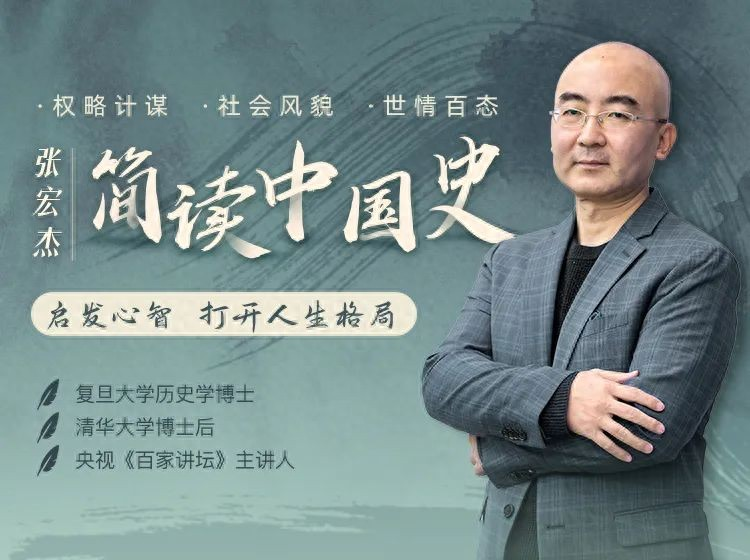
That's why, based on the difficulty of reading history, i decided to read chinese history simply and clearly。
Its role is to help the general reader to quickly understand the history of china in the context of world history and to build a holistic concept of chinese history in a relatively short period of time。
Someone asked, why not talk about china's general history?
The first reason is that general history is not conducive to a clear understanding of the history of china. There are often more words in general history, such as the famous white life history of china, 12 volumes of 22, or about 14 million words, and it would take one or two years to read seriously。
On the other hand, general history is often written in a more rigid way, beginning with a one-to-one-on-one sequence. The second is each divided into political, economic, technological, cultural and soybean dimensions, one piece at a time. When you see the back, you forget the front. In particular, many of the existing general histories have the same problem, which is to focus on history and history, to list points of knowledge and not to bridge the logical lines behind them, that is to say, to combe the patterns behind them。
So what i have to do is to break the order of the generations and to refine the history of china. Out of specific generations, specific personalities, specific events, the big pattern behind history。
So the program does not appreciate the history of one and another claims, the succession of kings, and the rise and collapse of one dynasty after another, which, despite the variety of retrofittings, is essentially a repetition of patterns. What i want to tell you is the rules of the game behind these processes and how they were formed。
So for example, general history is like a man's yearbook, written every year. And this schematic, more like an assessment or an examination of this man, makes only a few points, but wishes to go further。
The second reason is that it is difficult to compare between china and china in general or to analyse chinese history in the context of world history。
Sometimes history takes a long, long, long, wide-sighted look to discover some holistic patterns. For example, only if you go up to space will you see that the earth is round. Or that it is only by jumping out of the mountains that you will find the true faces of the mountains。
“don't read chinese history, don't know china's greatness; don't read world history, don't know the chinese character.” without reading the history of the world, you cannot judge precisely the place of chinese civilization in the world and its uniqueness。
So what i'm saying about china's brief history is to put chinese history in the context of world history. In general, chinese writing about chinese history would have the problem of falling into china’s own hands without paying attention to the world factors that affect china. In fact, however, in the course of developing chinese history, world factors have played a key role in many times. Some elements of the bi-river basin and middle east civilization, for example, have played an important role in stimulating the early emergence and development of china's dynasty. The programme also focuses on the analysis of the same differences and differences between china and the world。
In fact, there are many stages in chinese history similar to that of europe. Aristocratic societies, such as those under the seal of the zhou generation, have very similar aristocratic spirit and rules of the game with the western “envelope age”, i. E. The medieval century. China's qinhan empire has many amazing similarities with europe's roman empire。
After the collapse of the han empire, the “warrant invasion” or the so-called “judgment” was not a phenomenon unique to china, but a worldwide phenomenon at the time, and the roman empire collapsed in the same wave of “warrant invasion.” china's history also has a phase of “synthesis” with that of other countries, such as china's reaction to foreign aggression, almost identical to that of its neighbour, myanmar, in south-east asia。
Of course, chinese history is more fundamentally different from that of other countries. For example, the roman empire, which was an empire, was not a family name and did not follow the same path. It is this difference that led to the collapse of the qin han empire and the roman empire, respectively, that led to a different path of development in china and europe。
So i will compare in this program the qin and greek civilizations that were influenced by geographical factors, the qin han empire and the roman empire, the qing dynasty china and britain’s financial capacity before and after the industrial revolution, and the reaction of china, japan, and myanmar to the west’s colonial invasion, to highlight the unique laws of china’s history。
A thousand people have 1,000 hamlets in their eyes. Every person who reads history also learns different experiences and lessons. My show is a typical one, and there must be a lot of bias. But if this little book stimulates you to think more proactively about history, or if you can use it as a guide map of chinese history that i've drawn, and take it to roam and explore a deeper and broader history, then my purpose is to do so。
Moo, kang wen, mabel and others
Zhang hongjie of chinese history
Ph. D., university of jordan
After qinghua university
20 years of chinese history
45 audio courses
♪ forever, always listen ♪
The original price is $129
Exclusive benefits
Just $99
Click on the bottom poster and sign up now
We look at history, we look at stories, we look at people。
What happened to us, to the ancients, and they've gone over it
Successes and failures have both experience and lessons。
We're using a successful approach
You can do more than that。
That is what history means。
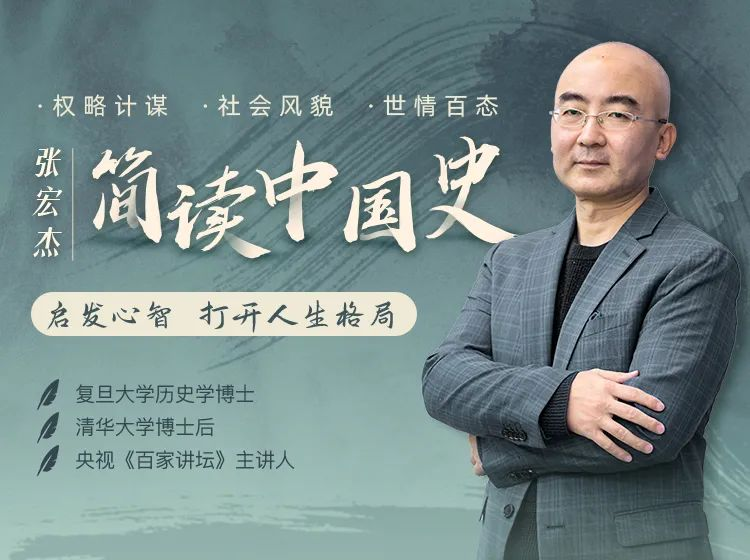
Some say i only listen to professor zhang hongjie
Because you can understand, you can understand