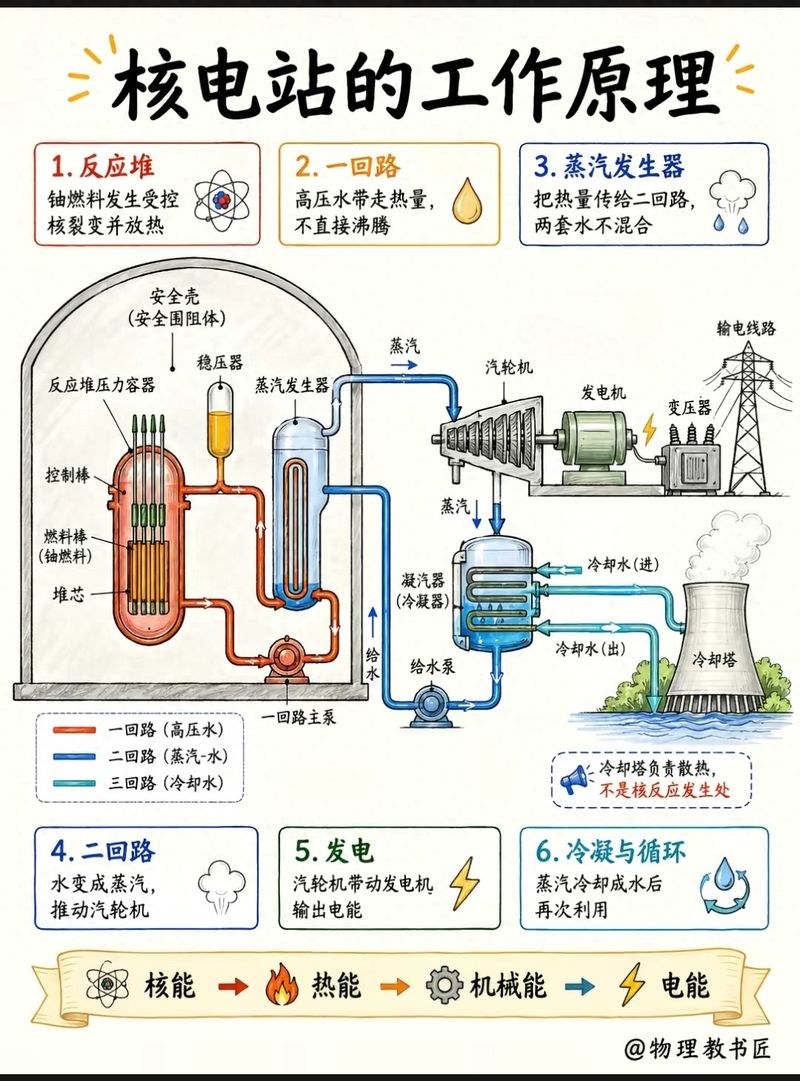
In fact, the principle of nuclear power plants is simple, and the following is a map of the country's mainstream water-pressure reactor, with three water-cycle circuits for energy conversion, and a full-scale nuclear thermal power and mechanical power:
1 core module step-by-step resolution:
(1) reactor + one loop (red pipe, nuclear safety core)
1. Reactor cores: controlled nuclear fission of uranium fuel rods that continue to release large heat energy; the deeper the control rod is inserted, the more neutrons are absorbed and the lower the fission power is absorbed, which precisely regulates the reaction intensity。
2. One round of high-pressure cooling water: to remove fission heat from the reactor pressure vessel, to maintain high-pressure conditions under the steady pressure of the compressor, and to keep the water temperature above 300°c without boiling steaming; to drive the flow of circulation by the main pump of the one round, and to keep the entire course of the journey radioactive and closed。
(2) vapour generator (separate two circuits)
High-temperature high-voltage water flow from the road to the internal steam generator to switch the heat to the external side for water; the two waterways are physically isolated, completely unmixed, and the radioactivity spreads to the second circuit。
(3) second circuit (blue pipe, power generation)
The two circuits heat the water and heat it up into high temperature high vapour, high-speed delivery to the steam engine, shock the wind engine blades rotate and turn thermal energy into mechanical energy; the engine connects the axle to the generator, the rotor cuts the magnetic sensor to produce electrical energy, and the power grid is delivered outside the transmission line after voltage is raised by the transformer。
(4) condensation cycle + 3 times road heat spread (green green pipe)
(a) a low-pressure vapour that is completed enters the condenser, is recondensed by three circuits of cooling water into liquid water, and is re-pressurized to recycle the steam generator
The three-way cooling water extracts sea/surface water, takes the remaining heat from the condenser and sends it to the cooling tower to cool thermal cooling and recycles。
Focused error zone: the cooling tower is responsible only for residual heat dispersion and is completely uninvolved in nuclear reactions and is not exposed to radioactive media。
2. Total energy chain road
Nuclear power (uranium fission) hydrothermal energy (one-way water heating) electro-mechanical energy (voltilization of turbines) (generator generation)
Ii. Core principles of the four-generation technological route for nuclear power & key differences
First generation nuclear power (test prototype pile, 1950-1960)
Rationale:
Based on basic nuclear fission principles, simple water cooling reactors, without a standardized design, which only validates the viability of nuclear power generation, representing: the united states of america's hiping harbor prototype reactor, the soviet union's obninsk reactor。
Core panel:
Inadequate security redundancy design, low stack capacity, high failure rate, no commercial value, technical verification only, have now been fully decommissioned。
Second generation nuclear power (commercial mature pile, major 1970-2000s)
Other organiser
Mainly pressurized/boiling water piles, following a one-way + two-way base structure, standardized bulk construction, supported by basic safety barriers (pressure containers + safety casings), leading to scalable commercial power generation. Representatives: greater asia bay m310 and west house ap 600 early。
Core characteristics:
1. Reliance on active safety systems: pump, power, personnel intervention-driven cooling systems to remove core heat
2. Economically satisfactory, but with insufficient safety redundancy under extreme conditions (the fukushima accident exposed two generation of short-boards: the failure of the plant-wide active cooling system and the collapse of the core)
3. There are now many two-generation improvements (second-generation +) in the country's older fleet of aircraft in transit。
Third generation of nuclear power (currently new main domestic power, walloon i/country and 1/ap1000)
Rationale:
It remains a mature pressure water reactor infrastructure, superseding non-dynamic safety designs, and retaining three physical security barriers (fuel casing + pressure vessel + safety shell)。
Core upgrade distinction:
1. Inactivated safety: a plant-wide power outage, loss of external power, reliance on natural forces such as gravity, natural convection, pressure differentials, and a 72-hour period without external power, manual intervention, sustainable cooling of cores and elimination of core melting
2. Double safety redundancy: thicker safety shells, additional excess cooling pipes, anti-aircraft impact design
3. Nationally produced machines: dragon i (chinese nuclear/chinese nuclear), state i (state voltage cap 1400) is the main domestic force, suitable for national plant sites and transport systems。
Fourth generation nuclear power (research and development demonstration phase, commercial targets after 2030)
Mainstream technology routing principles (6 mainstream stacks)
Including fast neutron breeder reactors, high temperature air coolers, and cold-temperature reactors, which are completely iterative 2nd generation/3rd generation pressure bottom logic:
1. The core breakthrough of the fast reactors: to move away from relying on slowening neutrons, to consume uranium plutonium spent from traditional ballast water reactors, and to increase the utilization of uranium resources from about 1 per cent to more than 95 per cent from three generations to achieve a closed cycle of nuclear fuel
2. Inherent safety: eliminating the risk of core smelting from the core's physical design level, auto-croping under extreme accidents and self-exporting of residual heat
3. Outreach scenario: high-temperature cooling reactors can produce 900°c high-temperature process heat, suitable industry for steel, hydrogen, chemical heating, and no longer limited to simple power generation
Representative projects: demonstration reactors for high-temperature cooling reactors in rock island bay in the country have been networked and demonstration works for the 600mm reactor in xiapur are under way to validate the commercial capacity of the four generations of fast reactors。
Comparison of core four-generation technology differences
Intergenerational, core security logic, fuel utilization, core positioning, national realities
Generation, basic active security, no redundancy, extremely low technical verification, no active aircraft. Group
Second generation, active security systems, relying on external intervention 1%, early commercial power generation, older fleets, progressive longevity
Three generations, active + inert dual safety, 72 hours of self-refrigeration, 1%, major new machine at this stage
Inherent physical safety, closed fuel cycle 90% + power generation + industrial energy mix demonstration stacking, gradual commercial roll-out
Key additions: 1. Our daily new nuclear power plants are all three-generation pressurized water reactors that match the structure of the maps and significantly upgrade the security system, while the basic circuit structure remains unchanged
2. Three or four generations did not reverse the original thermocycle logic, three generations optimized safety-diving capabilities and four generations addressed long-term pains in fuel utilization, multi-species applications and nuclear waste elimination industries。