Since the discovery of natural radioactivity in beckler in 1896, mankind has entered the gates of the nuclear world. Then, in 1919, rutherford et al. Used alpha particles to bomb the nitrogen core for the first time to achieve an artificial nuclear reaction. In 1905, einstein laid the foundation for a more nuclear energy use of the formula for qualitative energy conversion. Atoms consist of atomic cores and extra-nuclear electrons. The energy generated by changes in the extra-nuclear electrons is chemical energy, whereas the energy generated by changes in the nuclear neutrons and protons is nuclear energy (atoms nuclear energy)。
Depending on the form of its use, we can divide nuclear energy into three categories: nuclear decay, nuclear fission and fusion. The so-called nuclear decay energy is the energy released during the radioactive decay of the nuclide; the nuclear fission energy is the energy released during the fission reaction of the heavy cores 235 u, 238 u; and the nuclear fusion energy is the energy released by the condensation reaction of some lighter cores, such as the nucleotide. For nuclear fission energy, it is common to include controlled nuclear fission reactors and uncontrolled atomic bombs. The uncontrollable application of fusion energy is the hydrogen bomb and the manageable application is the nuclear fusion reactor. Nuclear decay energy is also used more widely, including radioisotope tracer, irradiation processing, radiation imaging, etc。
In 1942, fermi built the world's first nuclear reactor (chicago i) at an indoor tennis court at the university of chicago, opening a new chapter in the human use of nuclear energy. Reactors are devices for achieving a controlled, self-sustaining, chain-based nuclear fission response for the use of nuclear energy. The early reactors, however, included mainly the soviet nuclear test reactor, as well as the united states nuclear power plant in hipingport, as well as the heavy water research reactor at our atomic energy research institute and the shielding experimental reactor at tsinghua university, most of which were built in the 1950s and 1960s。
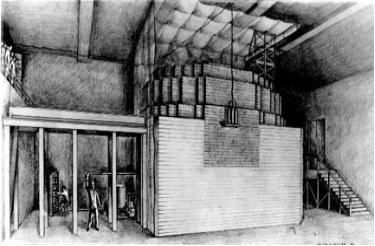
The world's first nuclear reactor, chicago one
The most commonly referred to nuclear power plants, and the most widely applied, are water-pressure reactors, short of water-pressure reactors. The compressors use light water for cooling and slowing agents, and in the course of their operation the refrigerants maintain a relatively high pressure of up to 15 mpa, approximately 150 atmospheric pressures. The pressure is so high that the water flowing through the core does not boil and remains a liquid phase. The core export temperature can be over 300°c, which can achieve a higher heat-replacement efficiency. This is a typical illustration of the working principles of a nuclear power plant in a compact water reactor. In fact, nuclear power plants are similar to the basic thermal cycle principles of traditional power plants, but we have replaced traditional steam boilers with nuclear steam supply systems. The nuclear vapour supply system consists of a number of key equipment, such as reactors, steam generators, voltage stabilizers, main pumps, etc. The coolant flows through cores, releasing the heat from the nuclear fuel fission, taking it from the core, entering the steam generator in heat exchange with the second circuit water and turning the water from the second circuit into a steam-driven wheel. The model of the main equipment of the pressurized reactor is presented here, including nuclear reactors, steam generators and safety casings of the pressurized reactor, as well as conventional islands and associated facilities。
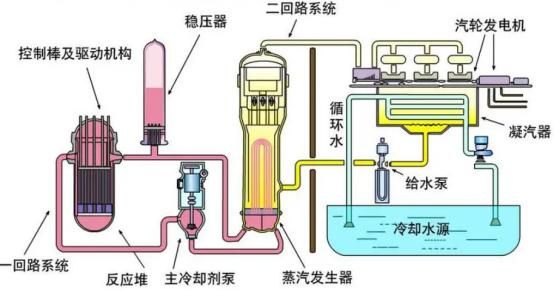
A diagram of the working principles of the pressurized water reactor nuclear power plant
Nuclear power is recognized as a safe, clean and efficient form of energy. Nuclear power has a very high energy density, with 1kg 235 u fully fissioned energy equivalent to approximately 2,700 tons of total combustion power from standard coal. In the fusion response, 1kg of fusion energy is equivalent to approximately 1,100 tons of total combustion energy from standard coal. The high energy density has resulted in the non-requirement of large-scale sites for the storage of nuclear fuel and nuclear waste in the construction of nuclear power plants, thereby reducing transport costs accordingly. At the same time, nuclear reactors typically carry a single fuel, which does not need to be replaced for a year and a half and is of a higher economic nature。
And nuclear power is a clean energy source. Nuclear power plants at the same level of power compared to the annual waste emissions of fire plants not only consume very small amounts of fuel per year, but also do not produce greenhouse gases such as co2, so2. For example, our autonomously designed nuclear power plant, dragon i, can generate 10 billion degrees per year, meet the urban and industrial needs of 1 million people, save more than 3 million tons of coal and reduce more than 8 million tons of co2。
So, is nuclear power safe? The safety of nuclear power is also guaranteed. We prevent the release of radioactive materials into the surrounding environment, primarily by setting up multiple barriers and implementing deep defences to ensure the safety of nuclear power. The multi-lane barrier is designed to prevent radioactive material from being released into the surrounding environment. Among them, the first barrier is the fuel core, the second is the fuel casing that is covered outside the fuel core, the third is the reactor's circuit and its pressure boundary, and the last is that we wrap the entire reactor's nuclear islands (including the reactor and the steam generator, the one-way road, etc.) in a thick steel pre-resilient concrete safety shell. At the same time, we are also designed to further enhance the safety of nuclear power by introducing redundancy, multiple layers of overlapping protection, including equipment and measures。
The evolution of nuclear power since its inception in the 1950s can be broadly divided into four stages. The first generation is the early prototype reactor, the second generation is the commercial power reactor, the third generation is the advanced light water reactor and the fourth generation is the new nuclear energy system。
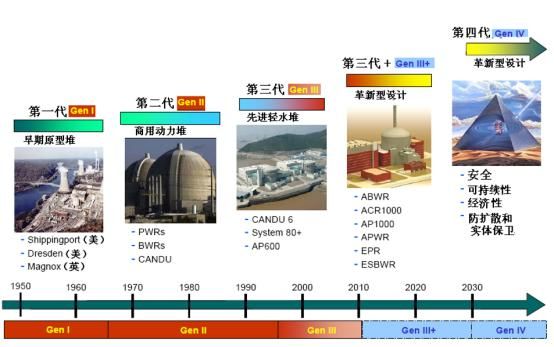
Experience in nuclear power technology development
Among them, the first generation of nuclear power plants was built mainly on prototype nuclear reactors, such as the soviet obninsk experimental nuclear power plant and the hippinport nuclear power plant of the united states, the first commercial nuclear power plant in the world. Most of them were built in the 1950s and 1960s and are now largely decommissioned. The first generation of nuclear power plants proved the viability of nuclear power technologies。
The second generation of nuclear power plants, commercial reactors built in the 1970s, have more operational experience, more technological maturity, better economic and safety certification and continuous improvement. Second-generation nuclear power plants have also proved economically viable。
Third-generation nuclear power plants, which are more secure, are designed to prevent and mitigate serious accidents and can compete economically with natural gas units. For example, on 30 june 2018, the world's first ap1,000 nuclear power plant was built in three nuclear power plants。
The fourth generation of nuclear power plants has been further upgraded in economic and safety terms compared to previous generations, mainly as a result of major innovations in nuclear reactors and fuel cycles, while safety and economy have become more advantageous and better oriented towards the long-term development of nuclear energy。
Our nuclear industry began on 15 january 1955, when, at the expanded conference of the central registry, our leaders made great strategic decisions to develop china's atomic energy enterprise and to develop atomic bombs. Our first atomic bomb exploded successfully on 16 october 1964。
Some of our early nuclear power units were imported mainly from abroad. For example, nuclear power in greater asia bay and ridge australia was introduced by the french nuclear power unit m310; the heavy water reactor built in the third phase of qinshan, which introduced canadian technology; and vver from russia, which was imported by tian wan, and ap1000 from the united states. Our nuclear powerers are also constantly carrying out autonomous innovations that have made it possible to break through difficulties and have finally achieved autonomy, including a range of advanced nuclear power technologies, such as the “state and one” of dragon i, high-temperature cold reactors and sodium fast reactors。
Our main nuclear power base. The first is the qinshan nuclear power plant, located in hangzhou bay, the first self-designed, constructed and operated nuclear power plant of a compact water reactor in the country, which achieved its first grid-connected generation in 1991. And nuclear power in qinshan has been hailed as “the glory of the nation”, ending the history of nuclear power in mainland china. The qinshan nuclear power station also carried out a heat demonstration project in 2021。
The first phase of the project consisted mainly of providing carbon-free, clean and efficient nuclear heating to nearly 4,000 households in three sub-districts of sea salt. Over the more than 30 years since its establishment, qinshan's nuclear power has generated more than 73 billion kwh, equivalent to a reduction of 680 million tons of carbon dioxide, which has made an important contribution to the implementation of our two-carbon strategy. The greater asian gulf nuclear power plant, located on the eastern side of shenzhen, was officially opened for commercial use in 1994 and is the first commercial nuclear power plant in the country to be built with foreign capital equipment and technology。
As you may learn from news reports, the “walong one” nuclear power plant is a three-generation nuclear power plant with full ownership of our intellectual property rights and, like china's high iron, has become a “national card” for our country's nuclear power technology. On 27 november 2020, the first global nuclear power plant, zhualong i, was launched. On 20 may 2022, the hwalong i offshore dump, which brought k2 nuclear power plant units into commercial transport in karachi, pakistan, also filled a third of pakistan's own power gap。
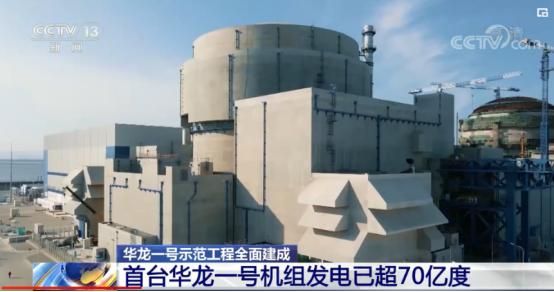
Our country's national name card for nuclear power heading to the world — the dragon one —
At the same time, our country has carried out useful explorations of the fourth generation of advanced nuclear energy technologies, with fruitful results. On 20 december 2020, the first global grid-connected nuclear power plant of the first global ballbed modular high-temperature cold reactor. The difference between high-temperature cooling reactors and water-pressure reactors just described is that it uses helium for cooling agents, graphite for slowing agents and reactor structure materials, with better safety and higher export temperatures, thus making high-temperature cooling reactors more efficient and 50 per cent more efficient, equivalent to 1. 5 times the capacity of the same heat-voltage water reactors. And because of its higher export temperature, it has reached the highest temperature achieved by modern industrial-scale reactors. - 750°c, which allows cogeneration and can be combined with the steel industry, etc。
Over the past few decades, our nuclear power has passed from nothing to nothing, from weakness to strength, from learning to introducing to autonomous innovation, and has crossed from running to running. Our current nuclear power technology and combined power are also among the world's first parties. Nuclear power will also continue to contribute to our green, low-carbon and high-quality development, contributing to the preservation of the qingqingshan and building a beautiful china。