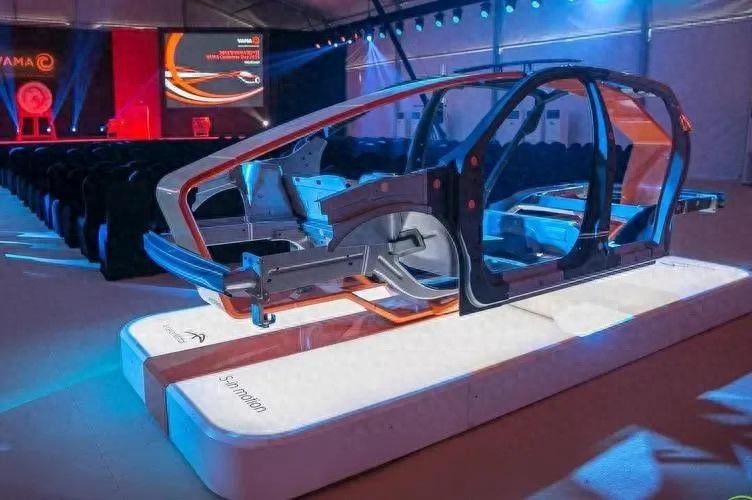
In recent years, light quantification has become the most frequently mentioned feature of the launch of new cars by individual companies, up to overrun and down to domestic vehicles. However, although light quantification is taking place, there are many ways. It's like a mathematical certificate, it's a direct one, it's a reverse one, but it's very different. The issue of light quantification was raised in the first generation of bmw 7 when it was released, so let's see today how light quantification works with bmw 7 models。
Bmw smart light quantification structure
The new generation of bmw 7 introduced the smart light quantification structure of bmw, which draws on technology developed by bmw i vehicles. The complete new bmw 7 is the first of the same-grade models to combine high-intensity carbon fibre enhancement composites with steel and aluminium alloys. Bmw 7 is a light-quantification approach that is certainly cost-effective, and such a technology is justified in the flagship model。
As a result of this light quantification method, the weight of new vehicles was reduced by up to 130 kg compared to the previous generation. In fact, this figure refers to the reduction in the mass of the whole vehicle. If you look only at the white body, the new generation of bmw 7 is reduced by more than 200 kg. The difference between the two numbers is the weight of the configuration on the vehicle。
Mercedes s: aluminium hybrid
It's more traditional to be mercedes than bmw 7 is. Cash level s is still used for light quantification through high-tech materials such as aluminium and composites。
In fact, since 1990, mercedes-s level has been focusing on light quantification, using aluminium hybrids. Over the years, the third generation of aluminium mixed car casings now contain more than 50 per cent of the aluminium content, and aluminum materials are used on the roof and front. Although the light quantification technique of mercedes does not seem to be as powerful as it appears, it can be reduced successfully by 100 kg in such a traditional way. In addition, although aluminium materials were used, the geometric structure of the body parts was optimized during the design process, resulting in a 50 per cent increase in the resistance of cash class s vehicles。
Audi a8: ultra light quantification technology
Audi ultra light quantification is a technique that audi can improve vehicle efficiency by improving materials for manufacturing, improving the structure of parts and thus reducing body weight. Initially, this technology was applied only in the field of audi racing, and it is now widely available in the production vehicles of audi civilian。
As a pioneer of all-aluminium alloy vehicles, from 1994 to the present, audi has produced more than 550,000 rigid safety vehicle types. This body structure is much less heavy than the steel body and is much more intense than the steel body. At present, the space frame structure of the audi's secure body is like a biological skeleton built with high-strength aluminium. Today, products have grown to the third generation, a 60 per cent increase in strength over the previous generation. In addition, approximately 50 per cent of all aluminium required for the manufacture of the audi a8 body can be reused through recycling. It seems commendable that light quantitative technology for “light plants” not only reduces weight but also effectively avoids material waste。
Jaguar xj: all aluminium body
The light quantification of jaguar xj is simple, it's the whole aluminium body. In 2003, the jaguar xj model began to carry its body in full aluminium. The seventh generation of jaguar xj, built with a second generation of light additional quantification of aviation technology, was officially launched in 2009。
Because of the sensitivity of aluminium alloy materials to temperature, the use of traditional welding processes to connect body parts reduces the intensity of materials. Furthermore, materials are susceptible to physical alteration after heat, resulting in lower accuracy of body parts. As a result, welding has not been used on the whole of the jaguar's aluminum vehicle to replace welding with welding and to increase the strength of inter-component connections with the adhesive process。
As a result of the full aluminium body, jaguar xj used to have 150 kg less mass than other vehicles of the same grade. However, the whole aluminium body also poses a problem, namely, that when the body cover is damaged by external force, it cannot be repaired and welded and can only be replaced directly. As a result, some vehicle costs are also incurred。
Finally, let us look together at the four automobile companies mentioned above, whose flagship vehicle type uses light quantitative techniques to provide the quality of their preparation. For the sake of fairness, we have chosen the top vehicle type with a 3. 0 l v6 engine, but only a new generation of bmw 7 is 740 li, which is a rear wheel drive。
As can be seen from the table, bmw light quantification techniques should be the most effective. While a rear-wheel-drive vehicle would be lighter than a four-wheel-drive vehicle, it would still be lowest even if it were given a weight of 200 kg. Retrospective emphasis has been placed on the pan-alumanese jaguar, which is the most heavy of the four cars, and it seems that comrades who have not yet succeeded in the revolution still have to work. Benz-s's performance is not ideal either, is it because it's too many configurations in the car to get so heavy? The “light plant” is performing well and the aluminium framework structure appears to be working well。
In general, although there are differences in light quantification, the main objectives are to reduce weight, increase economy and improve vehicle manipulation. However, the state-of-the-art light quantification technology is now used mainly in flagship vehicles, and it is believed that consumers will be more satisfied if it can be used at an early stage on medium- and low-end models acceptable to most consumers。