The successful adoption of the draft law on foreign investment, which was submitted to the thirteenth national people's congress on 8 march for consideration at its second session, will be a fundamental law in the area of foreign investment. It will be important for the construction of a new system of open economy in the country and for the creation of a climate of rule of law, internationalization and facilitation。
The enactment of foreign investment laws is an objective requirement for the reformulation of our foreign investment legal system
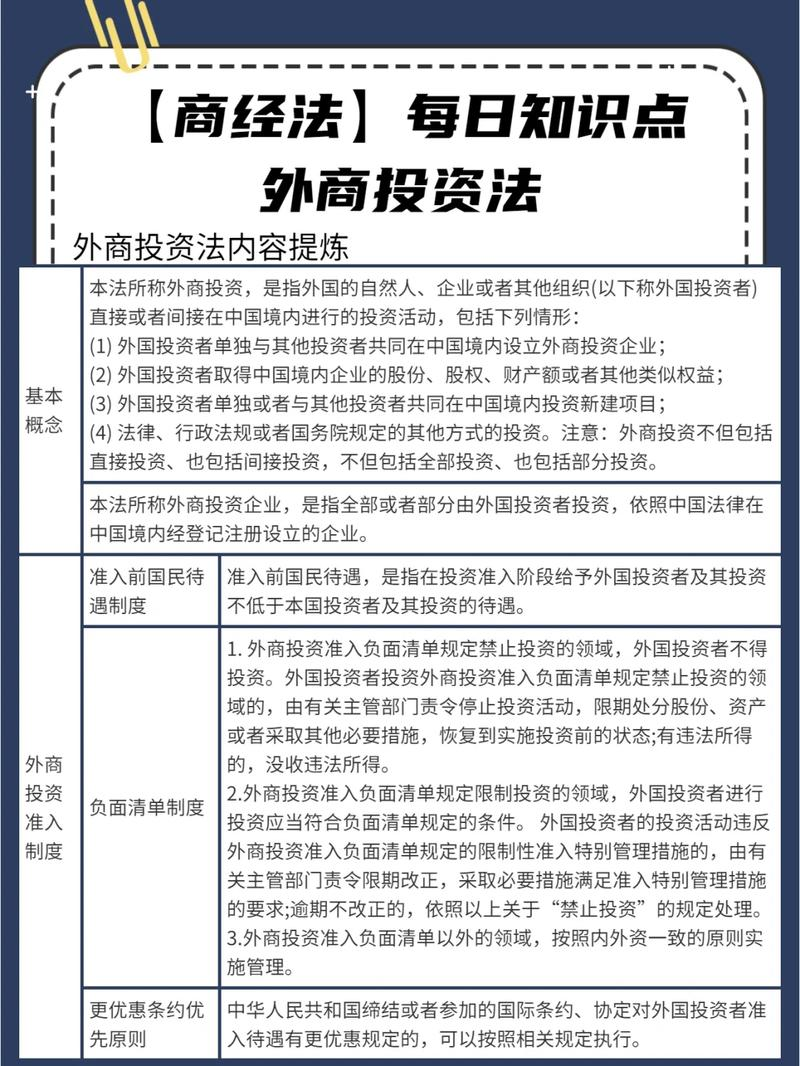
For 40 years of reform and opening-up, despite the fact that we have developed a legal regime for foreign investment based on the “three acts on foreign investment” and supported by sectoral laws, supplemented by administrative regulations, sectoral regulations and so on, there is still a need to reform our legal regime for foreign investment in a systemic and institutional manner, as required by the evolution of the international, domestic and economic trade and investment situation and, above all, by the reform of our foreign investment management system and the reform of our economic system。
Our “three foreign investment laws” are in fact hybrid legislation integrating commercial organic law and foreign investment law, which have provided strong legal guarantees of the rule of law for our foreign business investment enterprises. However, with the gradual improvement of the legal systems of the main market players, such as our corporate law and the law on partnerships, and the convergence of domestic and foreign enterprises, the three foreign investment laws are no longer adapted to the requirements of the new era for reform and liberalization, and the promotion, protection and regulation of foreign investment practices are difficult to achieve in a systematic manner. Thus, the ccp central state council's opinions on the establishment of a new system for an open economy call for “a new basic law on foreign investment, incorporating into the basic law on foreign investment the elements that regulate and guide the behaviour of foreign investors and their investments”. The general content of the form of organization of foreign enterprises, their activities, etc., may be regulated by uniform laws and regulations applicable to the various market subjects, and by uniform laws and regulations in accordance with the principle of uniformity in domestic and foreign investment”. It can be said that foreign investment law-making is necessary, feasible and urgent。
Foreign investment law is the legislative expression of our basic policy of maintaining openness to the outside world

The reform of openness and the use of foreign investment are inevitable options for our socialist modernization. The 11th plenum made the historic decision of china to implement reform and openness. Comrade deng xiaoping pointed out that no country could be isolated in order to develop. In 1986, the state council issued the regulation on the promotion of foreign investment; in 1998, the central and state councils of the central republic of china issued a number of opinions on the further expansion of external openness and the increase in the level of use of foreign investment; in 2010, the state council issued a number of opinions on the further development of the use of foreign investment; and in 2015, the central and state council issued a number of opinions on the construction of a new system for an open economy, with the full deployment of innovative foreign investment management systems. The secretary-general of xi stated that china's economic development over the past 40 years had been achieved in conditions of openness, and that future high-quality development of the chinese economy must also take place in more open conditions。
The draft foreign investment act under consideration clearly states: “the state adheres to the basic state policy of openness to the outside world and encourages foreign investors to invest in china in accordance with the law; the state pursues a high level of investment liberalization facilitation policy, establishing and improving foreign investment promotion mechanisms and creating a stable, transparent, predictable and level playing field in the market environment.” this is the legislative expression of our fundamental policy of maintaining openness to the outside world, and it is to be hoped that the new paradigm of full openness in our country will promote reform, stimulate innovation and promote development, as well as strengthen confidence and determination in foreign investment。
Foreign investment laws will provide stronger rule of law guarantees for foreign investment
The structure of the chapters of the draft foreign investment act, as well as its specific provisions, shows that the promotion and protection of foreign investment law is the main tone of our foreign investment policy, while the protection of foreign investors ' rights is one of the cornerstone regimes of foreign investment law. In recent years, our country has made significant efforts to improve the business environment, but there have been some criticisms and challenges from foreign sources, such as the exclusion from public procurement of products produced in china by foreign enterprises, and the perception by multinational enterprises that our intellectual property protection is inadequate。
The draft foreign investment act under consideration, in turn, responds positively to foreign concerns by making clear in the general section that “the state shall protect by law investments, earnings and other legitimate interests of foreign investors in china”. In the chapter on investment promotion, it is clearly stated: “the state guarantees foreign investment enterprises participation in government procurement activities through fair competition in accordance with the law. Government procurement shall be treated equally in respect of products produced in china by foreign investors in accordance with the law.” in the chapter on investment protection, it is clearly stated: “the state protects the intellectual property rights of foreign investors and foreign investment enterprises, protects the legitimate interests of intellectual property rights holders and related rights holders, and encourages technical cooperation based on voluntary principles and commercial rules. The conditions for technical cooperation in the process of foreign investment are determined by equitable consultation among the investors, and the executive branch and its staff may not use administrative means to enforce the transfer of technology.” thus, the adoption of the draft foreign investment law would provide strong legal guarantees for foreign investment and would certainly increase the attractiveness of foreign investment in chinese markets. (by meng goose north, professor, chinese people's law school)