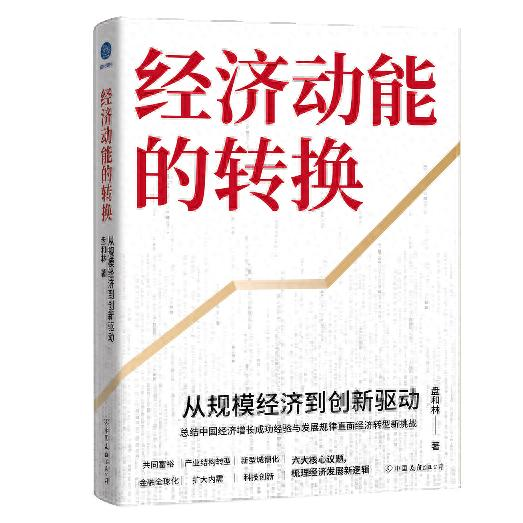
The professor of disco and lin, economic dynamics conversion. Chart
The new book, economic dynamics transformation: from economies of economies to innovation drives, by professor accompanies the underlying logic of the evolution of china's economic kinetic energy since the reform and liberalization. Its core narrative lines are clear and strong: china’s economy’s success stems first and foremost from the activation of the traditional dynamic of economies of scale through realistic institutional changes (e. G. Property rights reform, marketization) and, ultimately, from a new stage of development driven by science, technology and innovation。
From making big cakes to distributing cakes
At the origin of wealth creation, “realism” is reflected in a profound reform of the property rights system. The combination of ownership reforms, from rural “package-to-house” to urban “contracting-to-plant” and state enterprises, which are essentially linked directly to personal gain through clarity or simulation of property rights, has greatly motivated micro-subjects. This can be seen as the first leap in china's wealth logic: from a planned distribution of the planned economy to a market economy of “a combination of labour and factor contributions”. The results had been significant in addressing the issue of “saturation” and in accumulating initial capital for subsequent industrialization and urbanization。
However, simple internal incentives quickly encountered bottlenecks. In this book, professor tsai and lin have ably pointed out that the evaporation of the chinese economy cannot be separated from its enormous scale effect. This constitutes the most important wealth logic of the 40 years before the reform was opened: cost reduction through economies of scale and market occupation. On the supply side, a large population base allows china to independently form a whole industrial chain, from buttons to high iron, from toys to computers, and to produce domestically, creating an unparalleled cost advantage. On the demand side, an equally large and expanding domestic market ensures that any marketable product can quickly reach a profitable scale. This “smuggling dividend” is most striking in the real estate sector: population urbanization brings with it a massive housing demand, land finance and financial leverage together magnify the supply capacity, co-create two decades of housing boom and recreate the balance sheets of government, business and residents。
However, the book does not avoid the path dependence and challenges posed by economies of scale, namely, “inner-roll competition” and “trade friction”. When the scale expands to a certain extent and the incremental market turns into a stock market, competition among firms becomes hottening, price wars become the norm, profit space is extremely constricted, and a circle of “incremental gains” emerges. Externally, large export volumes are bound to be accompanied by large trade surpluses, triggering increasing international trade friction. The book goes on to point out that this growth model, which is centred on scale, is based on the logic of the distribution of wealth, which is “high water surge”, but once the rate of “water” (scale) rises slowly, competition between ships and between people on board over “water levels” (wealths) will be unprecedented, with problems such as the fragmentation of rich and poor and regional imbalances. This means that the logic of wealth, centred on making big cakes, is no longer sustainable and how to divide cakes and make new cakes becomes an urgent new subject。
From “population dividend” to “innovation dividend”
Faced with the decline of traditional kinetic energy, the book points the way to relief to innovation. This marks a second leap in china’s wealth logic: from economies of scale that rely on factor inputs (labour, capital, land) to innovative economies that rely on full factor productivity gains。
This book provides a detailed analysis of why china must embark on the path of science, technology and innovation. First is the pressure of global competition. As a “world factory”, china faces cost competition from the latter countries at the lower end of the value chain, while at the higher end of the chain it faces a technology blockade from developed countries. Failure to innovate leads to a situation where there is a “front stop, followed by a chase”. The second is the need for domestic development. In the past, the model, which was driven by factors such as the demographic dividend, the land dividend, is less effective as labour costs rise and land resources are limited. More importantly, it is only through innovation that technological barriers are created that enterprises can achieve excessive profits, workers can earn high wages and the state can cross the “middle-income trap”. At this point, the core source of wealth is no longer the scale of production, but the monopolistic rents generated by knowledge, technology and business models。
So how can innovation be stimulated? The book sets out two key logics, “first-to-first” and “clear property rights”. The “first-to-first” expression of great policy wisdom. It means adopting an inclusive regulatory approach to new technologies and practices, allowing them to try first, improving rules in practice rather than strangling new possibilities with the old framework. The rise of china's internet economy benefited precisely from the early relatively relaxed development environment. From poaching to wisps, from dripping to bytes, none of them grew up in the “first up”. Clarity in property rights is the fundamental guarantee of innovation. Particular emphasis is placed on the importance of intellectual property rights. Strong innovation incentives are created by giving innovators temporary monopoly (patents) to recover high amounts of r & d inputs and obtain excess returns. From china's 5g to the pharmaceutical research and development of medicinal condolences, a clear definition of property rights is the constant input of an innovative heart pill。
The book also explores in depth three key elements of enabling innovation: capital, talent and data. In terms of capital, the development of multi-level capital markets such as venture capital (vc) and private equity (pe) replaced traditional bank credit and became key supporters of the “high risk, high return” characteristics of innovative enterprises. In terms of talent, the book points out that china's large group of engineers and graduates of higher education constitute a “brainbrain dividend”, but there is a greater need to stimulate originality by reforming the educational and scientific research system. In terms of data, the book foresees the critical role of data as a new factor of production, and the breakthrough development of artificial intelligence (ai) is based on big data (new “economies of scale”), strong algorithms and advanced algorithms. The rapid rise of chinese ai firms, such as deepseek, has brought about an innovation breakthrough at the algorithm level, using china's wealth of applications and data resources。
This series of shifts implies a fundamental change in the logic of wealth creation. The wealth effect of innovation is no longer evenly spread, but is characterized by a strong “winner-for-winner” character. A small number of successful innovators will have a huge return, which in itself is a reward for adventure and wisdom. At the same time, the innovation economy has introduced new demands on the role of government: moving from direct involvement in the economy, leading investments, to creating a good culture of innovation — protecting property rights, preserving fair competition, providing basic research support and procuring innovative products. This shift is reflected in the reference to “demand-based thinking as an alternative to subsidized thinking”。
China's structural transformation “revelation”
Throughout the book, the book is a “revelation” that attempts to reconcile the logic inherent in china's economic development at the theoretical level. It honestly reveals the profound inevitability of a transformation driven from scale to innovation, and systematically describes the institutional changes and elements necessary to achieve this transformation。
The narrative of the book is strong and its “practical” approach is consistent. It recognizes the historical virtues of economies of scale and does not shy away from the inherents and frictions it brings; it aspires to the future of an innovative economy, and it is acutely aware of the rigidities that exist in terms of originality, institutional incentives, etc. This ambivalence of pragmatism is in itself an important component of the “innovation friendly” environment。
However, the book also leaves some room for further reflection. First, innovation drives the tension between common wealth. While innovation brings great wealth, it can also exacerbate the income gap between capital and skilled elites and workers in general. How innovation dividends can be more inclusively shared through policies of redistribution and equalization of opportunities, such as taxation, social security, education, etc., is a subject mentioned in this book but which needs to be explored in greater depth in the future. Secondly, the balance between openness and security. The book highlights the importance of financial globalization and technology exchange, but in the current international environment, the importance of the security and controllability of the supply chain of the industrial chain has never been greater. The balance between the expansion of openness, the introduction of high-end elements and the preservation of the economic security of the country is a major test on the path to innovation. Finally, the development of a culture of innovation. Much of this book is written at the institutional and factor levels, but the spirit of innovation lies in a culture that dares to take risks and tolerate failures. This requires profound changes in social perceptions, educational concepts and even the media environment, no less difficult than any institutional change。
In short, economic dynamics transformation: from economies of scale to innovation drivers provides us with an insightful framework for understanding the past, present and future of the chinese economy. It is a clear indication that china's wealth logic is undergoing a profound revolution: a shift from an expansion on a sweat-driven scale to an innovative fission driven by wisdom. This path of transition is by no means an easy one, full of known and unknown challenges, but the direction is clear. The success of this dynamic transformation will determine not only whether china will be able to cross the middle-income trap, but also the fundamental place of the chinese nation in the future global landscape。