


How do you read through the latitude
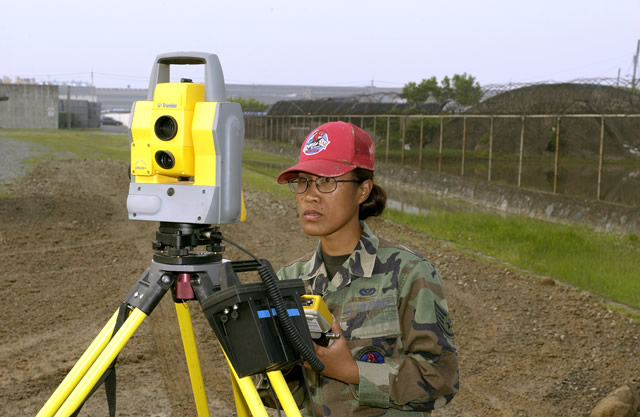
Before learning about instrument structures, two of the most commonly used concepts are identified: horizontal angles and vertical angles. As a measurement tool, all structures are designed around the function of measuring angles, to which the basic structure and interrelationships between components are also subject。
I. Vertical and vertical angles
Horizontal angles
Definitions: the angle of the projection line (i. E. The horizontal line) on the horizontal side of the line of sight。
Range: 0-360o clockwise
2. Vertical angles
Definition: is the angle of the horizon and its corresponding horizontal vision。
Range: -90 +9000 up plus minus
Supplement: the relationship between the vertical angle and the ceiling range is: α = 900-z
Ii. Basic structure and its interrelationships
Learning from the concepts of horizontal angles and vertical angles makes it clear that, in order to obtain a horizontal angle vertically, the horizontal, lead protruding and vertical orientations must be correctly identified, so that the instrument structure must constitute the above-mentioned baseline and line and maintain the correct relationship between them。
1. Basic structure
I. Telescopes: make-up of visual axes, magnification of images, precise approval
Ii. Vertical axis: the axis to the left and right of the angle, with a view to the target at different locations
Iii. Horizontal axis: telescopes lean over the rotational axis to target different heights
Iv. Vertical disk: measuring vertical angles
V. Horizontal scales: measuring horizontal angles
Vi. Reading prisms and micrometers: reading disk readings
Vii. Normal levelrs: indicator of station horizontal and lead plume to guide vertical axes
Viii. Vertical desktop indicator standards: indicator for vertical desktop reading indicators, guide reading indicators
Ix. Basements: vertical axes, calibration instrument helix, base
2. Interrelation of major components
Vertical axes vertically with a ranger axis
Vertical axle and horizontal disk are junction and through its centre
• horizontal axis should have a vertical axis, with an angle axis to the horizontal axis straight
Horizontal axis is tangent to vertical disk and through its centre
The reading indicator of the vertical palette must be horizontal or condensed when the indicator calibration is medium straight
Add: to sum up the above five relationships, the three axes need to be right and the two discs need to be right. Straight
Three, several common optical longitudes
The optical latitudes are of many kinds and the structure and interrelationships are essentially identical. These instruments are classified by precision, namely j07, j1, j2, j6. "j" is the initial letter of the "labour" spelling, with the lower mark indicating the accuracy of the angle (i. E. The error in the angle) and the more common type of the wittert3 used in the teaching materials is the j1 type, chase 010 is the j2 type and wittt4 is the j07 longitude。
Renumbering
(b) the rotation of microwheels, where the disc moves relative equals the routing, so that the reading is referred to as the repetition method using the reverse gravitation. Here we give the example of the reading method of the t3 instrument, which is typical. We use the t2 type of instrument, but because t3 is more typical, t2 is simpler than t3 and may be used in future work environments, we learn t3 and other types of instrument are much the same, and we believe that once we have the t3 reading method, we can adapt. T3 and t2 readings will certainly be explained during the presentation。
1) the value of the microdisk
The minimum spectra value for the t3 instrument disk is (15 at one time). When the rotational microspiration causes the palette to move in relative reverse by a fraction (4 ' ), for the table indicator, the reverse is actually only half-size, equivalent to 2 ' . (example: two persons walk in relative motion). At this point, the microdisk of the microscope designs 60 large cells (in other words, one week) for the rotation of the two lines relative to the movement of a fraction, which are subdivided into 10 cells。
Compared with t3 instruments: the microdiscs of the t2 instrument microscopes designed to rotate the two-diverse motion in relative motion into 60 large cells, which are subdivided into 10 cells each
So:
Large cell value for microdisk: 2” (t2 instrument: 1)
A small cell of the microdisk: 0. 2” (t2 instrument: 0. 1)
In short, since the microdisk of the microscope designs 60 large cells for the rotation of the dichotomy in relative movement of a fraction, the reverse is actually like moving only half a grid each, making the value equal to twice the number of angular seconds, so multiplying the direct reading of the microdisk by two is the reading in an angular seconds. Namely:
2) presentations of examples
Microdisk readings are 0, and the discs are like vertical and parallel glass panels。
A: distance of 5°4 split to indicator; b: distance of 185°4 split to indicator; general, a=b. If you read a, you get the angle. How do i get a
The value of a and bs can be read from the calculator, as shown in figure (b). The 5°4 split and the indicator overlap were given a value and the 185°4 split and the indicator were given b values. Middle:。
As mentioned earlier, when the 5o 4 splits are merged with 185o 4 splits, each of the two fractions must move, and the readings on the microdisk are directly m, which can be seen as having an automatic medium base known as the "average effect"。
3) description of special cases
(1) indicator line
If the indicator line is in the correct position, a =b, as shown in the figure, also coincides with the indicator line when no and (n+180)o are split. So, for the median m, it is possible not to set a gravitational line, and in fact, there is no indicator line in the window for the desktop reading of some instruments (e. G. Chase 010)。
(2) t2 instrument reading
The value of the calculator is different from that of the t3 device, with a large grid of 1 and a small grid of 0. 1, so the t2 device does not need to multiply the value by 2 and the value itself can be considered as an agular second reading。
Even for the t3 instrument, the readings do not need to be multiplied by two readings, two measurements are obtained and the medians are obtained with the final results, which can only be obtained by adding up the values that were read twice。
(3) reading points when the indicator line is not central or does not exist
We know that the line (repeated) of 180o is equal to the indicator. So we can read the number of grids between the two lines directly after re-coding, then multiply it by half the value of the grid (2 ' ), which is the correct reading。
(4) no and (n+180)o splits are read when they appear in the dashboard window。
It is not possible to read the fractions between no and (n+180)o directly, at which point the value of n should be equal to the corresponding fractions of two degrees (the t3 instrument is 30) minus the fractions between (n+1)o and (n+1+180)o. The fractions of figures 3-28 are: 30-6 = 24, 24 x 2 = 48'
4) readout program summary
1 rotation of the microspiration to recoup the positive-reverse composition close to the indicator line (the centre of the field of view)
2 reads the positive partition of the left side close to the indicator line (central sight field) no
3 reads the split between no and (n+180)o n, multiplied by half of its fraction value: g/2, received a "score" reading: nxg/2
4 reads the seconds of the microdisk。
The method of use of latitudinals



