23. What are the trends in disseminating impact studies? What are the new topics
A: today, in the twenty-first century, humanity has entered an era of high levels of informatization. Trends in social and global informatization will inevitably lead to the expansion of the field of communication impact studies and the transformation of research subjects. According to rogers, a well-known american communicator, future research on communication effects will be a study of the information society as a whole and will continue to receive attention, in addition to some of the traditional topics of mass communication, and the “social, behavioural and psychological impact of the spread and use of new communication technologies” will be an important element of impact research。
According to another communications scholar, salvagio, new media research is different from traditional media research in terms of its perception of “effects” and “effects”. In particular, traditional research is primarily based on changes in individual attitudes or actions; and since the use of new media itself implies changes in individual lives and behaviour, and the process of popularization takes a very short time, communication scholars are directly confronted with the problems of social change and macro-effects caused by new technologies and media。
Research on new topics should include social pathologies in the information society as a result of the spread of information on new and traditional media2 and changes in social life and behaviour of the “relationship gap”4 “knowledge gap”4
24. What does computer networking mean for traditional mass communication
Response: computer networking constitutes a challenge and a shock to traditional mass media and offers new opportunities for their development:
Overall, the rise and growth of the computer network industry has placed considerable competitive market pressure on the mass media. The internet, as a product of new and advanced information technologies, is advanced and interactive
I. Topics for discussion:
What are the general functions of mass communication
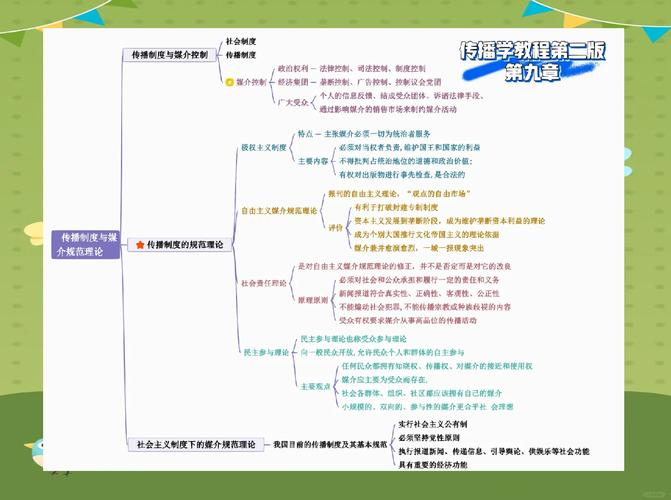
Response: the general function of communication is divided into two levels: one is to analyse the individual (individual) function of transmission from a psychological perspective, and the other is to analyse the social function of transmission from a sociological, economic and political perspective. The former is mostly about interpersonal transmission, while the latter refers exclusively to the social function of mass communication。
The four main social functions of mass communication are the one proposed by laswell: the function of environmental monitoring, the social coordination function of mass communication, which provides the basis for decision-making and action, the social coordination function of mass communication, which is the function of social integration through choice of information, interpretation and comment, the cultural communication function of mass communication, the transmission of knowledge, experience, the educational function of values, the recreational function of mass communication proposed by wright。
2. What are the strengths and weaknesses of the control theory model
Response: mode of control theory: mode of transmission process guided by theory of control. The change from "one-way straightness" to "two-way circularity" introduced the "results" mechanism。
The control theory model is changed to “one-way linear” to “two-way circular” and introduces a mechanism of “revenue” to reflect more objectively and accurately the actual transmission process。
Question no. 1. There is a tendency to create illusions that appear to be passed on among “communicators”, that they are accorded full equality of status and opportunities。
2. A circular formulation can also be misleading. The shortcomings of the monetary model were only half corrected。
What is the content of the “knowledge gap theory”? How
The “knowledge of knowledge” theory is a theoretical hypothesis developed in 1970 by american communicators ticino et al. On the basis of a series of empirical studies. According to this theory, the knowledge gap between the high socio-economic status is tending to widen, as the higher the socio-economic status often obtains information faster than the lower the socio-economic status, the more information the mass media transmits。
The mass dissemination of information, both for the socio-economically high and the low, will lead to an increase in knowledge, but as the socio-economically high have access to information and knowledge much faster than the latter, the “knowledge gap” between the two continues to widen over time。
An overview of the “agenda functional” hypothesis
A: makum and shaw found that there was a first high degree of correspondence between the electorate's judgement on important current issues and those repeatedly covered and highlighted by the mass media. The issue of mass media coverage as a matter of importance is equally reflected in public awareness; the more emphasis the media places on the issue, the higher the public interest. Makum and shaw see mass communication as a function of setting the “agenda” for social and public affairs, and media news coverage and information dissemination activities, in a way that gives different degrees of prominence to the various “issues”, influence the judgement of the world in question about “significant matters” and their importance。
Characteristics: (1) communication effects are divided into cognitive, attitudinal and operational dimensions. The “agenda-setting function” hypothesis focuses on the effects of the earlier stage of the process, namely the cognitive level。
(2) the “agenda-setting function” hypothesis examines the medium-term, integrated, macro-social effects of a series of reports with a longer time horizon as a whole of mass communication。
(3) the “agenda-setting function” theory implies a media perception that the media are institutions engaged in “environmental re-establishment”. That is, media coverage of the outside world is not a reflection of the mirror, but a purposeful trade-off。
The agenda-setting function is a theoretical hypothesis based on leipman's “teather environment” and raswell's concept of “environmental surveillance function” for dissemination. Its concept is constantly being refined and clarified:
(1) the role mechanisms for “agenda-setting functions” are becoming clearer. Scholars look at the “agenda-setting function” mechanisms for mass communication from three perspectives: cognitive models, prominent models, priority models。
(2) undertake a more in-depth study of different types of “topics”。

(3) analysis of different features of “agenda setting” in different media. For example, the “agenda setting” of newspapers has a greater impact on the longer term “the order of importance”, while the “hotting effect” of television is more pronounced。
Shortcomings: it highlights only one aspect of the media that “sets” or creates social issues, and does not address one aspect that reflects them. While the media's “agenda-setting function” is generally powerful, it cannot be absolute。
5. An overview of the five levels of dissemination
Response: there are five main levels or types of human communication: self-dissemination, interpersonal communication, group communication, organization of communication and mass communication。
Self-dissemination refers to each individual's own self-information communication, which focuses on feedback from the neurophysical and psychological mechanisms of the human person。
Interpersonal communication is broadly and narrowly defined as face-to-face exchange of information between individuals, or personal communication, including through the use of the telephone, correspondence and other media; it broadly includes group and organizational communication, forming the level of first-hand, group and organization of three interpersonal communication。
The main modes of organizational communication are top-down, bottom-up and horizontal
Mass communication refers to the dissemination of information to an extremely wide audience through modern communication media; characteristic 1: it requires the transmission of information through specific media whose characteristics are open, socially profitable, large and anonymous, and disparate, three mass communications which are essentially a one-way flow of information, with limited feedback from the audience, and the rapid development of modern science and technology, particularly electronic technology, which lags behind, making the transmission of information to the general public faster and more widely accessible, mostly by organizations (communicators) and professional communicators, rather than by individuals。