Introduction to the theory of 01 density general communications
Scholars in the fields of condensate physics, material chemistry, quantum chemistry and life sciences often use the first principle of calculation to explore, interpret or study, predict the nature of the material. However, the initial entry may be plagued by a multiplicity of theories, general letters and abbreviations in english, which make it difficult to clarify the logic. The aim of this paper is to provide a clear entry path for beginners。
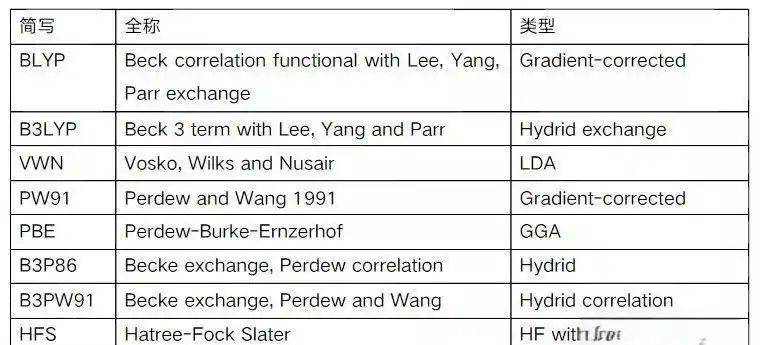
Within the framework of the dnt, our focus is on the state of distribution of electronics, i. E., the density of electronics. In short, the coordinates of the electronics determine all the nature of the object under study. But how do you describe this electron density in mathematical terms? This is not only a matter of long-term exploration by scientists, but also of multiple and varied density profiles. For example, the b3lyp, which is common in the literature, is a popular and broad letter of density, which is highly appreciated for its interoperability and low requirements for computing resources。
The acronyms of these density letters often contain information such as the developer's abbreviation and age of development, such as siblings of the same family, which together form the extended family of density。
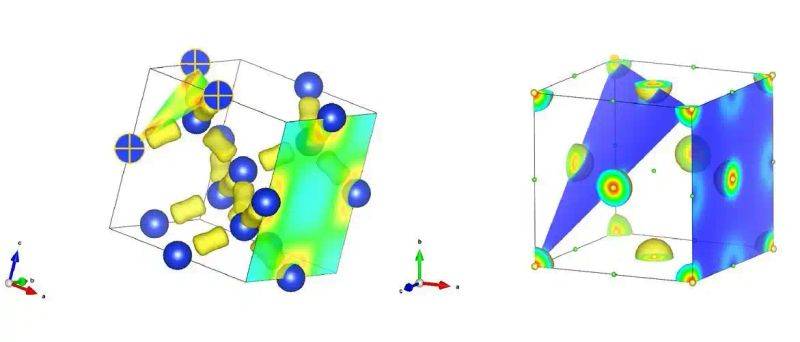
The importance of electronic density
In dft, electronic density is the key to determining the nature of the material. The properties of the substance are understood through mathematical formulae that describe changes in and distributions of electron density. This concept has played a central role in theoretical development, enabling scientists to reveal the mystery of the nature of matter through electronic density。
[major density profiles]
B3lyp, for example, was developed by various teams of scientists. The name reflects the developer's abbreviation and age, and demonstrates the diversity and family nature of the dft. This method of naming is not only historic, but also facilitates the retroactivity of later generations。
Three-generation development of the 002 density theory
[first generation theoretical foundation]
The first generation of a general communications theory of density, which originated in 1927 and was created jointly by thomas and fermi, is marked by the thomas-fermi model. This model simplifys the interaction between electronics, assuming that there is no interaction between them and no external interference, and therefore applies only to uniform gaseous electronic systems in their ideal state。

Second generation theory consolidation
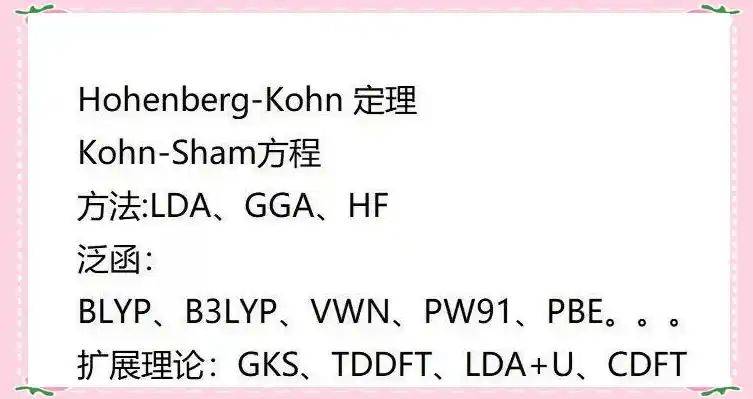
By the 1960s, the density theory had ushered in a second generation of development. During this period, the introduction of the hohenberg-kohn theorem and the kohn-sham equation laid the foundation for the density general communication theory. The hohenberg-kohn theorem explains that all physical volumes in the system can be determined only by electronic density, while the kohn-sham equation provides a clear mathematical expression of the density general message theory and allows its wide application。
To address the “unknown exchange nexus”, kohn and shen luxix introduced the lda approach in 1965. This approach has shown better results in dealing with certain issues. However, as research progressed, it was found that the lda approach was not accurate in some cases. To improve this, becke, perdew and wang, among others, proposed a broad gradient approximation (gga) approach in 1986. The gga approach shows greater accuracy in dealing with more complex systems than with lda. In addition, “combating density general letters” are a method of treatment that has received much attention in recent years, by which the impact of the hartree-fock (hf) exchange is added to the trade-off, thus further improving the accuracy of the calculation。
Third generation theoretical innovation
The development of the third-generation general doctrine of density marks an entirely new stage in the doctrine. During this period, theoretical improvements became the focus of research in order to address practical problems in different areas, such as a more precise description of material gaps. The third generation of development focuses on practical applications in various fields, extending to non-local effectiveness and improving computational precision. Among them, the generalized kohn-sham (gks) theory is a notable example of the expansion of the application of the kohn-sham theory of local power to non-local power. In addition, methods such as the broad correspondence theory of time density (tddft), the lda+u and the cdft have demonstrated their respective advantages in different areas。
Looking to the future, the development of the density generalist theory will revolve around increasing generality, precision and computational speed。