1. Basic issues of blueberry cultivation
1. 1. The nutritional matrix
The nutritional matrix that is now prevalent in the market is often referred to as nutrient earth and is mostly resource-consumption. Some of these products contain unfermented, non-hazardous livestock waste, which is mixed with field and mountain soil after drying or drying. At appropriate temperatures and humidity, these matrices can become hotbeds for pests and diseases, seriously endangering the health of family members, especially the elderly and children. Modern nutritional matrices often use untreated livestock waste, increasing the risk of disease and pests and affecting the environment. In addition, because these products originate mostly from fields and fields, and in order to improve the aerobics and frenzy of the matrix, it is often necessary to add materials such as pearl rock that cannot be decomposed and absorbed by the soil, which undoubtedly poses a potential threat to the environment and human health。
1. 2. Bacteria problems and seeding
Bacteria problems are critical to blueberry growth. The roots of the blueberries are specialized parasitic saplings, which are not only essential for the nutrients and water absorption of the blueberries, but also help them to resist adverse environmental conditions. Blueberry growth is dependent on bacterial roots, which, if absent, can seriously affect their growth and even lead to the death of plants. Chile and israel had suffered severe losses from the lack of necessary roots when inducing blueberries. However, in some specific areas of the country, such as the north-eastern eastern mountains and the mountains south of the yangtze river, seeding is usually not subject to roots problems due to the presence of wild oranges and indigenous roots. However, in hebei, shandong, liaoning, etc., due to the lack of indigenous roots in the soil, special attention must be paid to the problem of roots when seeding. To address this problem, the university of jilin agriculture introduced blueberry fungus from canada, together with tissue culture techniques, which have successfully enabled the cultivation of seedlings。
1. 3. Cold temperature requirements
Cold temperature requirements are also an important factor in blueberry growth. High, semi-high and short blueberries are required to accumulate 800-1060 hours of cold temperatures at temperatures below 7. 2°c. Blueberries require appropriate cryogenic conditions, and if winter cold conditions do not meet this demand, they will only grow trees without flowers, and they will weaken and become more serious。
2. Blueberry species selection and climatic conditions
2. 1. Varieties selection
The selection of blueberry varieties also requires decisions based on planting purposes. Blueberries of the large fruit type in rabbit eyes, high and semi-high bushes are usually suitable for fresh fruit cultivation. Farmers may choose the high-quality varieties of these types for gardening or small area cultivation to produce fresh fruits and market them. It should be noted, however, that different varieties are suitable for fresh fruit or processing uses, and that all varieties of dwarf blueberries, as well as most varieties of semi-high blueberries, are smaller, e. G. Medden in the bush and single fruit weights are only 0. 6 grams and north village single fruit weights are only 0. 7 grams. These small fruit varieties are susceptible to break-up of the bark at harvest and are therefore more suitable for use as processing materials. Without an acquisition contract for the processing plant, it would be inappropriate for farmers to plant these small fruits。
2. 2. Impact of climatic conditions
Climate conditions are essential for the growth of blueberries. High, semi-high, and short blueberries prefer cold and wet climates. The climate has a significant impact on blueberry growth. Blueberries are not recommended in case of high temperatures and drought during the growing season and lack of spraying facilities. Because high temperatures lasting more than 35°c for more than 15 days can lead to the cessation of photocosynthesis, increased respiratory activity and, consequently, over-consumption of tree nutrients, leading to early leaf loss problems。
3. Nutritional value and use of blueberries
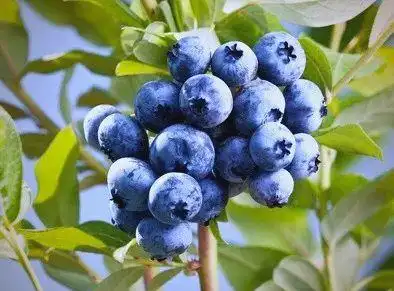
Blueberries, known as “blueberries in the united states”, are known for their blue fruit, which belongs to the citrus vegetative plant of dowdish. The mean weight of the fruit is between 0. 5 and 2. 5 grams, with a maximum of 5 grams, a beautiful colour, a layer of white pollen, a fine, small seed and up to 100 per cent edible. Taste it, the taste of blueberry fruit is fresh and sweet, and it's excellent. Blueberries are not only delicious but also nutritious and are listed among healthy foods. According to a study by the junior berries institute of the agricultural university of jilin, of the 14 blueberry species cited, fruit lumbers contained up to 163 mg/100 g and fresh fruit ve amounted to 9. 3 ug/100 g, well above other fruits such as apples and grapes. At the same time, the total amino acid content of blueberries is 0. 254 per cent, which exceeds even the abundance of amino acids。
4. Blueberry garden selection and plantation
4. 1. Soil and garden preparation
Blueberry cultivation is not always appropriate, and the choice of the garden is crucial. First, soil ph is a key factor, with acid soils suitable for blueberry growth and blueberries suitable for growth in acid soils with ph values of 4. 5 to 5. 5. Second, the park needs a good drainage system to ensure that the accumulation of water does not affect the growth of blueberries. In addition, sufficient sunlight is essential, as blueberries require sufficient sunlight for light cooperation. Following the selection of a suitable park, the following work was done to plant it. Pre-planting requires careful preparation, including soil tillage, fertilization and seeding options. These steps are essential for the healthy growth and high quality of the blueberries。
4. 2. Planting points
For the planting period, either spring or autumn can be chosen. Plantation needs to be selected at the right time, and after setting the planting period, attention needs to be paid to the setting of the range. For rabbit-eye blueberries, the usual range is 2 m x 2 m or 1. 5 m x 3 m; the length of the tall blueberries is 1. 2 m x 2 m; and the range of the short blueberries is between 0. 5 and 1 m, with a range of 1 m. In addition, the configuration of pollination trees is an integral part of the planting process. Because the blueberries of rabbits are self-inflicted, pollinating trees have to be configured, and tall blueberries are the right option. For tall and short blueberries with high self-flower yields, the configuration of pollination trees can also improve fruit quality and yields. In practice, the ratio of primary plant varieties to pollination varieties is usually 1:1 or 1:2。
5. Land-based water management techniques
5. 1. Soil management
After planting, management of fertilized water became a key link. The soil is managed by tillage and weeding methods to ensure blueberries. The roots of the blueberries are thinly distributed and thin, and lack root hair, and therefore they have high requirements for soil soothing and ventilation. On the sandy soil, high-crowded blueberries are often used for soil management using a method of ploughing, which is best managed at depths ranging from 5 to 10 cm. However, in specific areas, such as the long white mountains, due to the fact that dark brown forest soils are usually adhesive yellow layers of soil between 23 and 30 centimetres, it is important to be careful in their cultivation to avoid excessive soil reversal. In addition, weeding is an effective soil management method that combines grass-grass and herbicides。
5. 2. Fertilizer strategy
The management of fertilization of blueberries is critical, as their nutritional needs differ from other fruit trees. Blueberries are sensitive to fertilizers and need to regulate the use of nitrogen, phosphorus and potassium fertilizers according to soil conditions. Blueberries, typical of calcium fertilizers, are prone to the loss of iron and green when growing on calcium soil. At the same time, blueberries are also oligotrophic plants with relatively low levels of nitrogen, phosphorus, potassium, calcium and magnesium in their trees. Therefore, special care should be taken during fertilization to avoid harm to blueberries. In addition, blueberries have a particular preference for ammonium nitrogen, which is more absorbent to the soil. In blueberry cultivation, there is little application of farm fat, mainly on nitrogen, phosphorus and potassium。
6. Blueberry winter protection
6. 1. Snow protection against cold
While blueberries are cold-resistant plants, appropriate winter protection measures are essential if they are to be safe throughout the winter. By taking appropriate protective measures, we can ensure that blueberries remain healthy during the winter and provide a solid basis for harvests in the coming year. In cold areas, blueberries are protected through snow piles, and in cold and snowy areas in the north, cold protection can be provided in the form of artificial snow piles during winter. It also has many advantages, such as easy access, labour savings, low cost and effective soil moisture conservation。
6. 2. Other measures to combat the cold
In the north-eastern region, cold-proof techniques are widely used in the cultivation of small berries, such as black-sweet vinegar. The application of the burial method to combat the cold is suitable to overwhelm branches in the soil to reduce the risk of breakage. The same applies to blueberries. Specifically, blueberry branches are overwhelmed and covered with a shallow layer of soil to protect them before winter. It is important to note that because the blueberry branches are hard and easily broken, orchards that are buried in a cold-proof manner are recommended to reduce the risk of broken branches。