I. Status of the development of the strawberry industry in the country (i) status of strawberry cultivators
In the 1980s, the excellent varieties introduced in our country from europe and the united states and japan quickly replaced the old varieties and became the main plant species for production. Hebei bao's main plant varieties, which are all-stars, are characterized by fruits and durable storage, but tastes sour and have been replaced by excellent varieties such as fragrances and early birth, which are now growing on a large scale in the form of disease-resistant, high-quality and productive fragrances. In the 1980s, the main plant species in liaoning dandong were greila, which was characterized by large and abundant fruit, with only more deformity in the production of the fruit, the infrequently coloured tip of the strawberry fruit, the formation of chrystals, the precipitous loss of the plant in the later stages of its outcome, and the gradual replacement of the local plant by the spanish virginia in the 1990s, with a high yield, a high yield and a high disease resistance. After 2000, strawberry varieties such as red and cheesy gradually became dominant in the market. Both varieties account for about half of the total strawberry area。
In the beijing changping strawberry season 2001-2002, for example, there were three main plant varieties in changping district, beijing city, known as child one (kamrosa) `sweet charlie' `sweet daughter', of which `child one' accounts for 90 per cent of the total area under cultivation. In 2008, after the successful holding of the seventh world strawberry congress in 2012, the size of the strawberry season 2009 - 2010 was 24, the proportion of "red" cultivation was 42 per cent, the area of "zang ji" was 14 per cent and the area of "child one" "sweet charlie" was gradually reduced。
In the 2011-2012 strawberry season, the seventh world strawberry congress was held in changping, beijing, which brought unprecedented prosperity to changping's strawberry varieties, with 135 strawberries planted and displayed. The share of "roma" and "zhang ji" cultivation has reached 80 per cent。
During the strawberry season of 2016-2017, the changping region maintained 20 main strawberry varieties, with 91 per cent of the area under `red face' cultivation, less than 4 per cent of the area under `jackey' cultivation, and 6 per cent of the species under `christmas' `kyosa' series' `sprouts'。
While the pattern of heavy dependence on the `red face' for the main plant varieties produced in changping district has not changed, new strawberry varieties have emerged and have evolved towards diversification and high-yield quality。
(ii) plantation techniques and measures
In order to achieve better economic benefits for strawberry commodities, a number of high-yield, high-quality and low-capacity technical measures have been widely applied in protected areas. Currently, the following technologies are more commonly used in our greenhouses and plastic sheds。
(1) the technique of water fertilization is widely used in agricultural production in developed countries and is a combination of the words “fer-tigation”, i. E. Fertilization, irrigation,” in english, meaning a combination of irrigation and fertilization. The country is also known as irrigation fertilisation, plumbing fertilisation, water fertilisation, water fertilization integration, etc., which uses pipe irrigation systems to sow fertilizers into water, together with irrigation and fertilization, to meet the water and nutrient needs of crops in a timely and appropriate manner, to achieve synchronous management and efficient use of water fertilizers, or, in short, to apply them evenly and accurately to the roots of crops, depending on their strength and fertility, and to be used as a method of fertilization directly absorbed. The advantages of water fertilisation integration are to increase crop fertilization utilization, to promote direct absorption of water fertilizers near the roots of crops, to promote crop growth and increase crop yields, while reducing mechanical operations, inhibiting weed growth, increasing the utilization of the matrix and improving labour productivity. At the same time, the labour force has been significantly reduced, its intensity reduced and its ecological efficiency improved. The ministry of agriculture has proposed that, by 2020, our agriculture will achieve “controlling water use in agriculture, reducing the use of fertilizers and pesticides and achieving zero growth in the use of fertilizers and pesticides”, while the country faces a relatively low single-production problem. The development of integrated water fertilizer technologies is an important way of addressing the contradiction between water-control and productivity increases. It is important to increase fertilizer utilization and reduce the pressure on fertilizers to the environment and protect the environment. The integrated water fertilization technology uses all water soluble formulations, which results in high utilization of fertilizers and reduces the problem of plugging drip irrigation pipes。
(ii) honeybee pollination techniques strawberries grow relatively closed to the outside world in the solar greenhouses, while strawberries begin to bloom at low temperatures or in periods of insufficient light, pollen is not spread efficiently through the wind, and artificial pollination is time-consuming and inefficient. The incidence of strawberry malformations is very high because of the bad pollination. The planting of bees in greenhouses, pollination through bees, has greatly increased the commerciality of strawberries, reduced the number of malformations and had a good effect on the normal growth of the fruit. Usually, for every 400m2, there are 4,000 to 5,000 bees per case. A bee usually needs an adaptation process from a dry outside into a hot, wet, hot greenhouse, during which many bee will crash into a shed and die in a hurry if the bee does not have pollen to harvest. To this end, 3d of the formal bee playtime adapts in the greenhouses, with strawberry flowering at 5 per cent opening the wind vents so that a small number of bees can come out, and then gradually open the wind door to free access. Pollination can be carried out using the max if encountered with severe temperatures and indigence。
(3) the technique of false seedlings is widely applied, with seedlings being planted in trophic quagmire or bed, which can improve the ventilation of strawberry seedlings, increase the area of nutrition and nurture strong seedlings, with few pests and insects. Fake seedlings are now mostly developed in spring and autumn sheds, such as base-based seedlings and cell-based seedlings, high-foot dens, etc. The seedlings grow consistently, are well managed, and provide a good basis for strawberry production; seedlings using a matrix can also be transported at long distances to improve strawberry productivity. With the increase in the number of years of cultivation, the problems caused by the barrier to strawberries are becoming more acute. It is even more important to grow strong seedlings by breeding them on a foundational basis。
(iv) plumbing techniques there are many nutrients that can be saved in the supply of strawberry plants, allowing strawberry plants to extract more strawberry side gravitational sequences and to increase strawberry fruit rates. Plumbing is carried out throughout the fruit-growing season, especially before strawberry production。
(5) in greenhouse culture, especially in the northern solar greenhouse, low temperatures in winter can easily cause strawberries to fall into hibernation or to suffer from figs, and severe damage can lead to freezing injuries, while insufficient light can lead to bad growth of strawberries. It has been found in practice that additional light in winter shed cultivation can facilitate strawberry growth, increase yields and reduce the number of deformations. The use of heating and lighting facilities in japanese plastic sheds is very common. Led light is generally used for light-making, which is generally more edible with red orange and blue purple light, and is usually 4h after temperature-preservation, which can easily lead to the growth of strawberry seedlings if the time of light is longer。
(6) the use of new types of farming, such as the po film, can increase the radiance of the shed, improve the temperature protection performance and generally have a useful life of more than two years. The fumigation techniques of cedars, blue plates and sulfur can reduce pesticide use. Biocontrol techniques can combat pests, and insect treatment is a typical example, for example, in chile. The prevention of red spiders, the control of aphids, etc.; the use of biologically sourced biological agents such as pyrethroids, imposters, etc. In plant-phythmics; and the increasing use of microbiological products such as dead grasscrawl, raisins in the ground can combat some fungal diseases, especially in areas with more underlying diseases, with a certain impact on the prevention of atrophy; and the use of impotence in production can effectively combat strawberry disease。
(iii) changes in strawberry distribution channels
The sale of strawberries in the 1980s was largely free of special packaging, mostly in simple baskets of bamboo or plastic bags, and mostly in the form of street shopping or direct sales by vendors. Strawberries appeared at the mall in 2000 as high-quality fruits, and as people's incomes grew, their sales grew, and they gradually entered ordinary homes. Some high-end strawberries have begun to be used as gifts for visiting friends, strawberry packaging has entered an entirely new era, and there have been some new changes in marketing channels, such as in beijing, which include, inter alia, gift boxes, sightseeings, cooperative acquisitions, supermarkets for supply, small vendors, etc. The 2013-2014 planting season marked a turning point, preceded by sales channels dominated by gift boxes and sightseeing, supported by cooperative acquisitions, supply supermarkets and small traders。
After the cultivation season 2013-2014, tourism and small-scale vendor acquisitions accounted for about 30 per cent of sales, respectively, while others, in turn, were gift box sales, cooperative acquisitions and supermarkets (as shown in figures 1-1). As can be seen from figure 1-1, the way in which tourism is picked is very popular with consumers and tends to increase over the years。
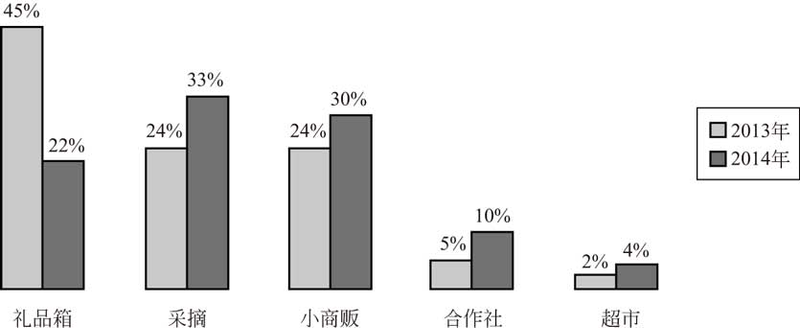
Figure 1-1. That's right
The data in figure 1-1 show that the direct harvesting of strawberry sales is gradually gaining consumer acceptance, reflecting a greater consumer focus on fresh safety and tourist consumption, as well as an increasing number of cooperative sales. As the industry develops, consumers are paying more attention to food safety, standardized management and uniform packaging sales are more conducive to the healthy development of the strawberry industry。
(iv) gradual changes in production patterns
Cultivation patterns have shifted from traditional to non-kidization, semi-kidization and hyper-planting. High-level cultivation has the advantage of good extraction environments and low labour intensity; semi-basic cultivation has the advantage of water conservation, fattening, temperature preservation, etc., as compared to foundational cultivation; and the ability to overcome interlocking barriers compared to soil cultivation, which are welcomed by farmers。