The cold of yesterday seems to have exhausted the last breath of the northern wind, and the sharpness that pierced the bone marrow has faded as it remains cold today. The sky is still blue and the sun is still a little warm and stingy on frozen land. The ice cream under the roof began to melt slowly, with the tipping edges gathering the crystaly beads, which had lasted so long that it had fallen “scrambled”, crushed on a hard rockboard and left a small, dark wet spot. The air is still clear, but it can already smell the very weak breath of life that emerges from the defrozen mud. From yesterday's rigidity, the herd was a little relaxed, and a small, daring sparrow jumped off a branch and pecked in the corner of the back wind. The whole world, as if from a deep freeze, was recovering the pulse very slowly and experimentally。
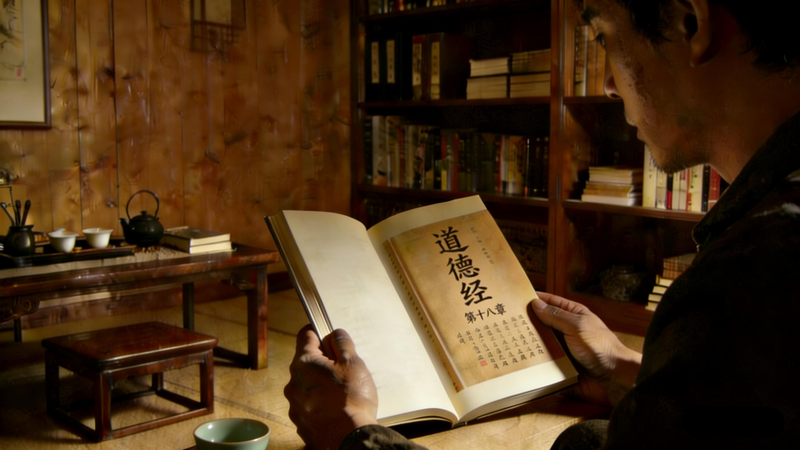
Yesterday's chapter 17, “the great, the know all”, depicted a near-optimal situation of “doing nothing” and “my nature” like a warm fire, baking me with frozen thoughts, bringing deep thoughts about governance, order and nature. It's a picture of harmony from the top down, from the inside. Today, however, the opening of chapter 18 is met by a completely different and almost pessimistic evolution of civilization that is cold and sharp, as if it had not yet been melted。
Chapter xviii: the path is ruined, and there is mercy; there is hypocrisy; there is discord among the six families; there is mercy; and there is disobedient nation, and there is loyalty。
Simplicity, force. Every short sentence, like a precise surgical knife, cuts open the surface, pointing directly to the vexing paradox and quaintness of civilization and humanity。
"wasn't there any mercy?"
Boulevards are abandoned, forgotten, blinded, and “benevolentness” is branded, promoted and promoted. Read it here, my heart is tight. Rather than rejecting the value of “benevolentness”, i am revealing a cruel truth: “benevolence” as a particularly emphasized moral norm that emerges and highlights precisely as evidence of the invisibility or invalidity of “the path”. When society as a whole finds itself in a state of natural harmony that is prevalent on the “roads”, people's behaviour is in line with “kind” and “means” and need not be specifically promoted as if fish were unaware of water. Only when harmony is broken and the moral sense is lost will it be necessary to erect the banner of “benevolentness” in order to discipline behaviour, make up for its shortcomings, and even ... To cover up corruption。
It reminds me of the village of zammon and the wider world. Are the old rules of mutual assistance, honesty, respect for the ancestor, and conservation of the forest, the ancient words of the zeng clan, and the rules followed in the drum house proceedings, some manifestation of the “path” at the community level? When these internalized traditions, this natural harmony based on bloodlines, is strong enough, why do people keep their “kindness” in their mouths all day long, when they act in a way that is proportionate to each other's circumstances? And when i was in a highly atomized and competitive urban jungle like the east side, the slogans of “good faith”, “cooperative win-win”, “social responsibility” were soared that it was precisely because of the absence of the “road” behind it — the best interests, the law of the jungle is the true rule. The louder the slogans, the more often the missing are。
"wise comes out, there is hypocrisy."
Ingenuity and ingenuity have emerged, with great hypocrisy and hypocrisy. “wise” here is not about real wisdom, but rather about smartness, wisdom and calculation. Hypocrisy, deception and disguise are inevitable when people are no longer content with the natural simplicity of following the “roads” and begin to use their wisdom to gain advantage and gain advantage. You set me up, i'll guard you against it, and you'll be the one behind it. Wisdom is like a double-edged sword, which, while creating convenience, also breaks down the trust that exists between people and breeds the cynicism. My personal business, my well-designed marketing jargon, my fraudulent methods of competition, my well-packaged fake projects, are not the very living footnotes of wisdom, hypocrisy? Even myself, i was trapped in it, chasing success with so-called “smart”, and finally reaping the disillusionment and debt of “hypocrites”。
"the six of us are disparaging and have mercy."
The loss of peace within the family, the father, the son, the brother, the brother, the brother, and the brother, are recognized and called upon in particular by the filial and loving. When it is natural to be close to one's flesh and blood, filial and loving are the instincts that are revealed and need not be labelled. It is only when there is a crack in kinship and the family is on the verge of dissolution that “good will” is raised as a remedy, a moral bar, in an attempt to recover the lost natural warmth. How sad is this! The era of filial and noble girls is often one of the most tense relationships and family crises. Does the word filial also imply to me some kind of recovery and compensation for lost “natural kinship”
“the country is in disarray and loyal.”
It is the political disarray in the country that leads to the emergence of “loyalty”. If politics is clear, the monarch has his word, his subordinates do their part, and the people live well, why should one of the “loyalty” be singled out? The emergence of “loyalty”, especially the sad, deadly loyalist, is often a sign that the state apparatus has become ill. Their “loyalty” is a reaction to “dizziness” and a last attempt to repair the collapsed “path”, which is tragic。
Close the scripture, i've been silent. The sun outside the window is still calm, but my heart is as if it had been dragged into the cold depths of the water. It does not offer warm comforts or distant ideals, but rather reveals with near-cool insight a frustrating “degradation” trajectory in the course of human civilization: from the natural fashion of the pristine “roads” to the absence of the “paths”, the moral reputations and heroes such as “benevolentness”, “benevolentness” and “loyalty” had to be relied upon to maintain order and repair the cracks, which in themselves had been accompanied by the “falseness” of “wise”. This is a downward spiral from “park” to “body”, from “natural” to “human”, from “harmonization” to “remediation”。
This contrasts with the supreme level of governance that i understood yesterday: "too, my nature"! The former is a popular ideal of “roads”, while the latter is a realistic picture of the situation after “roads are broken”。
So, my path, my return to the village of zammon, my daily vegan food, my readings, my sittings, and my attempts to help the world out of its bitter desires... What is the position of all of this, under this “vant-down” macro narrative? Was it a futile patch? Was it a follow-up to the current? Or is it another form of "intellectual" and "exhaustible"
Today i would like to revisit my life, my family, this seemingly obscurantic fortress, and the root causes of my own heart, with this heavy courtship。
Breakfast is still my simple porridge. Father ate silently. The heat of porridge rises between us, forming a short, vague barrier. There's never been much communication between us. Is that a silence behind the "failed road"? Because of the loss of mother as a natural emotional bond and of the hurried “natural” atmosphere of the traditional extended family, we need more deliberate, sometimes clumsy, expressions of filiality and compassion? Or is this silence itself another, deeper form of “path” between us — an unspoken, bitter and time-consuming, solid understanding and dependence? I can't decide。
After he had eaten, he dropped the bowl and looked at me and said, "it's cold, the windows of the attic are sewn, the old cloth is plugged. It's like saying the most unusual thing。
I nod my head: "well, i'll be there in a minute."
No more words. But in this simple conversation, is there a natural appearance of the avenue? Out of concern for his son's living, out of respect for his father's command and the need to keep himself warm, he did not label himself as a "kindness" but as a natural need and response to life itself. Here, it is not the slogan that has been preached, but the almost instinctive drops that melt in daily trifles. Perhaps, in the smallest family unit and at the most modest level of life, the “path” has not been completely “lost”? It's just a more silent and resilient way of going
After dinner, i'm gonna plug the windows. Find out some old cloths, get wet, put a little bit between the window frame and the wall, the tiny gaps that were drilled out by the years and the cold wind. This work is boring and requires patience. And i have done it slowly, but my thoughts are still on the book。
"wise out, there is hypocrisy." i look at my past. What i learned, what i used, what i was proud of, was not the kind of "wise" that went off the road? Marketing's wisdom, live delivery's wisdom, packaging's wisdom. These "wiss" have indeed brought short-lived visions of success, but they have also given rise to great hypocrisy -- – exaggeration of data, empty promises, human use, and ultimately self-lost and creditless bankruptcy. My return, in a sense, was a complete rejection of and flight from that kind of “smart” and “fatal”. My choice of “purity”, “reading the scriptures”, “sitting”, seems to be another kind of “wise”, but if i remain committed to it, using it to label myself, despise others, or even as a bargaining chip for something or gain, does it fall into the trap of a new “wise out, hypocritical”? The true learning of wisdom, perhaps just as the “end of the earth”, is to put down all deceptive hypocrisy and return to the truest state。
I stopped my work and looked at rough wooden window frames and plain old cloths in my hands. There is no “smartness” in this window-filling exercise, except the most direct reaction to the cold and the most modest maintenance of the house. This may be closer to some of the vestiges of the avenues — to use the existing resources, to solve problems, according to nature. Simple, direct, effective, no coincidence。
I walked out of the house, in the barn. The sun shines on you, and it finally warms up. In the square of the drumhouse, there were a few elderly people in the sun and chatting. From the weather, from farming, to some of the parents in the barn. Whose son sent money for work outside, whose daughter-in-law was a little bit confused, who was ready to start a new house..
I have heard that, suddenly, from these frivolous gossips, there is something about the fragrance of “the streets” and “the goodness and kindness”。
An old man lamented: “now that young people have gone out to see the world, they've gone wild and come home for a few days. It's better to have a family with a farm. It's a tough day, but it's in one heart.”
Is it implicit in this lamentation that the “pathway” community life, based on land, blood, and close collaboration, is dying? When young people leave their homes, traditional farming life and close family structures are difficult to sustain, “happiness” and “kindness” are referred to more frequently as the moral bond that sustains separated relationships. The ropes are necessary, but also reveal the potential facts of the “six relative discord”。
Another referred to a recent neighbourhood dispute mediated by the elders concerning a blurring of the boundaries of the home base. "people now, they're too good to fight. In the early years, there was no such thing as giving way to each other, so it went away."
The complaint points to “mixed wisdom, hypocrisy”. When trust in a simple neighbourhood is eroded by a smart calculation of personal interests, disputes and “false” arise. There is thus a need to come forward, to mediate on the basis of the treaty, and to reaffirm the virtue of “give”. This mediation is a necessary remedy, but it also mirrors the existing cracks in natural harmony。
However, i have also seen that, despite these changes and challenges, the drumhouse is still in place, the money is still in place, the elders are carrying out their mediation duties and young people are still working for money, mostly to send home or to build houses and get married. The concepts and norms of "benevolentness" and "happiness" are, like the old fabric, trying to “squeez” the social gap created by the changing times, the movement of people and the impact of ideas, in an attempt to preserve the warmth and integrity of this ancient community. They may not be as natural as they used to be, but they are indispensable adhesives and buffers in this era of facade。
This gives me a new and clearer picture of my desire to “help the world out of misery”. In the macro-level context of “roadbreaking”, individual practice and altruism may not be able to fundamentally reverse this downward spiral. But perhaps it could be the “old fabric of the windows” — at the specific, tiny level, filling some cracks, bringing a little warmth and slowing down some “windfalls”. Instead of trying to restore the “gold age” that has passed, it is based on a clear understanding of reality and on a little, sincere “repair” within its reach. At the same time, be vigilant against falling into the trap of a new “wise out, hypocritical” — not turning the practice into a brand, not turning the altruism into a trade, not into a coincidence。
In the evening, i went to the commissary to help. In the dark light of light, the father was wearing old glasses, slowly preparing some yellow pieces of paper, which were old accounts, some of which i did not know。
"dad, these are left?" i asked。
The father didn't lift his head either: "keep it. Some people were home, and it was hard. Now it's over. Maybe someday. It's his fault. Remember, it's my business."
His voice was flat, no complaints, no expectations。
I looked at those pieces of paper, and suddenly they touched me. What is this act of father? Is it "kind"? Is it "belief"? In business logic, it's probably stupid. But here he seems to be nothing but a simple thing: remember the difficulties of others, give trust and grace, and then put it down. There is no intention of showing “benevolentness” nor of taking into account possible “falseness”. He just does what he thinks should be done and then let the time go. This is not the death of a “loyalty” on the high ground, more like a silent, stubborn night watchman, holding a “letter” that may already be inappropriate but essential to him。
This letter, perhaps, is the last building block that individuals can hold when the avenue collapses? It has not been able to salvage the entire trend of “pathbreaking”, but it has given fathers a specific life, in this small shop, an inherent, clumsy sense of security and dignity。
In the night, the loft is alone。
“the path is in vain, and there is mercy, and there is hypocrisy, and there is discord, and there is kindness, and the nation is disobedient and there is loyalty.”
These four words, like four cold steel nails, lock me to the romantic imagination of “harmonization”, “naturalness” and “real truth” on the surface of a real rough plank. It reveals the second reverse of the desperate fall and remedy in the course of civilization。
This is an era in which i am no doubt living in a world where “the path” is invisible, “benevolent”, “intellectual”, “intellectual”, “insolent”, “insolent”, “six relatives”, “integrity”, and “nationals” are faced with a variety of “silent” and “loyalty” sad times。
My return to zamon, and not my work, was to the fullness of a path. Zamon is also changing and experiencing the erosion of the “roads”. In a broken vessel, i tried to find the tracks of the "park" of the building vessel, and to learn to fill some of the cracks and guard some of the temperature with some perhaps awkward formulas。
This is not pessimism, but soberness. Knowing that “failure” is the norm between history and reality, that “benevolentness” and “wiss” are the product of redress and that they may be alienated, i am better placed to put aside unrealistic illusions, to get to the ground, to do that little, sincere “sab” work, while recognizing its limitations。
"i don't believe, i don't believe." my warning echoes in my ears. Trust is so scarce in this era of “failure”. My work, which is to be built first, may be a letter to my own heart. Do not deceive yourself, do not disguise themselves, and do not seek to hasten. Only an intrinsic “trust” is sufficient if i, like my father, is able to hold on to my inner desire for “park” and “real” in order to maintain a relative “real” in an “absolute” environment。
Outside the window, there was a cold wind again, but it was not as strong as yesterday. The ice cream is still melting and the water drippings are intermittent. The world is still cold and the “road” may still be elusive. But at least in this little loft, under this lonely lamp, i try to understand the cold and the hidden roots and to find a sober and solid starting point for myself and for the perhaps insignificant “help” of the future。
I know。
In-joon, i see。
Wisdom, i've passed。
Six relatives, i've tasted it。
I can smell it。
I'm sorry to hear about this, but i'm sorry to hear about this, but i might later:
And keep my faith, and make my peace, walk my ways, and live my life。
The night is long and the road is long. But the heart was sank because of this cold insight, and much less of the false heat。