The reasons why many companies have chosen the public cloud saas are straightforward: cheaper, less costly, less self-sustaining. But one question is rarely seriously asked — is the data on someone else's server really safe
The security promise of the cloud
Public cloud service providers usually emphasize “many security clearances” for “data encryption storage” for “professional security teams 7x24-hour watch”. These commitments sound persuasive, but businesses are beginning to realize that trust is no substitute for control。
Data is physically in someone else's server。
No matter how well written the terms of the contract, the enterprise is unable to confirm where the data are stored, who has been contacted, whether they will be migrated across regions and whether they will be used for modelling training. This uncertainty is in itself a risk for core data relating to business secrets, customer privacy and intellectual property rights。
The ai era brought a new crisis of trust。
Public cloud products include ai assistants who, when opened, index and semantically analyse documents. Even if the service provider had promised that it would not be used for model training, the enterprise would not be able to validate that commitment. Did ai read it after a business plan was uploaded to the public cloud? Did you get into the model training data pool? There is no definitive answer to these questions。
Who is responsible for the disclosure of data。
User agreements for publicly owned cloud service providers usually make it clear that data leaks “take risks on their own”. In the event of data leaks, enterprises not only face regulatory sanctions and loss of customers, but also bear full legal responsibility. The scope of responsibility of service providers is very limited. The risk is on the enterprise side and the control is on the service provider side, and this misalignment is disturbing to a growing number of enterprises。
Compliance requirements make it increasingly difficult to choose between public and private。
The implementation of regulations such as the personal information protection act, the data security act, continues to increase. Audit finals from accounting firms, case files from law firms, patient data from medical institutions, customer information from financial institutions - compliance requirements in these industries are clearly pointing to “localization of data”. Cross-border storage and access mechanisms for public clouds, where direct contact with the red line occurs。
Why are more companies opting for privatization deployment
Privatization deployments place data on the enterprise's own servers or equipment and the data physically remain within the control of the enterprise. It addresses not the question of “how is public cloud technology good” but the question of “who is really in charge of the data”。
Data sovereignty has changed from “contractual commitments” to “physical facts”。
A physical device is in the machine room of the enterprise and the data are visible and felt. This is the most direct evidence for compliance officers, clients and regulators — data on the enterprise's own hardware and not in the hands of any third-party agency. Not “they promised not to look”, but “they simply cannot”。
The control of authority has moved from “service provider” to “self-determination”。
The system of competence of the public cloud is designed and controlled by the service provider, and the enterprise may establish its authority only within the framework defined by the service provider. The system of delegated authority for privatization deployment is entirely owned by the enterprise — who can see, who can download, who can edit, who can export, all set up and managed by the manager of the enterprise. There is no need to rely on the service provider's “security strategy” and there is no need to worry about whether the service provider's insiders have access to the data。
The audit goes back from relying on logs to “ownership”。
Public cloud audit logs are provided by service providers and businesses can only see the part that the service providers are willing to display. The audit logs deployed in privatization are fully documented in the enterprise's own system and are independent of service providers. Who visited the data, when, what operations were carried out, all within the control of the enterprise itself。
The threshold for privatization has been significantly reduced。
In the past, privatization deployments meant high costs, high technology thresholds and high burden of transport. Companies need to buy their own servers, build their own rooms and hire it teams to maintain them. For smes, this is a threshold that hardly crosses past。
In 2026, however, the situation had changed. The emergence of hard and soft integrated machines has transformed privatization deployment into a “interpolation connection” that does not require it personnel to understand linux, databases or security configurations. The maturity of the large open source model made it no longer necessary for privatization ai to study the model itself. The spread of the lateral reasoning framework allows ai to operate on local equipment without gpu server clusters。
The privatization threshold has been reduced from “building a data centre” to “buying an equipment”。
The savannah enterprise cloud will be used as soon as privatization deploys
100 per cent of the privatization deployments were made and the data remained physically within the enterprise's borders。
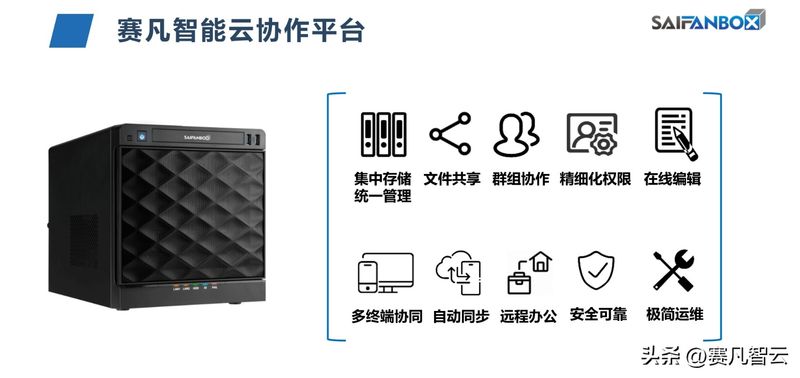
The sÉvan enterprise cloud disk supports the full deployment of the system in the enterprise's own servers, data centres or one aircraft. All documents, operating logs and ai reasoning remain within the enterprise without any third-party platform. Fitting networks and intranet environments can also function properly. Enterprises themselves maintain complete control over data storage locations, access rights and operational records。
The 17th degree, "one large piece at a time."。
Saifan provides a 17-degree atomic permission combination, which is controlled separately by each operation, such as viewing, previewing, uploading, downloading, editing, deleting, sharing, external distribution, etc. Permissions can be precise enough for each user to operate on a single file. The rights management is clearly controlled in conjunction with the isolation design of the four categories of data space (personal space, cluster space, public space, customer space)。
There is no super-administrator, and privileges do not depend on “administrator self-discipline”。
The system defaults that there is no "superadministrator" and that no one (including the administrator) is free to view all the files. Authority execution is enforced by the system and does not depend on “administrator self-regulation”。
Privatization ai, data can be used without domain。
Saifan's ai capabilities are also deployed locally, and model reasoning, data indexing is done in-house. The system of 17 levels of authority is strictly inherited at the time of ai's search — documents that are not available to users, and neither can ai. Audit records are maintained for each ai call and data do not leave the enterprise's borders。
A full-link audit, with every step of the operation traceable。
All critical operations such as uploading, downloading, deleting, sharing, and change of permission leave marks. Audit logs are stored independently to meet the audit requirements for insurance and industry compliance。
It is appropriate to meet national production requirements。
SÉvan has completed the adaptation of domestic hardware and software to support deployment on the umbrella uos, tritium and other national operating systems, which are compatible with mainstream chip environments, such as flying and twig。
Data sovereignty is not a question of whether or not, but of when
Not all data require privatization deployment. Public information within enterprises, non-sensitive administrative documents and ad hoc collaborative information have advantages in terms of efficiency and cost。
But the core data of enterprises — customer information, financial data, intellectual property rights, process parameters, strategic planning — are fundamental to enterprise competitiveness. Transmitting these data to third parties is essentially replacing “control” with “trust”. There was no better choice in the past, and enterprises had to accept that compromise. The threshold for privatization deployment has now been significantly reduced and an increasing number of enterprises are beginning to reassess this option。
Data sovereignty is not a question of “whether or not” but of “when to start”。