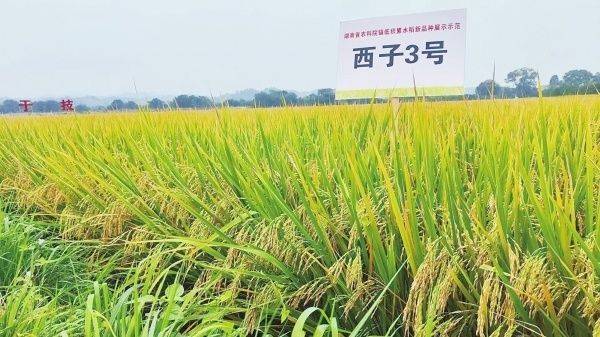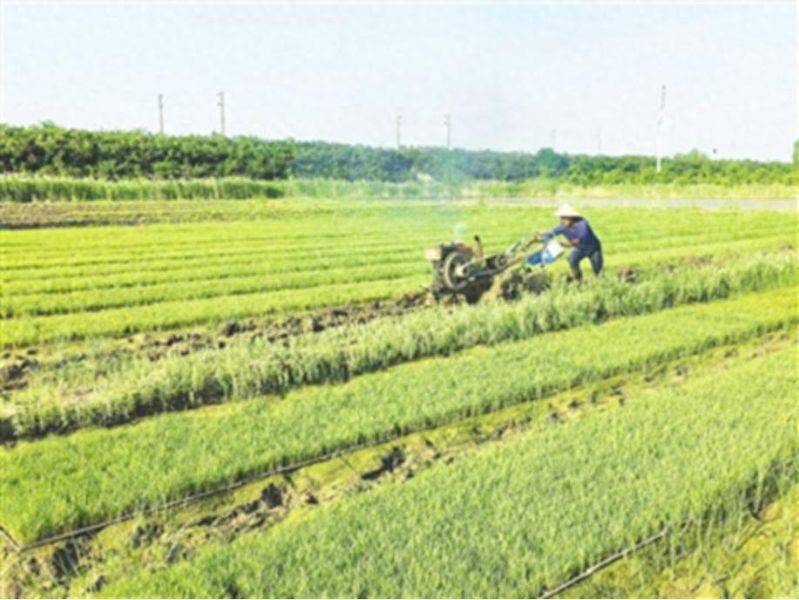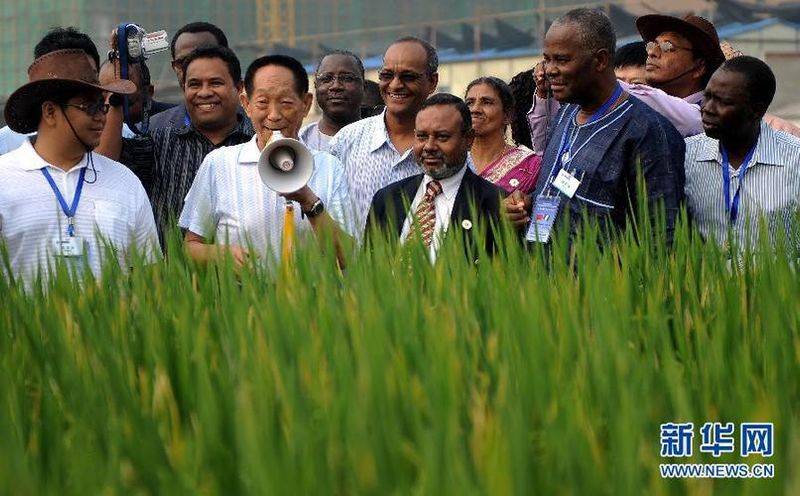
In the rice fields of gyeongfung town, north district of guangxi hong kong, the harvester is travelling through a special rice wave. The rice strain is generally as high as **2 m**, much higher than the adults on the side, and the rice ears in the sun bend the thick straw. This variety, known as “mega-paddy”, has brought into reality the dream of the yuan pilgrim pilgrim “under the ground”. (blockview://markdown-image-tos-cn-i-tt/02d7ec62b57c4873bc2f6061173b0745) but the “long” rice is much more than a visual wonder, and it is moving from a field in the south to a saline in the north as a new key to deconstructing the resource constraints of our cropland and securing the chinese food bowl. # why make rice "higher" a technical job? The “longer” rice is not a simple pursuit of the height of the plant, but its core objective is to construct a more efficient and resilient “ideal strain”. You can interpret it as a more rational “building” for rice: a higher tubing means a longer stasis, coupled with a nice piece of leaf, which allows the sun to penetrate the coronal layer and to shine into the lower middle, thereby increasing the light efficiency of the entire rice field community, which is the basis for increasing production. However, “high buildings” are also at risk of being “head-and-head”. As a result, high-drive rice breeding is a complex system project that needs to address the synergistic challenges of high-yielding, high-quality, counter-resilient (resilient, inverted, salinist, etc.)** at the same time. For example, the super-paddy varieties promoted in hubei, “red euphoria 1564”, raised the resistance of rice fever, heat resistance and salin resistance to level 3, while achieving a breakthrough in high-yield field acreage production ** 800 kg**, and remained stable at around 85 per cent at extreme temperatures. Although the national focus laboratory for hybrid rice did not directly release new varieties of high-drive rice, it provided a core technical reserve for the “strength and robust bones” of high-drive rice in areas such as **third generation of hybrid rice (growing yields up to 200-300 kg/acre), ** molecular breeding** (e. G. Screening in sterile systems using ai modelling) and ** saline rice**. # "long" rice, what "unconventional" places? The value of high-drive rice is particularly evident in “marginal lands” where conventional crops are difficult to establish. It is becoming a pioneer in food demand for salin lands, drylands and cold areas. - ** “setting home” in saline: ** there are about 1. 5 billion acres of saline in the country, a significant part of which has the potential to transform. High-resistant salin varieties are like the “last line” of salin. In the soil of fujian futeng city, where salt is up to **3. 5 per thousand**, the variety “twice 3261” achieved a breakthrough of acre production ** 707. 9 kg**. On unita's saline at 46° n, the zenlong pyramid workstation produced a five-year acreage breakthrough ** 500 kg**, which is more than four times higher than traditional local varieties **. Through the “engineered improvement + biological improvement” model, the city successfully planted more than 300 acres of rice and developed co-existence of rice crabs in the highlands, with combined benefits of **15 million dollars**. -** “strengthen” in drylands**: water conservation is key in the groundwater hypermining area in north china. Yuen long, a dry rice seeded by the hebei water test, matures on the basis of natural rainfall or a small amount of water during the dry season, with a saving of 280 cubic metres per acre compared to traditional wheat maize cultivation**, with a planned roll-out of **20,000 acres** in 2026. - ** “results” in cold and cold areas**: for high-altitude, cold and cold climate areas, the yoda town of yunnan lung county has been promoted with a series of high-dry and drought-resilient varieties, growing from 1,900 to 3,300 acres, resulting in an increase of **3,000 yuan for all households.** behind the “higher” is the “revolutionary” pattern of growing rice not only for its own excellent performance, but also for its ecological cycle agriculture model, the “i-tai”. Large plantations provide a natural shaded environment and stereospace for rice field farming. - **system of rice fishing, multiplier of benefits**: in zhejiang, food growers use high-dry rice to live with black frogs, ai's smart system manages feeding and water quality, without pesticides and fertilizer. Under this model, rice can be sold at a premium, plus the income of the frog, and the net profit of the acre is ** 3-4 times that of a normal rice field**. (blockview://markdown-image-tos-cn-i-tt/bbd141b647464644991a086b53e16ab93) in taijiang county, guizhou, the “high-dry rice + border ditch tank fish farming” model brought the combined annual income of an acre of land up to tens of thousands of dollars, with a high-yield demonstration of rice production **1026. 5 kg.** - **technology packages, machine support for farmers**: the promotion of high-flood rice requires mechanization. Liaoning's promotion of the “wide and narrow interpolation” technique (36 cm wide + 14 cm narrow line) increases the coronary light ** more than 25 per cent**, increases production ** more than 5 per cent** and provides larger operational corridors for harvesters to reduce losses. ! (blockview://markdown-image-tos-cn-i-tt/c548354b636f4074b79adc23a1f44fb8) beijo city uses beidou navigation-aided plugs, which are super-manufactured, resulting in labour savings **$2,000**. What does rice mean to the country? The research and development and dissemination of high-drive rice refers directly to the deep-seated needs of national food security. It supports more chinese food in the “china bowl” through multiple dimensions. - ** breaking the production ceiling**: high-yielding, high-stealing varieties, represented by super-mixed rice, have contributed to a “third-stage jump” of 900 kg of medium rice, 1,000 kg, 1100 kg of single-scale rice production and a breakthrough of two-season rice acre production ** 1,500 kg**. This directly increased food output per unit area. (blockview://markdown-image-tos-cn-i-t/1901e3611d4a1b8df7e821770029ba) - ** reactivation of sleeping land**: through saline-adaptation, arid lands, cold areas, high-dry rice amounts to a new “invisible grain field” for the country. The blueprint for the adoption of saline-resistant rice “to build another 100 million acres of good land” has been proposed by yuan yong pil, and the current 400 kg of saline-resistant varieties of ** acre are accelerating the adoption of this blueprint. - **advancing the green transformation**: models such as integrated rice fish farming have reduced the use of fertilizer pesticides and enhanced the biodiversity of agricultural ecosystems. The integrated rice duck farming model in red river state could reduce fertilizer pesticide use by more than 50 per cent compared to conventional cultivation**. Today, young researchers are continuing their struggle in the laboratory created by the yuanlong pilgrim. Although new varieties of high-dry rice have not been publicly released recently by laboratories, they have achieved solid results in the areas of third-generation hybrid rice, saline-resistant rice, low-lying cadmium rice**, such as stable single-season acre production of third-generation hybrid rice* *1,000 kg** and saline-resistant rice is acreage ** 400 kg in an environment of 3 to 5 per 1,000 salt content** * a solid technological foundation has been laid for the “long height” and “strongness” of rice. This is no longer a simple change of varieties, but a profound exercise on how to better feed the land and technology。